
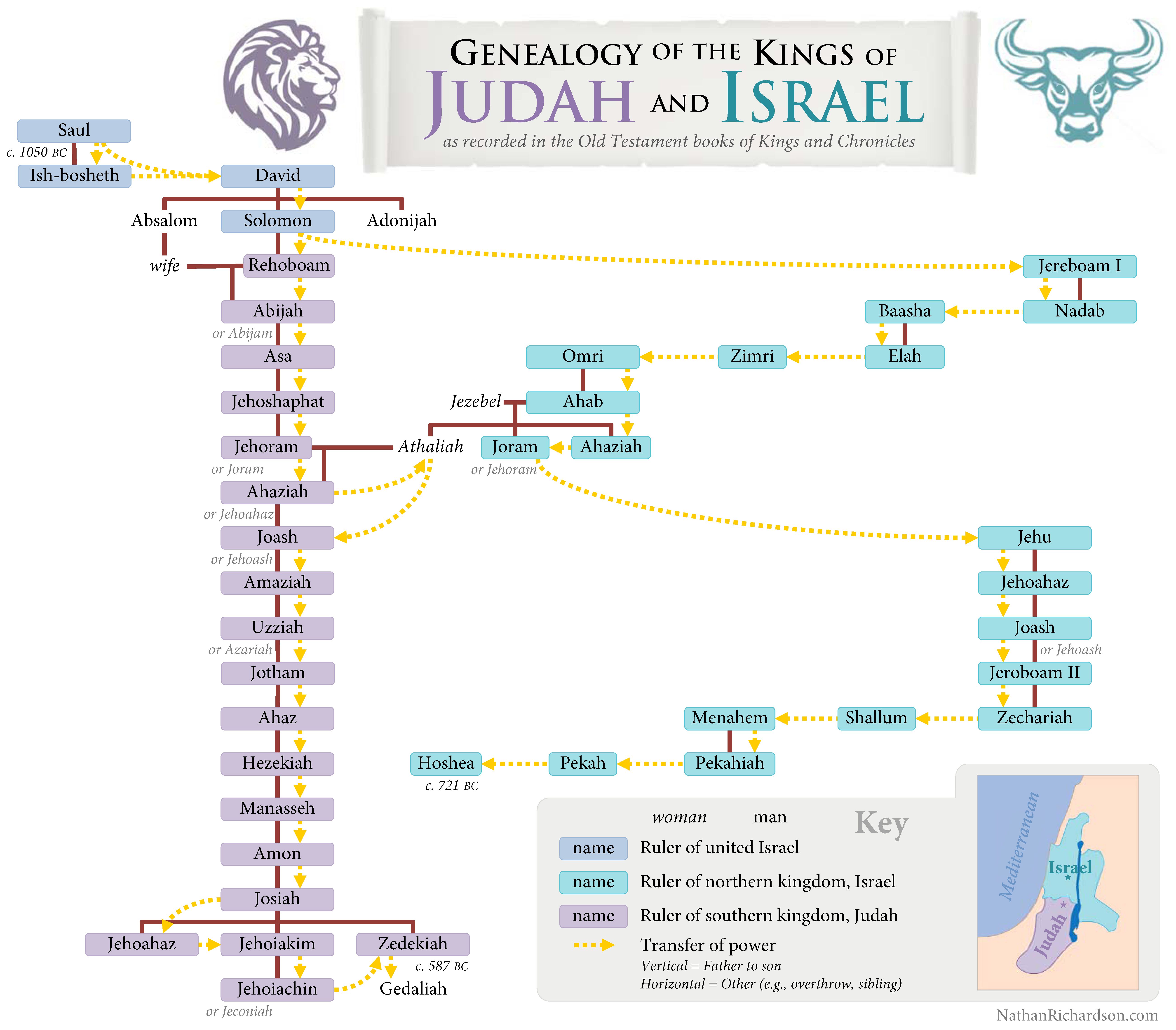
Despite the fulfillment of the prophecy that God would hand over to him the majority of the kingdom of Israel without a fight, Jeroboam failed to trust God for an everlasting kingdom.
“And Jeroboam said in his heart…If this people go up to do sacrifice in the house of the Lord at Jerusalem, then shall the heart of this people turn again unto their lord, even unto Rehoboam king of Judah, and they shall kill me. Whereupon the king…said unto them, It is too much for you to go up to Jerusalem:
- made two calves of gold, and said, behold thy gods, O Israel, which brought thee up out of the land of Egypt…
- the people went to worship unto Dan.
- And he made an house of high places,
- and made priests of the lowest of the people, which were not of the sons of Levi…which he had devised of his own heart;
- and ordained a feast unto the children of Israel: and he offered upon the altar, and burnt incense.”
The natural consequence of distrust is a never-satisfied need to control to feel safe, leading to tyranny.
The natural consequence of rejecting the worship / unity with the merciful God at Jerusalem, with its rules of social justice, is constant social turmoil.
The natural result of a king without power behind the throne is constant scheming preventing government’s handing of problems with social unrest and civil war leading inevitably, as with the better known rise and fall of the Roman empire, to self destruction.
Baasha…smote all the house of Jeroboam; he left not to Jeroboam any that breathed, until he had destroyed him, according unto the saying of the LORD…And he / Baasha did evil in the sight of the Lord, and walked in the way of Jeroboam…
Elah the son of Baasha reigned…two years. And his servant Zimri, captain of half his chariots, conspired against him, as he was…drinking himself drunk …and smote him and killed him…
And the people that were encamped heard say, Zimri hath…slain the king: wherefore all Israel made Omri, the captain of the host, king over Israel that day in the camp…Zimri…went into the palace of the king’s house, and burnt the king’s house over him with fire, and died…
Then were the people of Israel divided into two parts: half of the people followed Tibni…But the people that followed Omri prevailed…so Tibni died, and Omri reigned. And he bought the hill…and built on the hill, and called the name of the city which he built, after the name of Shemer, owner of the hill, Samaria.
Ahab the son of Omri did evil in the sight of the LORD above all that were before him...
And the following account gives a very clear description of how God feels about government mistreating the vulnerable.
And it came to pass after these things, that Naboth the Jezreelite had a vineyard, which was in Jezreel, hard by the palace of Ahab king of Samaria. And Ahab spake unto Naboth, saying, Give me thy vineyard, that I may have it for a garden of herbs, because it is near unto my house: and I will give thee for it a better vineyard than it; or, if it seem good to thee, I will give thee the worth of it in money. And Naboth said to Ahab, The LORD forbid it me, that I should give the inheritance of my fathers unto thee. And Ahab came into his house heavy and displeased…And he laid him down upon his bed, and turned away his face, and would eat no bread. But Jezebel his wife came to him, and said unto him…Dost thou now govern the kingdom of Israel? arise, and eat bread, and let thine heart be merry: I will give thee the vineyard of Naboth the Jezreelite. So she wrote letters in Ahab’s name, and sealed them with his seal, and sent the letters unto the elders and to the nobles that were in his city, dwelling with Naboth. And she wrote in the letters, saying, Proclaim a fast, and set Naboth on high among the people: And set two men, sons of Belial, before him, to bear witness against him, saying, Thou didst blaspheme God and the king. And then carry him out, and stone him, that he may die. And the men of his city, even the elders and the nobles who were the inhabitants in his city, did as Jezebel had sent unto them. And the word of the LORD came to Elijah the Tishbite, saying, Arise, go down to meet Ahab king of Israel, which is in Samaria: behold, he is in the vineyard of Naboth, whither he is gone down to possess it. And thou shalt speak unto him, saying…
Thus saith the LORD, In the place where dogs licked the blood of Naboth shall dogs lick thy blood, even thine…I will make thine house like the house of Jeroboam the son of Nebat…for the provocation wherewith thou hast provoked me to anger, and made Israel to sin. And of Jezebel also spake the LORD, saying, The dogs shall eat Jezebel by the wall of Jezreel. Him that dieth of Ahab in the city the dogs shall eat; and him that dieth in the field shall the fowls of the air eat.” (I Kings 21)
Jezebel brings down the prototypical reign of terror that recurs to Israel throughout its history. But as much as we hate the idea of experiencing great tribulation, it is when we need God the most that we experience his power and appreciate his salvation.
The showdown between Elijah the prophet of God and Jezebel’s prophets of Baal is a repetition of David’s championship over Goliath, and sends a powerful message to those who are willing to get into the fight.
when Ahab saw Elijah, that Ahab said unto him, Art thou he that troubleth Israel? And he answered, I have not troubled Israel; but thou, and thy father’s house, in that ye have forsaken the commandments of the LORD, and thou hast followed Baalim.
Now therefore send, and gather to me all Israel unto mount Carmel, and the prophets of Baal four hundred and fifty, and the prophets of the groves four hundred, which eat at Jezebel’s table…
Let them therefore give us two bullocks; and let them choose one bullock for themselves, and cut it in pieces, and lay it on wood, and put no fire under: and I will dress the other bullock, and lay it on wood, and put no fire under: And call ye on the name of your gods, and I will call on the name of the LORD; and the God that answereth by fire, let him be God.
And all the people answered and said, It is well spoken…
After a three year drought and famine and who knows how many deaths from starvation and sickness they were ready for a new protector.
And they took the bullock which was given them, and they dressed it,
-
- and called on the name of Baal from morning even until noon, saying, O Baal, hear us. But there was no voice, nor any that answered.
- And they leaped upon the altar which was made…
- and cut themselves after their manner with knives and lancets, till the blood gushed out upon them….
- and they prophesied / invoked the spirits / recited incantations until the time of the offering of the evening sacrifice, that there was neither voice, nor any to answer, nor any that regarded.
And Elijah took twelve stones, according to the number of the tribes of the sons of Jacob, unto whom the word of the LORD came, saying, Israel shall be thy name [for as a prince hast thou power with God and with men, and hast prevailed]:
-
- and he made a trench about the altar, as great as would contain two measures of seed.
- And he put the wood in order, and cut the bullock in pieces, and laid him on the wood,
- and said, Fill four barrels with water, and pour it on the burnt sacrifice, and on the wood.
- And he said, Do it the second time.
- And he said, Do it the third time. And they did it the third time.
- And the water ran round about the altar; and he filled the trench also with water.
And it came to pass at the time of the offering of the evening sacrifice, that Elijah the prophet came near, and said, LORD God of Abraham, Isaac, and of Israel, let it be known this day that thou art God in Israel, and that I am thy servant, and that I have done all these things at thy word. Hear me, O LORD, hear me, that this people may know that thou art the LORD God, and that thou hast turned their heart back again.
Then the fire of the LORD fell, and consumed the burnt sacrifice, and the wood, and the stones, and the dust, and licked up the water that was in the trench.
And when all the people saw it, they fell on their faces: and they said, The LORD, he is the God; the LORD, he is the God.
And Elijah said unto them, Take the prophets of Baal; let not one of them escape. And they took them: and Elijah brought them down to the brook Kishon, and slew them there.
Then Jezebel sent a messenger unto Elijah, saying, So let the gods do to me, and more also, if I make not thy life as the life of one of them by to morrow about this time.
And when he saw that, he arose, and went…into the wilderness...and he requested for himself that he might die; and said, It is enough; now, O LORD, take away my life.” (I Kings 18-19)
As a psychiatric provider, I often remind biblically knowledgeable persons of this passage. Elijah was a superlative prophet who channeled immense spiritual power. But like any other human, it drained him. We are body, soul and spirit and need to care appropriately for all three aspects.
And as he lay and slept under a juniper tree, behold, then an angel touched him, and said unto him, Arise and eat. And he looked, and, behold, there was a cake baken on the coals, and a cruse of water at his head. And he did eat and drink…and went in the strength of that meat forty days and forty nights unto Horeb AKA Sinai the mount of God.
Are you catching the signs? Elijah is one of the Melchizedekian Yeshua Messiah successors to Moses, which is a chosen / anointed position that doesn’t require David’s bloodline.
The Prophet appointment is not dependent on the Kingship lineage. There are many unnamed prophets of God who continue prophesying / preaching to Ahab, who, under duress, in fact believes and acts on some, but tragically not all, of their messages. Notice how Ahab “lets go”, which is the opposite of “let be / make it happen“, and the consequence is transfer of power, to the other side, exactly like a game of tug-of-war.
“And Ben-hadad i.e. son [of / human incarnation of] the god of Thunder and War the king of Syria gathered all his host together: and there were thirty and two kings with him, and horses, and chariots; and he went up and besieged Samaria, and warred against it. And he sent messengers to Ahab king of Israel into the city, and said unto him…I will send my servants unto thee to morrow about this time, and they shall search thine house, and the houses of thy servants; and it shall be, that whatsoever is pleasant in thine eyes, they shall put it in their hand, and take it away.
And, behold, there came a prophet unto Ahab king of Israel, saying, Thus saith the LORD, Hast thou seen all this great multitude? behold, I will deliver it into thine hand this day; and thou shalt know that I am the LORD.
- And Ahab said, By whom?
- And he said, Thus saith the LORD, Even by the young men of the princes of the provinces.
- Then he said, Who shall order the battle?
- And he answered, Thou.
- Then he numbered the young men of the princes of the provinces [trained to lead, i.e. captains], and they were 232: and after them he numbered all the people [able to go to war], even all the children of Israel, being 7,000.
And they went out at noon. But Benhadad was drinking himself drunk in the pavilions, he and the kings, the thirty and two kings that helped him…So these young men of the princes of the provinces came out of the city, and the army which followed them. And they slew every one his man; and the Syrians fled…And the king of Israel went out, and smote the horses and chariots, and slew the Syrians with a great slaughter.
And the prophet came to the king of Israel, and said unto him, Go, strengthen thyself…for at the return of the year the king of Syria will come up against thee…And it came to pass at the return of the year…and the children of Israel pitched before them like two little flocks of kids; but the Syrians filled the country.
And there came a man of God, and spake unto the king of Israel, and said, Thus saith the Lord, Because the Syrians have said, The LORD…is not God of the valleys, therefore will I deliver all this great multitude into thine hand, and ye shall know that I am the LORD…and the children of Israel slew of the Syrians an hundred thousand footmen in one day. But the rest fled to Aphek, into the city; and there a wall fell upon twenty and seven thousand of the men that were left.
And Benhadad fled, and came into the city, into an inner chamber. And his servants said unto him, Behold now, we have heard that the kings of the house of Israel are merciful kings…So they…came to the king of Israel, and said, Thy servant Benhadad saith, I pray thee, let me live….Then said Ahab, I will send thee away with this covenant. So he made a covenant with him / Benhaddad, and sent him away.
And a certain man of the sons / students of the prophets…waited for the king by the way…And as the king passed by, he cried unto the king…Thus saith the LORD, Because thou hast let go out of thy hand a man whom I appointed to utter destruction, therefore thy life shall go for his life, and thy people for his people.” (I Kings 20)
“And they continued three years without war between Syria and Israel. And it came to pass in the third year, that…the king of Israel said unto his servants, Know ye that Ramoth in Gilead is ours, and we be still, and take it not out of the hand of the king of Syria? And he said unto Jehoshaphat, Wilt thou go with me to battle to Ramothgilead? And Jehoshaphat said to the king of Israel, I am as thou art, my people as thy people, my horses as thy horses.
As a good king, possibly Jehoshaphat was trying to carry out God’s purpose for his nation, which is to draw other nations to the God of Israel. However, putting himself and his people under an unrighteous king’s control is not the way to go about it. (Ahem, get it? Any unrighteous political leader. Ringing a bell, anyone?) Also, they most certainly entered into a covenant to ally during this war, and that required Jehoshaphat to agree to include Ahab’s gods with YHVH. Forbidden.
And the king of Israel said unto Jehoshaphat, I will disguise myself, and enter into the battle; but put thou on thy robes.
Clearly this was to take the brunt of the fighting, aimed at the king! The natural reaction is to wonder what is wrong with Jehoshaphat! The answer is “Know ye not, that to whom ye yield yourselves servants to obey, his servants ye are to whom ye obey; whether of sin unto death…” (Romans 6:16)
And the king of Israel disguised himself, and went into the battle…And it came to pass, when the captains of the chariots saw Jehoshaphat…they turned aside to fight against him: and Jehoshaphat cried out…..And a certain man drew a bow at a venture [not aiming], and smote the king of Israel between the joints of the harness…and the king was stayed up in his chariot against the Syrians, and died at even: and the blood ran out of the wound into the midst of the chariot. So the king died, and was brought to Samaria; and they buried the king in Samaria. And one washed the chariot in the pool of Samaria; and the dogs licked up his blood…according unto the word of the LORD which he spake.” (I Kings 22)


 Kingdom Come