
“Jerusalem…the city which I have chosen me to put my name there…for all the earth is mine.“ (Ezekiel 24:2, I Kings 11:36, Exodus 19:5)
The garden of Eden is not found on earth today, no doubt it was flooded under the Mediterranean Sea at the time of Noah’s flood.
However the entrance to the garden of Eden, being “eastward in Eden” (Genesis 2:8), must still be above water on “the mountain of the LORD” since the gateway to the garden is where the Adams would have continued making the blood sacrifice for sin as taught by YHVH.
This is where Abel’s blood sacrifice was accepted over Cain’s vegan offering, for obvious reasons. Cain did not engage in activities designed to achieve peace, undividedness-unity, alliance with God through respecting his ways. Not even – notably – with his brother. Cain was either competing with his brother to be the favorite, or competing to be an equal with God directly. In any case, unity / peace with God requires unity / peace with his family.
“Cain brought of the fruit of the ground an offering unto the LORD. And Abel, he also brought of the firstlings of his flock and of the fat thereof. And the LORD had respect unto Abel and to his offering: But unto Cain and to his offering he had not respect.” (Genesis 4:3-5)
How did God show respect to one and not the other? Standard MO is fire from heaven,
“the LORD God sent him forth from the garden of Eden…and he placed at the east of the garden of Eden Cherubims, and a flaming sword which turned every way, to keep / guard the way of the tree of life.” (Genesis 3:22-24)
 Significantly, in the context of defying Almighty God, Jerusalem has been fought over more than any other place.
After the flood the Canaanites immediately staked their claim to this hyperdimensional portal and its “suburbs” – supportive territory – surrounding Eden,
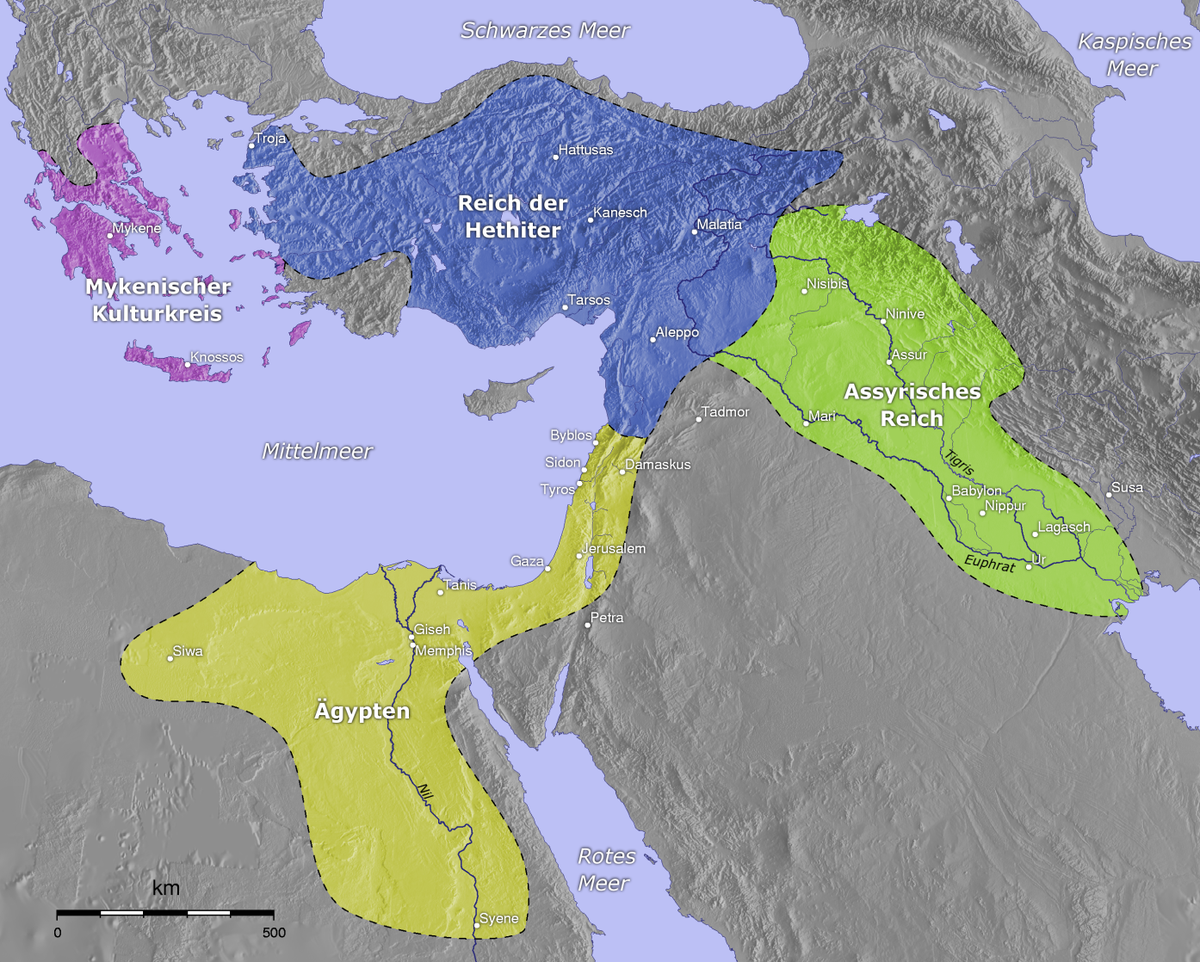
This totally makes sense because the objective is to seize Melchizedek’s territory, beginning with Cain vs Abel.
“And Cain said unto the LORD…Behold, thou hast driven me out this day from
- the face / פָנִי of the earth [in juxtaposition to heaven]; and from
- thy face / פָנִי [oversight, protection] shall I be hid…every one that findeth me shall slay me. And Cain went out from
- the presence / פָנִי / access to favor of the LORD. (Genesis 4:13-16)
The Hebrew word “paneh’ / פָנִי ” is translated into multiple English words in the same passage. This dictionary function allows us to grasp the abstract as well as literal meanings. The 2128 uses of of this word variously translated as “face, surface, countenance, presence, before me, in front of, under the oversight of, stand before” can be summed us as expressing a boundary to “this being”.
Throughout history there are multiple references, such as the following.
“the spirit lifted me up between the earth and the heaven, and brought me in the visions of God to Jerusalem…the glory of the God of Israel was there, according to the vision that I saw in the plain...Then did the cherubims lift up their wings…and the glory of the God of Israel was over them above. (Ezekiel 8:3-4, 11:22)
It is logical to deduce from the activity that this is a hyper dimensional portal to heaven. This clues us in to the motivation by the abomination that taketh desolate (Matthew 24:15) from the sea of outer space to, “as God sitteth in the temple of God, shewing himself that he is God.” (II Thessalonians 2:3-4)
In a previous post we reviewed how the noun identifying a person, place, or thing is the conversion of the verb describing the actions associated with that entity. In the word Jeru-salam, reverting the recent English letter J back to its original Y, we find that the forms ירה (yrh) and ירא (yr’) …reflect an exchange of energy from a higher, dispensing level to a lower, receiving level. It appears that the form ירה (yrh) mostly describes the sending of the energy; either the exchange viewed from the perspective of the dispensing side, or else the shock-free absorption of the energy on the receiving side. The form ירא (yr’) appears to deal mostly with the receiving of the energy; the exchange viewed from the perspective of the receiving side, and that usually with the anticipation of intense alteration.
The general meaning of the graceful verb שלם (shalem) is that of wholeness, completeness or “unbrokenness” (and see for the opposite the verb רעע,ra’a)…
In the Hebrew language it’s quite simple to indicate not only a condition (like shalem), but also the means to get there (to “shalemize”). The usage of this shalemize form in Scriptures is quite revealing. Wholeness is achieved or restored most often by some kind of restitutory payment or covenant…shalem is used when vows are to be paid to the Most High, or when days of mourning are to be completed (Isaiah 60:20), and ties in directly to the Messiah and his salvific work (Joel 2:25).
The derivatives of this verb are:
- The famous masculine noun שלום (shalom), meaning peace (Isaiah 32:17). Peace in the Bible doesn’t just indicate a warless state, but rather a state of completeness and harmony or rather un-dividedness. It also covers completeness (Jeremiah 13:19), prosperity (Genesis 43:27), health and safety (Psalm 38:4).
- The masculine noun שלם (shelem) peace offering or a sacrifice for alliance or friendship (Amos 5:22, Exodus 24:5).
- The denominative verb שלם (shalam), meaning to be in a covenant of peace (Job 22:21, Isaiah 42:19).
Peace and how to make it..
Peace — defined as the absence of conflict or discord — may be achieved in…such a level of understanding of irreconcilable elements that these can be…joined, in…a unified theory or system of definition. This process requires no censoring and demonstrates all elements to be most intimately related to the identity of the whole. The key-word of this process is relationship. That’s what this root means.
In Hebrew, peace-making means whole-making, and not warm-fuzzy-deny-your-concerns-and-stop-being-difficult-making. Hebrew peace-making requires the effortful acquisition of intimate knowledge of one’s opponent, and since in Hebrew love-making is pretty much the same as knowing someone (the verb ידע, yada’, means both to know and to have sex…the command to “love your enemy” (Matthew 5:44) has not a lick to do with placidly suffering abuse and trying to conjure up lofty feelings for the brute who’s mistreating you, and everything with studying your enemy until you know enough about him to either appreciate his motives (and behave in such a compatible way that he stops assaulting you) or else blow him out of the water by being superior.
When Jesus says, “blessed are the peace-makers” (Matthew 5:9), he does not refer to those people who insist we should all assume a state of blissful indifference, but rather those people who grab the bull by the horns and stare deep into his eyes and pick his brain with an axe. Making peace starts with making a relationship with your enemy, and it results in getting to know your enemy (which in turn makes the chance excellent that at some point your enemy will stop being your enemy).
“Now the LORD had said unto Abram, Get thee out of thy country, and from thy kindred, and from thy father’s house, unto a land that I will shew thee: And I will make of thee a great nation…And I will bless them that bless thee, and curse him that curseth thee, and in thee shall all families of the earth be blessed…and into the land of Canaan they came.” (Genesis 12:1, 11:31)
Genesis 12:2–3 is routinely used by many evangelical theologians and preachers as the basis of a call to bless Abraham by blessing his family. I have no dispute with that call. However, calls to pray for and otherwise support Israel as Abraham’s sole legitimate nation-state are common in evangelical media, while teaching that Ishmael’s existence, from whom modern Arabs descend, was a mistake. Instead of seeing the modern Arab-Jewish conflict as a vexing problem in search of a solution in the peace of Christ, many Christians see it as an inevitable, cosmic battle, predicted in Scripture, whose end can only be the defeat of one “side”—namely, that of the Arabs.
We need to understand that the land deal is not an arbitrary gift to a privileged people. It is not even a reward for good service. It is a base of operations for battle.
The land deal is simply an essential part of the package deal of dominion as necessary conditions for retaking control away from the Adversary, boots on the ground to retake Jerusalem’s gateway to heaven itself from Adversarial Nimrod’s Uncle Canaan, father Cush, brothers Mizraim / Egypt and Phut / Libya, and nephew Havilah / Arabia by God’s holy people in every nations.
“if ye will obey my voice indeed, and keep my covenant, then ye shall be unto me a kingdom of priests, and an holy nation. These are the words which thou shalt speak unto the children of Israel.” (Exodus 19:5-6)
“ye [who have accepted YHVH’s Savior as the Christ] are a chosen generation, a royal priesthood, an holy nation, a peculiar people;” (I Peter 2:9)
“And it shall come to pass in the last days, that the mountain of the LORD‘s house shall be established in the top of the mountains, and shall be exalted above the hills; and all nations shall flow unto it.” (Isaiah 2:2)


 Kingdom Come