~ 2600 – ~ 2181 BCE: Egypt’s Old Kingdom spans the Flood
The Pyramid Texts, the earliest known corpus (academic for “literary body”) of ancient Egyptian religious texts, were carved onto the subterranean walls and sarcophagi of pyramids at Saqqara.
Why carved onto pyramid walls? To survive Noah’s Flood. The oldest of the texts have been dated to c. 2400–2300 BC., the era preceding Noah’s Flood. Consistent with the Hebrew scriptures report of this era, anthropologists also date Classical Sumerian cuneiform texts, reflecting the fallen angels’ reign on earth, as ending at this same time.
The Papyrus of Turin / Turin Kings List dating from this time lists all of the ‘official’ historic Pharaohs of Ancient Egypt from the beginning of time.

Well, more or less. Significantly rows 1-11 are missing – the records of the first rulers.
Like the Sumerians, the ancient Egyptian Pharoahs considered their civilization as the legacy of gods who came from elsewhere in the cosmos.
We can logically deduce that rows 1-11 were redacted by succeeding paganized Pharaohs because the Turin King List validates, not the pagan Sumerian records, but the only other ancient option – the biblical account of the Order of Melchizedek from Adam to Shem.
“the word of the Lord endureth for ever.” (I Peter 1:25)
“we have not followed cunningly devised fables [like others]...We have also a more sure word of prophecy…the scripture / writings.” (II Peter 1:16-20)
Bear in mind that every ancient political system – including but not limited to the Egyptian Pharoahs – deemed the human vicar / representative / manifestation of a god to be the very image and likeness / wielding his power. We can logically conclude that the corruption of Egyptian religion included the standard practice of eliminating unpalatable historical truth. “Who controls the past, controls the future” is detailed in George Orwell’s textbook case 1984.
- Adam
- Seth
- Enos
- Cainan
- Mahalaleel
- Jared – In the book of Enoch it is reported that certain angels began engaging in sexual intercourse with human women “in the days of Jared.” This corroborates the report in Genesis 6:1-22 “when men began to multiply on the face of the earth, and daughters were born unto them, that the sons of God saw the daughters of men that they were fair; and they took them wives of all which they chose.”
- Enoch – “the seventh from Adam” to distinguish him from Cain’s son Enoch, was famous for being God’s anointed King of the whole earth during an era of falling away to false gods, as well as condemning the fallen angels for having sexual intercourse with human women in contrast to the rights of human males. This demonstrates the Adversary’s strategy of blurring the distinction between the righteous and unrighteous.
- Methuselah
- Righteous Lamech
- Noah across the Flood
- Shem, the last acknowledged by paganized Egyptians.
The rival lineage of the Seed of the Serpent mirrors the true champion of God’s people, significantly in names, leading to confusion in oral traditions and loss of records over time.

- Father / Authority the Devil
- Cain
- Enoch
- Irad
- Mehujael
- Methusael – in the same generation as
- Lamech
- Jabal
- Jubal – As the the inventor of string-music, he corresponds to ungodly Lamech’s son Jubal. His rivalry with his own father, whether as Apollo with Zeus or Jubal with Lamech is 100% consistent with the history of godless hopeful heirs to thrones staging coups. following Zeus’ takeover of his father Lucifer’s power.
- Tubalcain, an instructer of every artificer in brass and iron: which can be rephrased in modern terms as Chief Engineer in Weapons Research and Development equivalent to Wernher Von Brau
- Ham
After the Flood, Proto-Sinaitic script develops into the Phoenician alphabet which is used for most of the 1st millennium BC (think Moses) to write Canaanite languages sub-categorized by historians as Phoenician, Hebrew, Moabite, Ammonite and Edomite, and Old Aramaic. This was widely disseminated by Phoenician merchants across the Mediterranean and most other alphabets in the world today are descended from this.
In 750 BC, the Greeks added vowels to the Phoenician alphabet and the combination was regarded as the initial true alphabet. The Latins / Romans and combined some Etruscan / northern Italy characters and Britain’s Futhorc runes to make the English alphabet. The letter “J” was added by Spain after the first publication of the 1611 Authorized King Iames’ Bible.
Contrary to the King James Only Movement, this is not the last word on translations / languages.
“wait ye upon me, saith the LORD, until the day that I rise up to the prey: for my determination is to gather the nations, that I may assemble the kingdoms, to pour upon them mine indignation, even all my fierce anger: for all the earth shall be devoured with the fire of my jealousy.
For then will I turn to the people a pure language, that they may all call upon the name / attribute of the LORD / the Singularity, to serve him with one consent.” (Zephaniah 3:8-9)
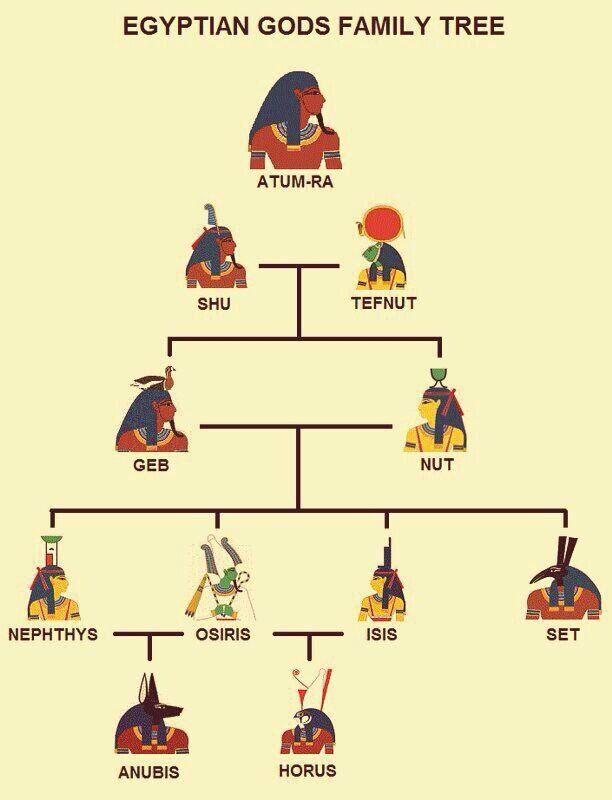
Facing off against the LORD, these are the names of the gods written on the papyrus starting with row 12.
- Row 12 – Amun-Ra is a result of merging of two deities in order to give them a new meaning and importance and was quite common in Egyptian religion. Amun was the Creator and Ra was originally the sun god / Son of the Morning / the first light.
- Row 13- missing, but based on other ancient Egyptian sources would be Shu most evidently Lucifer.
- Row 14 – Geb equates to Satan, the son of Shu and god of the earth. This would be the clone of Lucifer, i.e. the Sumerian Enki / Greek Zeus / biblical Satan, the “god of this world” after authority was delivered to him by Mrs. Adam when she submitted to him.
- Row 15 – Osiris the son of Geb, god of the dead and of resurrection equates to Apollo who is notorious for disseminating a multitude of hybrid demigods.
- Row 16 Set, Osiris’ brother / i.e. close relative murdered Osiris, then dismembered his brother’s corpse and spread the pieces all over the country. Distributing a dismembered a corpse to spread tidings of bloody vengeance against anyone who rebelled against the new leadership was not unique to Set or Egypt, being documented in the Bible. This matches the end of the pre-flood era when “the earth was filled with violence” (Genesis 6:11) better known as the Greek Titanomachy.
- Row 17 Horus the Elder brother / close relative to Osiris is best known from The Contendings of Horus and Seth brutally battling for hegemony of the entire region. Horus was the ultimate victor, but in the struggle his eye was gouged out. We can all parallel him with the Norse god Odin, right? Odin appeared in early Roman sources, such as Tacitus’ Germania of the first century CE, as Mercury – a cloned son of Zeus / Satan.
- Row 18 Thoth – The Greeks identified Thoth with Hermes, the herald of the gods, another one of Zeus’ cloned sons. This is equivalent to Jabal: he was the father of such as dwell in tents, i.e. nomads whose latest news from their travels would always be welcomed by isolated farmers, and whose knowledge from encounters with other cultures would awe and impress the hicks making them easy prey for a gypsy caravan. Gypsies were so named because they were initially thought to have come from Egypt. For thousands of years they have adhered to tradition including practicing portable trades such as repairing metal tools, working with horses, fortune telling, and entertainment.
- Row 19 Maat – is generally translated as “that which is straight” or “truth” but also implies “order”, “balance” and “justice”. Ma’at is reportedly the daughter of the sun-god Ra who we know is Lucifer. The earliest substantial surviving accounts of Maat are found in the Pyramid Texts of Unas (ca. 2375 BCE and 2345 BCE), which places it in a biblical time frame just before Noah’s flood of judgment on wicked mankind. Validating the general state of wickedness of this era, Maat represents the inevitable development from Antichrist’s promise of liberty to strict laws to avert rebellion.
- “God spared not the old world…bringing in the flood upon…chiefly them that walk after the flesh in the lust of uncleanness, despise government. Presumptuous are they, selfwilled…While they promise them [their converts] liberty, they themselves are the servants/slaves of corruption.” (II Peter 2)
- We are seeing this in America today, the so-called “Land of the Free” as an elitist government is radically spreading immorality over society with mass media appealing to a new norm and legalized protections of homosexuality and gender self-identification by children. An analysis of America’s current socio-political climate draws on de Tocqueville’s 1835 prediction that American democracy is a tyranny of the majority. Because tyranny relies on gaslighting and dismissing facts, no definitive portraiture of freedom is made; therefore, the tyrannized are instead in collective submission to its illusion.
- Row 20 Hor / Horus – posthumously conceived by Isis to resurrect her brother Osiris. Nimrod and Semiramis undoubtedly resurrected this practice. Horus shows up later in the pantheon of gods.
It is a great enigma why mainstream scholars consider this ancient text a pure myth and why most details of the ancient text have been overlooked and omitted from the history books…
 The Palermo stele is another incredible ancient text that mentioned the pre-dynastic rulers of Ancient Egypt. This ancient Stele even makes reference to Egyptian God Horus, suggesting that he was a physical ruler of the Ancient Egypt thousands of years ago.
Interesting, Egyptian High Priest Manetho, who had access to unlimited ancient texts from the Ancient Library of Alexandria, and who wrote for the Pharaoh the history of Ancient Egypt in 30 volumes makes reference to the divine beings that ruled during Pre-Pharaonic Egypt.
If you look at today’s Egyptologists, you with find out that they too make use of Manetho’s dating considering it as a very reliable tool when studying the officially recognized dynasties, yet for some mysterious reason, the same Egyptologists have decided to avoid anything related to Pre-historic dynasties, carefully selecting certain details and adopting them as their own, while rejecting anything that does not fit into ‘their view‘ of history. [Emphasis in the original.]
The First Dynasty of Egypt (c. 3150 – c. 2900 BCE) was founded by Menes/Narmer shortly after Noah’s flood, post-Tower of Babel with dispersion into languages and nations. He began by uniting the regions of Upper Egypt (south) and Lower Egypt (north) under a centralized government then expanded his territory into Canaan and Nubia…Narmer was especially interested in religion and the concept of the afterlife and the mastaba tomb (a house for the deceased) was developed under his reign.
During this period the divine rule of the kings began and a recognizable Egyptian culture, including the development of writing, arts, and sciences developed. The title `pharaoh‘ was not used during this period; rulers were referred to as `kings.’
“That Egypt was created through military means is a basic concept expressed in the art of the period. A sizeable set of stone objects, including ceremonial mace-heads and palettes, contain scenes of war and fighting between men, between animals, and between men and animals.”

These Egyptian images include depictions of gods, giants and what appear to be dinosaurs, consistent with the written documentation in Genesis 6 and Job 40 of the circumstances that brought about destruction by flood and the end of the era when gods freely interacted with humans, significantly – sexually.
The earliest known springtime public sex rituals took place in ancient Egypt. Early Egyptian mythology includes a tale similar to the story of Noah. The sun god, Ra, recoiled from humanity’s wickedness and killed almost everyone along the Nile…the few survivors…engaged in public, orgiastic sex that repopulated Egypt.
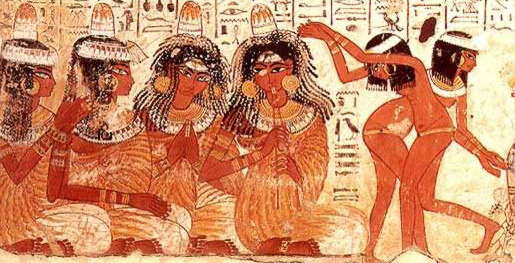
In commemoration, every spring as the Nile flooded, the Egyptians held fertility festivals involving public drunkenness, dancing, and group sex…In some, priests petitioned the gods for good harvests during ceremonial public sex with temple prostitutes. In others, some revelers repaired to newly planted fields for drunken orgies.