
“Now when [the Roman governor] Festus was come into the province…the high priest and the chief of the Jews informed him against Paul…and laid many and grievous complaints against Paul, which they could not prove.
Festus inherited and greatly inflamed the social unrest problems of his predecessor Felix. “He valued peace with the Jews more than justice and, despite determining his prisoner was innocent” refused to release Paul. In his quest for a political alliance with the Jewish rulers, Festus publicly dismissed their clear homicidal intentions towards Paul as a simple religious dispute. He actually tried to give up Paul to the Jewish rulers by encouraging him to go back to Jerusalem to be judged by them, knowing it would result in his death.
Paul was not so heavenly minded as to be no earthly good. He operated in close connection to his social environment. Judea had been fomenting revolution for at least fifty years, and was a tinderbox needing just one last strike to blow. If Festus allowed this revolution to happen, it would result in Festus’ disgrace and demotion by Rome, quite likely even his death – if not by a Jewish mob, by an irate Roman politician looking for a scapegoat.
Paul’s only safety net was Festus’ sensible greater fear of Roman over Jewish reprisal if he didn’t treat Paul as the Roman citizen that he was when he appealed to Caesar. You can imagine the efforts of the Jews to get Festus to turn a blind eye on that one.
But Paul was a legal expert Pharisee who was trained by what amounted to a Supreme Court Judge, Gamiel.
When he answered for himself, “Neither against the law of the Jews, neither against the temple, nor yet against Caesar, have I offended any thing at all…I stand at Caesar’s judgment seat, where I ought to be judged: to the Jews have I done no wrong, as thou very well knowest. I appeal unto Caesar.”
Paul’s transfer here of his legal status as a Jew under the Jewish politico-religious authorities is exactly the same action taken when Paul transferred his religious affiliation from the Jewish authorities in Rome to Gentiles.
“And after certain days king [of the Jews] Agrippa [II] and [his sister] Bernice came unto Caesarea to salute Festus.
And…Festus declared Paul’s cause unto the king, saying, There is a certain man left in bonds by [the previous governor] Felix: About whom…the chief priests and the elders of the Jews informed me, desiring to have judgment against him…Against whom when the accusers stood up, they brought none accusation of such things as I supposed: But had certain questions against him of their own superstition, and of one Jesus, which was dead, whom Paul affirmed to be alive…when I found that he had committed nothing worthy of death, and that he himself hath appealed to Augustus, I have determined to send him. Of whom I have no certain thing to write unto my lord.
Wherefore I have brought him forth…specially before thee, O king Agrippa, that, after examination had, I might have somewhat to write. For it seemeth to me unreasonable to send a prisoner, and not withal to signify the crimes laid against him.”
Festus had gotten stuck with Paul because Paul had proven himself to be astute and clever in the use of courtroom tactics. Festus was “especially” glad to have king Agrippa assist in his examination because he could keep Festus safe on this tightrope examination, avoiding anything that would cause a problem with either Rome or the Jews.
Agrippa understood those confusing politico-religious wranglings of the chief priests and elders of the Jews, but mainly Festus was relying on Agrippa’s well-known skills as a superlatively unsavory slippery Roman politician.
King Agrippa II, who had been ruling Judea for about 5 years at the time of Paul’s examination, was very much the son of Agrippa I (ruled 41-44) who was “devout in his Judaism, which made him popular with his Jewish subjects.…This desire to please the Jewish people is also seen in his persecution of the early Christian leaders, as described in the book of Acts [where Agrippa I is called by one of his other names, Herod]…Agrippa was a skilled diplomat who knew how to appease both the Roman Emperor and the Jewish populace, staying in the good graces of both.”
King Agrippa II was likewise a skilled diplomat who benefited from good relations with three Roman emperors in succession, in part because he inherited his father’s goodwill with the restless Jewish populace. His Roman benefactors entrusted him with the supervision of the Temple in Jerusalem and the right to appoint the high priest. When the Jews revolted against Rome in 66, he personally went to hot spot Jerusalem to try to negotiate an end to the rebellion, and although his effort was in vain he was a big help to Vespasian when the inevitable war broke out, and during The Year of Four Emperors, as Vespasian clawed his way to the top. He had the means to do so because he had been granted rule [translate taxation] over so many territories during the previous reigns of Claudius and Nero that he was one of the most important rulers in the eastern part of the Roman Empire. In return for his support, Vespasian granted Agrippa even more territory.
Agrippa II was the most politically savvy player on stage. They didn’t have Twitter back then, but the bush telegraph would very effectively transmit every word back to Rome, especially to his rivals, in Rome’s toxic political environment.
Last but certainly not least, Luke includes Agrippa’s sister Berenice in the courtroom drama. For good reason. Without saying a word, she is the star of the show, all eyes on her at center stage.
And now, without further ado, ladies and gentlemen, the dialogue!
“Agrippa: (Bored, not even glancing his way, flicking his hand in the general direction of the accused)
“Thou art permitted to speak for thyself.”
Paul: (A clumsy public speaker, in a social milieu that prizes public speaking as an art form on par with peerless musicians and actors, haltingly stumbling through the requisite preamble for which he has neither the nature nor habit to produce well. Without a doubt causing his Roman audience to begin his trial by boisterously laughing in his face in derision, Compare his previous adversary Tertullus.)
“I think myself happy, king Agrippa, because I shall answer for myself this day before thee touching all the things whereof I am accused of the Jews: Especially because I know thee to be expert in all customs and questions which are among the Jews: wherefore I beseech thee to hear me patiently. My manner of life from my youth…know all the Jews; Which knew me from the beginning, if they would testify, that after the most straitest sect of our religion I lived a Pharisee. And now I stand and am judged for the hope of the promise made of God, unto our fathers: Unto which promise our twelve tribes, instantly serving God day and night, hope to come…
And 30 seconds into his presentation Paul has totally lost his entire audience who couldn’t care less about archaic Jewish religious beliefs. Some of them have no doubt begun loudly booing and hissing and mocking and shouting “Away with him!”.
Agrippa had undoubtedly never been paying any attention at all on this utterly and hatefully routine procession of Jewish sectarian squabbles. Like anyone else not harassing Paul, he is focused on his sister Berenice, and her diverting role in his life.
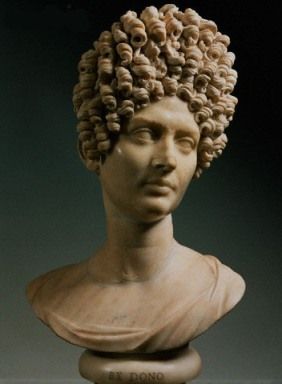
Berenice and Agrippa lived together in Rome and soon it was rumored they were incestuous. Not much shocked the Romans, but this was prohibited in all the laws of the ancient world [other than the Egyptian royalty, which explains the reason it was taboo for everyone else – the consolidation of family traits for power, while running the risk of producing a murderous madman]…
Agrippa’s contemporary, the Roman Juvenal (c. 55-130 AD) in his Satire 6, made open fun of Agrippa and Berenice… ”

So Paul suddenly goes on the attack with a rhetorical question.
“Why should it be thought a thing incredible with you, that God should raise the dead?”
Obviously, Agrippa’s benefactors, the Caesars, were all believed to have become immortal after death.
Even more importantly, with this concept Paul has seized Agrippa’s attention, as it invariably links to the growing Roman leadership’s conviction that the Gentile Messianic followers were, like the Zealots, plotting revolt against Caesar.
Can we not pick up the supremely political overtones of a gifted diplomat?
Then Paul plays on everyone’s fascination with the supernatural.
“At midday, O king, I saw in the way a light from heaven…I heard a voice speaking unto me…I am Jesus…I have appeared unto thee…
Interest rapidly fades into the Greek version of blah blah blah blah…
to make thee a minister [to] the Gentiles, unto whom now I send thee, To open their eyes, and to turn them from darkness to light, and from the power of Satan unto God, that they may receive forgiveness of sins, and inheritance among them which are sanctified by faith that is in me.”
When we place this statement in its social setting, we realize that Paul just grossly insulted his entire Roman audience.
The Romans had executed this King of the Jews as the leader of a revolution against Rome. Forgive that??
The Romans despised the Jewish population, which for the most part had been ground into abject poverty by Roman rule. The offer to grant an inheritance through an enslaved and impoverished Jew to the wealthy Romans was utterly bizarre.
Now it’s the suave, debonair Agrippa who just got his thought processes derailed. He was preparing a verdict of guilty of conspiracy against the Roman state and let’s get some lunch, and then this? He was totally unprepared.
Festus, always on the lookout for self-preservation, proves by his interjection into Agrippa’s exclusive purview to speak, that Agrippa was struck with a rare instance of being tongue tied. When Festus breaks legal procedure by interrupted loudly that Paul is mad, he is providing Agrippa with the response he doesn’t have on the tip of his tongue.
Given that his diagnosis was based on Paul’s “much learning”, and since undoubtedly Paul was using his lengthy incarceration to obsessively-compulsively read the scriptures and Talmud we can conclude that Festus was diagnosing the equivalent of Bipolar Disorder from signs of manic behavior.
Nicely done, Festus.
He just handed both Paul and Agrippa an exemption from further pursuit of this case on the grounds of Not Guilty By Reason Of Insanity. Everyone is happy – Paul’s credibility in the religious community would be squashed, and Agrippa’s status in Roman society would be salvaged.
And salvaged it needed to be. We can be utterly certain that when Festus spoke up, that there was dead silence in the courtroom, all eyes riveted on Agrippa waiting for his response to being offered…
forgiveness of sins.
What a public slap in the face to Agrippa and his sister Berenice. It could only be their long acclimation to public slurs and insinuations, and their social training, like the Brits’ stiff upper lip, that kept them from betraying their anger at this insult.
But make no mistake, the audience got it.
And Paul was burned right there. So, unlike incompetent Festus who would never amount to anything in public office, Agrippa smoldered in silence, patiently allowing Paul to continue in the certain knowledge that, given enough rope, this rash Paul would hang himself.
“Whereupon, O king Agrippa, I was not disobedient unto the heavenly vision: But shewed…the Gentiles, that they should repent and turn to God, and do works meet for repentance. For these causes the Jews caught me in the temple, and went about to kill me.”
For once, Agrippa has something in common with these religious Jews. Highly intelligent, he files that thought away for later.
“I continue unto this day…saying none other things than those which the prophets and Moses did say should come…
King Agrippa, believest thou the prophets? I know that thou believest.”
Way to go Paul!
Put King Agrippa on the hot seat, in public. (Blue dress?) 
And everyone is stunned.
What had begun as a dreadfully boring bureaucratic delay in enjoying the rest of the day made tolerable only by filling out the blah blah blah from the front of the room with satire from the back has become the most mesmerizing public spectacle since, well honestly, even overriding, the last show at the Colosseum, given how formulaic they had become. Only rarely did a really well-heeled financier stage better shows than simple stalk and kill.
FOCUS! They don’t want to miss a single word spoken by that hayseed about the highest-scoring gossip topic making the rounds on the social circuit. Everyone holds their breath and you can hear a pin drop.
This apparently inept bumbler, like the classic Columbo-type criminal investigator, has just trapped Agrippa.
- “Yes” appeases the Zealots among the Jews but earns outrage from the Romans battling these Zealots.
- “No” alienates the ultrasensitive Jews which worsens the difficult political position of the Romans who tactfully accepted every conquered nation’s gods. Either answer lands him in trouble.
But Agrippa got where he was by slipping out of multiple traps laid by rivals.
 Shakespeare’s “immortal” plays use clever repartee and oblique meanings as his protagonists parry. “I am sick” in love or of love?
And so do the antagonists in Luke’s truly immortal and even more gripping account of court proceedings.
Agrippa recognizes that Paul has also just handed him his trump card. And suave, sophisticated, socially and politically brilliant Agrippa breaks the tension with a perfectly honed sarcastic response to Paul’s insults.
“Almost thou persuadest me to be a Christian.”
Francis Ford Coppola couldn’t have dreamed up a better one liner.

The popularity of the hymn notwithstanding, we can’t possibly believe that anyone hearing Agrippa’s statement thought that he was seriously considering “repent, and be baptized, for the remission of sin” publicly, in that trial, among individuals well acquainted with his illicit relationship to his sister.
On the one hand the Romans burst out in raucous laughter at Agrippa’s clever repartee. This will definitely make the rounds at the social gatherings in Judea and back to the gossip in Rome, with its accompanying positive publicity for Agrippa more than compensating for Agrippa’s humiliation from Paul’s outrageous public condemnation.
And the cherry on top was that at the same time Agrippa just won the support of the Jewish religious rulers. They immediately perceive that Paul has just been thrown a baited hook with which to reel him in as a ringleader of one of the Zealot factions. This Christ that Paul preached was an open challenge to the power of the established Jewish rulers through their alliance with Caesar’s political hegemony.
But Paul doesn’t take the bait.
“Ye shall be brought before governors and kings for my sake, for a testimony against them and the Gentiles. But when they deliver you up, take no thought how or what ye shall speak: for it shall be given you in that same hour what ye shall speak. For it is not ye that speak, but the Spirit of your Father which speaketh in you.” (Matthew 10:16-20)
He doesn’t identify himself as a Christ-one, a rebel against Rome’s immortalized Caesar son of a god.
Even more skillfully than Agrippa he slips out of both adversaries’ grasp in one short sentence.
“I wish you were as I” with the clear implication that:

Paul / God had the last word.
“And when he had thus spoken, the king rose up, and the governor, and Bernice, and they that sat with them [closest friends / political allies: And when they were gone aside, they talked between themselves…Then said Agrippa unto Festus, This man might have been set at liberty [and we could have looked the other way while the Jews assassinated him] if he had not appealed unto Caesar.
God is in control.


 Kingdom Come