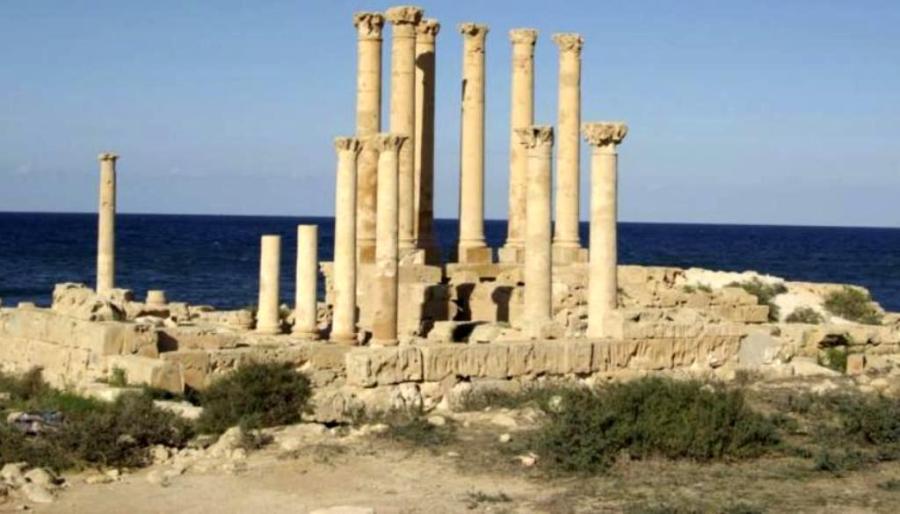
Melqart (also Melkarth or Melicarthus) was an important Phoenician god and patron deity of the city of Tyre. Associated with the monarchy, sea, colonization, and commercial enterprise…Melqart’s stature is attested by the reverence the god was accorded by two of the Phoenician’s immediate successor cultures in the ancient Mediterranean: Greece and Carthage…
While Baal, El, and Baalat were important deities…Melqart was considered the head of the pantheon at Tyre. Indeed, his very name means ‘king of the city’ (melek-qart) and he was referred to as Baal de Sor or ‘Lord of Tyre’. Melqart, in addition, assumed some of the characteristics of both Adonis and Eshmun as he was the focus of a festival of resurrection each year in the month of Peritia (February-March) in which a sacrifice was made by fire or a figure of the god was ritually burnt. Hence, his other name the ‘fire of heaven’.
Remember, Lucifer is equated with the King of Tyre, and the Seed of the Serpent was Tyre’s chief god.
The god had a long-lasting temple dedicated in his name at Tyre, built during the reign of Hiram in the 10th century BCE.
The date is the same as Solomon’s reign, establishing that this is the same Hiram documented in the Bible. Additionally, the style of Hiram’s temple at Tyre matches that of Solomon’s temple in Jerusalem.
Melqart’s temple was famously visited by Herodotus in the 5th century BCE who described its impressive entrance as having two columns.
Just like those at Solomon’s temple.
Hiram appears to have copied the form of Solomon’s magnificent temple to El.

This seems to be the period when Melqart comes into his own as there are no references to the god prior to the 10th century BCE. Outside the god’s temple, at a specially constructed altar, worship involved prayers, burning incense, the pouring of libations, and making offerings to the god of animal sacrifices, foodstuffs, and precious goods…Women, foreigners, and pigs were not allowed in the sacred precinct of Melqart’s temple, which also functioned as the city’s treasury.
Aha! These practices are fully consistent with Israel’s proscribed worship of YHVH! So Hiram not only copied the form but also the function of the new temple, indicating that Hiram led his nation in a religious conversion to monotheism, exactly as happened in Egypt under Pharaoh Akhenaten.
And this explanation fits with the biblical account of Hiram’s relationship with the kings of Israel.
“And Hiram king of Tyre sent his servants unto Solomon; for he had heard that they had anointed him king in the room of his father: for Hiram was ever a lover of David.” (I Kings 5:1)
The consistency with which the concept “love” is portrayed throughout the Bible in 442 passages provides a reliable interpretation in every single instance and refutes any single biased exposition. No, guys, they weren’t homosexuals.
That interpretation of love as lust broadcasts a prepubescent obsession with sexual pleasure while breaking away from female [Mom’s] power imposing responsibility.
Hiram’s “love” for David must be interpreted to mean the same thing as Jonathan’s “love” for David.
“the soul of Jonathan was knit with the soul of David, and [in other words] Jonathan loved him as his own soul [identified as being one with himself].” (I Samuel 18:1-4)
This is relationship – choosing to complete each other’s identities in the male and female roles by taking on! – not avoiding! – responsibilities and burdens unable to be fully born by either – such as childbirth and all forms of labor. This is only able to be tolerated when each partner shares the same values and goals in life – already identifies as being the same in the essential elements with the chosen partner.
The first references found at the beginning of the Bible establish that “love” means “joining identity” with one’s child, one’s wife, even one’s favorite food, and most of all, YHVH, shown by keeping his commandments (Exodus 20:6) and by extension to human masters (Exodus 21:5), but amazingly, even strangers (Leviticus 19:34).
Love is a relationship – it’s all about how we treat other people, places and things.
“Then Jonathan and David made a covenant, because he loved him as his own soul. And Jonathan stripped himself of the robe [royal regalia] that was upon him, and gave it to David, and his garments, even to his sword, and to his bow, and to his girdle [emblems of military leadership.]” I Samuel 18:1-4)
Jonathan’s actions are proof positive that he transferred his position of heir to the throne to David.
Like when Pharaoh promoted Joseph to ruler of Egypt.
“And Pharaoh took off his ring from his hand, and put it upon Joseph’s hand, and arrayed him in vestures of fine linen, and put a gold chain about his neck; And he made him to ride in the second chariot which he had; and they cried before him, Bow the knee: and he made him ruler over all the land of Egypt.” (Genesis 41:41-43)
So barring any evidence to the contrary, a reliable and valid understanding of King Hiram’s “love” for David is that he submitted himself to David as Melchizedek of the whole earth.
This is confirmed by the account immediately after this statement.
“And Solomon sent to Hiram, saying, Thou knowest how that David my father could not build an house unto the name of the LORD his God for the wars which were about him on every side, until the LORD put them under the soles of his feet. But now the LORD my God hath given me rest on every side, so that there is neither adversary [including Hiram’s major city-state of Tyre] nor evil occurrent.
And, behold, I purpose to build an house unto the name of the LORD my God, as the LORD spake unto David my father, saying, Thy son, whom I will set upon thy throne in thy room, he shall build an house unto my name. Now therefore command thou that they hew me cedar trees out of Lebanon; and my servants shall be with thy servants…
when Hiram heard the words of Solomon, that he rejoiced greatly, and said, Blessed be the LORD this day, which hath given unto David a wise son over this great people…So Hiram gave Solomon cedar trees and fir trees according to all his desire…and there was peace between Hiram and Solomon; and they two made a league together.
In every sacral kingdom, making a league required submitting to the acknowledged true king – the god of the nation. This is described in the Bible in when King Ahaz of Judah submitted himself to the pagan priest-king Tiglathpileser of Assyria in a league of protection.
Ahaz sent messengers to Tiglathpileser king of Assyria, saying, I am thy servant and thy son: come up, and save me out of the hand of the king of Syria, and out of the hand of the king of Israel, which rise up against me….And king Ahaz went to Damascus to meet Tiglathpileser king of Assyria, and saw an altar that was at Damascus: and king Ahaz sent to Urijah the priest the fashion of the altar, and the pattern of it, according to all the workmanship thereof…and the king approached to the altar, and offered thereon… [as was the custom of the pagan kings but prohibited by YHVH] (II Kings 16)
And likewise at Tyre, after righteous King Hiram passed away, worship of YHVH corrupted into worship of the Seed of the Serpent.
As Tyre [capitol of its Mediterranean empire] insisted every new colony build a temple to Melqart, the god was exported across the Mediterranean…very important at Carthage, where a stele indicates that a temple was dedicated to him. The Carthaginians were also obliged to send annual tribute – one tenth of their annual profits – to the temple of Melqart at Tyre for the next few centuries…Hannibal too, famously swore an oath to the god in 237 BCE when, aged 9, he stated that he would forever be the enemy of Rome. Hannibal, too, was not the only Carthaginian general that deified himself and took on the appearance of the god.
Closer to home, Melqart [as one of many titles] is probably confused with [i.e. interpreted as being a different individual rather than a different title for the same individual] Baal / Lord in several passages of the Bible, for example, when describing the sins of King Ahab in I Kings 16:31-2. Melqart appears in an inscription on a 9th-century BCE stele found near Aleppo, Syria. It is written in Aramaic and was dedicated by Bar-Hadad, king of Aram, a Syrian-Hittite kingdom.
About this same time in history, Nebuchadnezzar covered his new Ishtar Gate at Babylon with images of the same cloned seed of Satan, called Marduk, the snake-dragon, the mushussu.

The Great War marks an enormous watershed in the history of German archaeology, a kind of golden age. The two decades before its outbreak saw the opening or expansion of state sponsored investigations. In Mesopotamia, Assur, Babylon, Samarra, and Warka. In Egypt, Abusir and Tell-el-Amarna. In Asia Minor, Didyma, Kos, Miletus, Pergamon, and Priene. There was Baalbek in Syria, Samos in Greece, Pasargadae in Iran and Axum in Ethiopia. The Royal Museum in Berlin acquired three monumental gates (from Babylon, Mschatta, and Miletus), and (secretly) the head of Nefertiti.
Numerous other German excavators—funded by other means—started work at Hattusa in Anatolia, Tell Halaf in Syria, Jericho in Palestine, and elsewhere. Four ‘Turfan’ expeditions ranged across Chinese Turkestan, racing against Russian, French, British, and Japanese teams to wrench Buddhist murals from their cave walls. Very many of these excavations were taking place on territories held by the Ottoman Empire, which with the German Empire held a secret partageagreement, ensuring export of half of any finds, in violation of the official antiquities laws. Germany’s scholars and museums benefited immensely…
In Egypt, the British accused the German scholars at Thebes of collaborating in illicit antiquities dealing; seizing the site.
This gate/portal was moved to the Pergamum – means “Where Satan Dwelleth” – Museum in Berlin during Hitler’s combined occult – and rocket fueled – acceleration to the heights of power. Given the hyper dimensional quality of spirit beings / aliens, no doubt some kind of hyper dimensional portal is required for establishing contact with spirits either in the cosmic space or on earth.
In marked contrast to this reverence and preservation, the rise of Islam’s Da’esh (ISIS) and its expansion across Syria and Iraq were characterized by well-publicized…“performative destruction…”
The political and military actions of Da’esh can only be understood by recognizing the importance of jihadi Salafism as a branch of Sunni Islam. Salafis seek to revive the ideological purity of the seventh-century pious ancestors. They believe that the only valid sources of authority are the earliest texts—the Quran and Sunna (words and acts) of the Prophet Muhammad and his companions.
Salafis emphasize an imperative to combat polytheism, idolatry, unbelief, and all attempts to associate other beings or things with God.
- (ISIS) released a video showing the fiery destruction of the Temple of Baalshamin at the Syrian site of Palmyra.
- A United Nation agency says satellite images confirm explosions reported at another Palmyra temple which has largely been destroyed.
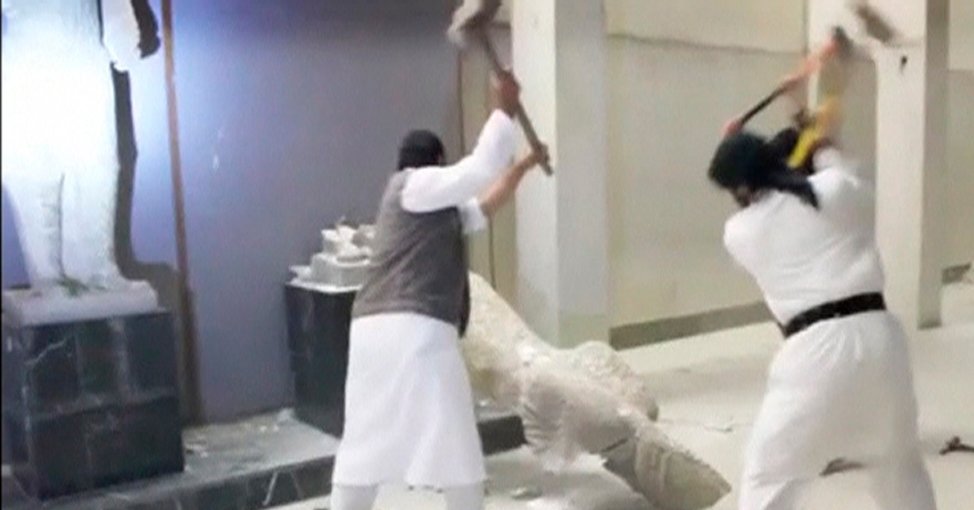

Call me a terrorist if you will, but isn’t the destruction of this heritage of carnage exactly what YHVH calls his people to do?
“These are the statutes and judgments, which ye shall observe to do in the land, which the Lord God of thy fathers giveth thee to possess it, all the days that ye live upon the earth. Ye shall utterly destroy all the places, wherein the nations which ye shall possess served their gods, upon the high mountains, and upon the hills, and under every green tree: And ye shall overthrow their altars, and break their pillars, and burn their groves with fire; and ye shall hew down the graven images of their gods, and destroy the names of them out of that place.” (Deuteronomy 12:1-3)
“Josiah…reigned in Jerusalem one and thirty years. And he did that which was right in the sight of the Lord, and walked in the ways of David his father, and declined neither to the right hand, nor to the left…And [in the original performative destruction] they brake down the altars of Baalim in his presence [sight prior to the availability of online videos] ; and the images, that were on high above them, he cut down; and the groves, and the carved images, and the molten images, he brake in pieces, and made dust of them, and strowed it upon the graves of them that had sacrificed unto them. And he burnt the bones of the priests upon their altars, and cleansed Judah and Jerusalem. And so did he in the cities of Manasseh, and Ephraim, and Simeon, even unto Naphtali, with their mattocks round about. And when he had broken down the altars and the groves, and had beaten the graven images into powder, and cut down all the idols throughout all the land of Israel, he…had purged the land.” (II Chronicles 34:1-8)


 Kingdom Come