-
75 million people died in World War II, including about 20 million military personnel and 40 million civilians, many of whom died because of deliberate genocide, massacres, mass-bombings, disease, and starvation.
Over 1/3 of these deaths were inflicted on the Soviets who lost around 27 million people during the war, including 8.7 million military and 19 million civilian deaths.
A quarter of the people in the Soviet Union were wounded or killed in WWII, and the country lost a third of its national wealth.
Compare the cost to the U.S. – 300,000 lives lost, and no financial cost, but rather making a killing (pun intended) on the Lend-Lease Act.
America sent arms and equipment to the Soviet Union totaling $11.3 billion, or $180 billion in today’s currency from 1941 to 1945.
Including, but not limited to, 400,000 jeeps & trucks, 14,000 airplanes, 2.7 million tons of petrol products and 4.5 million tons of food.
Exactly like Hitler’s plan to recover from WWI by expanding east, Stalin fully expected to repay his losses by expanding west into conquered territory.
Winston Churchill had long worried about the limitless Soviet ambitions. Fifteen years earlier, he told the Commons…”I think we ought to recognise that the dangers which come from Russia are at the root of the failure of Disarmament leading directly to WWII. This mighty Power, outside the family of nations, outside the concert of Christendom, proclaiming a creed destructive of all existing civilisation…possessed of unlimited manpower, and rapidly equipping itself with all the most frightful and devastating instrumentalities of modern war”.
As the leader of Great Britain, Churchill knew what he was talking about. Just one lifetime ago Napoleon was on the precipice of total European control, and two world wars later German leaders envisioned leading a new world order, and it took virtually all the rest of the developed countries to stop them.
To avert what he firmly believed would be WWIII, Churchill developed a top secret plan called “Operation Unthinkable”. On 1 July 1945 British, US, Polish and newly allied German forces were to attempt to liberate East Germany and Poland from Russian control. If they did not succeed, Churchill believed that Allied forces would be sucked into a Third World War.
This plan was supported by America’s Office of Strategic (espionage) Services, the forerunner to the CIA, Germany’s Admiral Karl Donitz who briefly replaced Hitler as the war was drawing to a close, and America’s George Patton, celebrated general whose force of will and brilliant strategy had liberated western Europe.
Patton, like Churchill, was convinced that the Russians posed a greater hazard to world peace than the Nazis. “We may have been fighting the wrong enemy all along. But while we’re here, we should go after the bastards now, ’cause we’re gonna have to fight ’em eventually. I’ll say this; the Third Army alone with very little help and with damned few casualties, could lick what is left of the Russians in six weeks.
You mark my words. Don’t ever forget them . . . Someday we will have to fight them and it will take six years and cost us six million lives…Let’s not give them time to build up their supplies. If we do, then . . . we have had a victory over the Germans but we have failed in the liberation of Europe; we have lost the war!
But Patton’s Third Army was ordered to halt by America’s high command as it reached the German border. US President Harry Truman refused to help drive the Russians from Eastern Europe, and with a weary post-war new British government, England’s Operation Unthinkable was closed.
Convenient timing.
With a full blown conspiracy theory.
Forcing us to consider that the U.S. President conspired with Stalin to support their takeover of Eastern Europe.
Unthinkable!
No, it’s not.
Upon America’s late arrival to the European theater of war, the American War Cabinet stated: “The Russian Army has developed a capable and experienced High Command. The army is exceedingly tough, lives and moves on a lighter scale of maintenance than any Western army, and employs bold tactics based largely on disregard for losses in attaining its objective. Equipment has improved rapidly throughout the war and is now good. Enough is known of its development to say that it is certainly not inferior to that of the great powers. The facility the Russian have shown in the development and improvement of existing weapons and equipment and in their mass production has been very striking...It would be beyond our power to win a quick but limited success and we would be committed to a protracted war against heavy odds.”
Reread the first sentence in the above paragraph. America was a late arrival to WWII, putting boots on the ground only at the last minute to establish succession to Great Britain, whose world-wide empire it had by then bought out through the Lend Lease Act for which England paid a total of $4.336 billion
In every battle for supremacy alliances of convenience are made – regardless of ideological differences – until one contestant emerges victorious over the others. It is more believable than not that in the closing months of WWII the U.S. continued its alliance with Russia rather than risk destroying, or losing being cut in to, Germany’s tremendous spoils of war.
Few countries have contributed so much to science and technology as Germany. For most of the 20th century, Germany had more Nobel Prizes in the sciences than any other nation, and today the raw output of German scientific research consistently ranks among the world’s best.
At the top (get it?) of the shopping list was the rocket.
“The rocket will free man from his remaining chains…open to him the gates of heaven.”
—Wernher von Braun
The world’s first functional long-range ballistic rocket was Nazi German’s V-2, soaring to 100 kilometers / 62 miles in 1944. This became the definition of the lower boundary of “outer space”.
America’s delayed advance across Germany allowed Russia to obtain rocket and nuclear technology from Germany. It should be obvious that the US traded not only Eastern Europe but also a share of the German rocket technology in its alliance with the Soviets against Germany.
The Space Race had started – with a planned tie.
Thirteen years later on October 4, 1957 the Russians became famous for being the first nation to exceed that limit when, using their new and improved version of the German V2 rocket, they lobbed the first satellite – any object designed to stay in space – 500 miles up. It stayed there for 21 days before degrading and falling back onto earth.
-
But what about the Cold War?
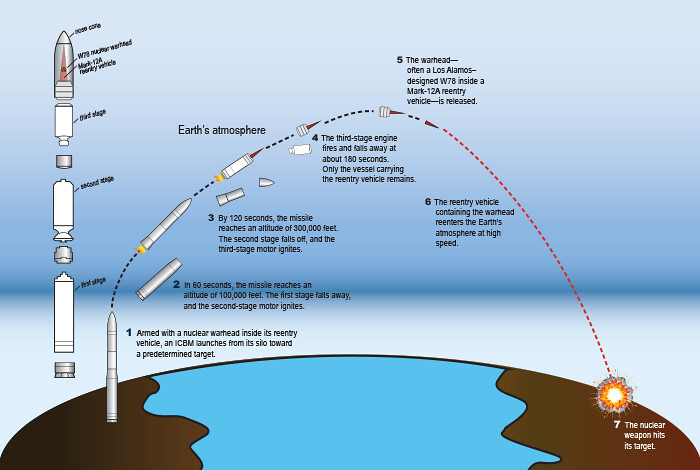
From 1954 to 1957 Soviet rocket designer Sergei Korolev headed development of the R-7 (rocket based on Germany’s V-2) the world’s first ICBM. Successfully flight tested in August 1957, the R-7 missile was powerful enough to launch a nuclear warhead against the United States.
It is not unthinkable that the Cold War was also an extension of the American-Soviet alliance, promoted as existential rivalry to maximize the angst-driven willingness of both peoples to sacrifice taxpayer funding of exorbitant government expenditures on the new technology. This only developed into true rivalry as each side felt strengthened enough to win a war.
This pattern of “the enemy of my enemy is my friend” politics is frankly seen in the Western nations’ alliances created with certain Middle Eastern nations at this same time.
Exactly as with Russia, alliances that were formed for the benefit of both sides during wartime conditions were tossed aside once the Western nations obtained all they could. This was not only due to lack of a solid foundation of shared values and goals, but most of all, due to the West’s greed and determination to attain hegemony over as large a part of the world as it could.

In the 21st century the following militaristic organizations are well-known as enemies of America.
But they didn’t start out that way. Their growth and development were funded by the U.S. as allies.
Since the Industrial Revolution, it is access to Middle East oil empowering everything from engines to factories to empires that drives every significant political move, be it alliance or enmity. These were established by the Western Powers prior to WWI, were part of the spoils of war driving WWII, and continue in our day as the opening salvos of WWIII.
Iran
The discovery of petroleum in Iran 1908 spawned a contest for control of the region between the United Kingdom and Russia, in what became known as The Great Game. After the Russian Revolution preoccupied Russia with domestic affairs, an Iranian military coup established Reza Khan, the first shah of the Pahlavi dynasty.
In 1951 Prime Minister Mohammed Mosaddeq nationalized the British-owned oil industry, but the United States’ CIA and the British MI6 forced Mosaddeq from office and exiled opposition leader Ayatollah Ruhollah Khomeini.
An international consortium of foreign companies then ran the Iranian oil facilities for the next 25 years to its benefit until in 1979 the Islamic Revolution against Western control transformed Shah Mohammad Reza Pahlavi’s absolute monarchy to an Islamic republic under the reinstated Ayatollah Khomeini.
Iraq
In 1916 the country of Iraq was created on paper during a treaty between England and Imperial Russia, defining their respective sphere of influence and control in West Asia. In 1920 under the Sykes-Picot Agreement France gave Britain control, defining the territorial limits of Iraq solely on land grabs with France without accounting for the politics of the different ethnic and religious groups in the entire territory comprising this artificial country, in particular those of the Kurds.
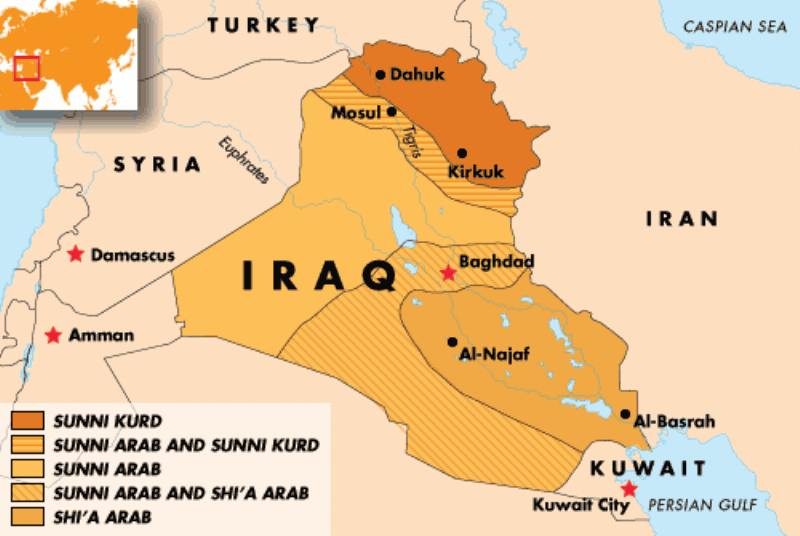
The British had promised two Arabian warlords the same prize – monarchy – for supporting Britain against the Ottoman Empire during WWI. Ibn Saud, the top supporter, won Arabia, hence “Saudi” Arabia, with the Hashemite Arabian runner-up granted a foreign country made up for this purpose. He, in return, granted the rights to huge oil fields.
In 1958 a military coup overthrew the foreign Hashemite monarchy to stop Britain from bleeding it dry of oil revenues. In 1961 the “First” Kurdish Iraqi War began when the completely different religious and ethnic group incorporated into the Iraqi territory without consulting their preference attempted to establish their own self-governing country.
During this nine-year long war the CIA-supported Ba’athist party carpet-bombed Kurdish villages with President Kennedy-supplied munitions including napalm. From 1980-1988 during the Iran–Iraq War Baathist Saddam Hussein’s American-supported Kurdish genocide resulted in another estimated 50,000–200,000 casualties.
Saudia Arabia
Since 1902 Abdulaziz Ibn Saud had been so successful in uniting regions of Arabia into a single state with his Islamic religious militia that he was not only able to make a politically advantageous arrangement to be the local ruler with the Ottoman Empire during WWI, but also with the British after they defeated the Ottomans, and then with rising star America.
On March 3, 1938, an American-owned oil well in Dhahran, Saudi Arabia, drilled into what would soon be identified as the largest source of petroleum in the world. This allows Saudi Arabia to have an outsized role in some foreign policy decisions.
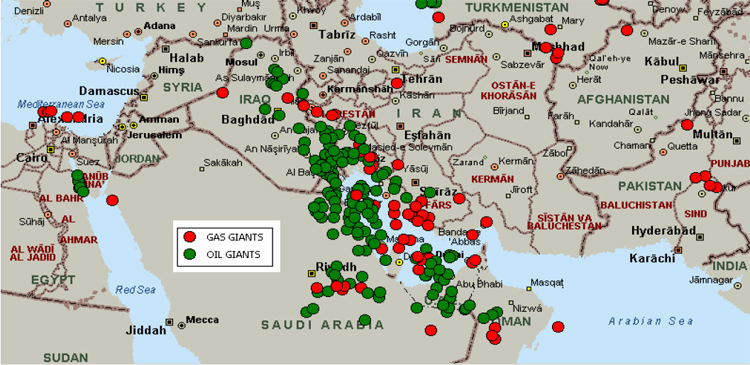
In 1988 Saudi Arabian Osama bin-Laden founded Al-Qaeda ‘the Base’ or ‘Foundation’, a pan-Islamist militant organization spearheading a global Islamist revolution to unite the Muslim world under a supra-national Islamic caliphate.
During the nine-year Soviet–Afghan War the United States backed the Islamic insurgent groups known collectively as the Afghan mujahideen , including bin Laden’s Al-Qaeda, who fought against the Communist Democratic Republic of Afghanistan and the Soviet Army.
-
234) Unthinkable!


 Kingdom Come