The one thing all messiahs (Hebrew) / christs (Greek) offer is destruction of the oppressing and death-dealing enemy.
The objective of any group guided by self-serving motivations, whether public or secret, can be generally summed up as the annihilation of other groups of humanity by one means or another. This concept is graphically portrayed in the film aptly named Alien Covenant. Or we can just remember the actual history on which fiction is based.
Any leader who promises to solve problems by defeating an external enemy is a false savior because they treat their followers as victims of others’ oppression and allow them to continue living a self-centered life instead of accepting personal responsibility for the need to change.
“And ye shall hear of wars and rumours of wars…For nation shall rise against nation, and kingdom against kingdom:” (Matthew 24:6-7)
The Roman / Fourth Empire never stopped wedging its way as far as it could. So let’s understand that, for the sake of brevity we’re starting with World War “I” in the modern era, but that this is a misnomer, a sleight of hand distraction from the underlying continuous warfare.
The causes of World War I included increased economic competition between nations. In the wake of the Industrial Revolution’s total dependence on oil, the Ottoman Empire, with its vast oil fields in the Middle East, had no shortage of potential partners. The Ottoman–German Alliance between the German Empire and the Ottoman Empire was ratified on August 2, 1914 after the outbreak of World War I to provide Germany safe passage into neighboring British colonies where lay the oil fields.
World War I (28 July 1914 – 11 November 1918) was fought between two coalitions: the Allies (or Entente) – France, the United Kingdom, Russia, Italy, Japan and (late in the game) the United States, against the Central Powers – German Empire, Austria-Hungary, the Ottoman Empire, and Bulgaria. Fighting took place mainly in Europe and the Middle East.
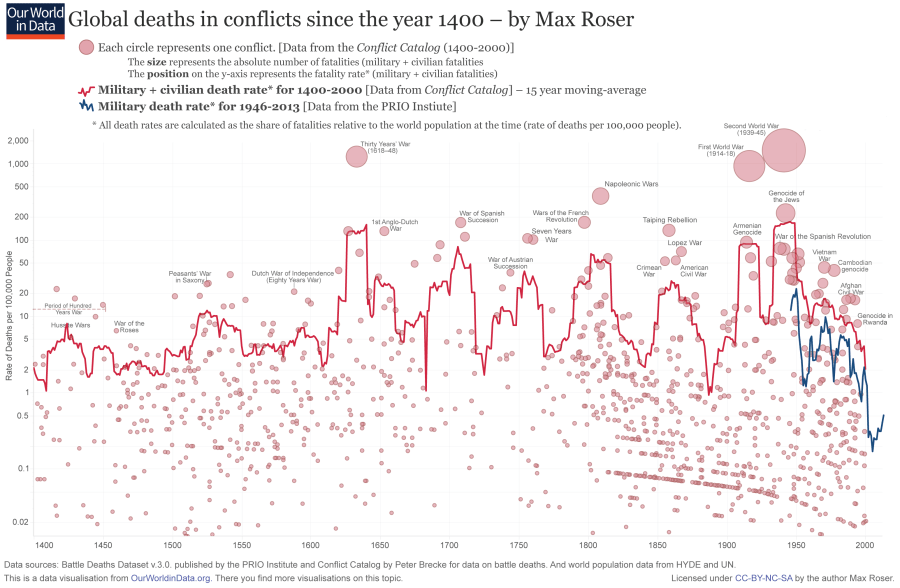
The Industrial Revolution’s technological developments in weaponry resulted in an estimated 9 million military dead and 23 million wounded, plus up to 8 million civilian deaths from causes including genocide using airplanes, tanks, chemical weapons, big guns, the machine gun whose deadly potential was demonstrated by killing almost 60,000 British soldiers on the Somme battlefield in one day – submarines, and radios.
The peace treaty ending WWI immediately fragmented into violent revolutions around the world.
- Russian Revolution with the overthrow of the Tzar
- Collapse of the German Empire with the abdication of the Kaiser
- dissolution of Austria-Hungary with the collapse of the Habsburg monarch
- the Bulgarian Tsar stepped down.
- The collapse of the Ottoman Empire fueled Turkey’s successful war of independence.
- Greece pursued war with Turkey to acquire territory inhabited by ethnic Greeks. Army mutinies and popular uprisings in 1922 led to initially a military coup forcing the abdication of King Constantine I in 1923 and the establishment of the Second Hellenic Republic in 1924 then General Pangalos installed as dictator in the military coup of 1925, a return to democracy under Venizelos in 1928 and the restoration of the monarchy by a military coup in 1935.
- Spain experienced a notable postwar economic slump and renewed anti-imperial action in the colonies, went to war in 1920 to maintain control – read national income – but failed and a military dictatorship was installed to quell popular uprising.
- Egypt and Sudan jointly revolted against the British occupation leading to Britain’s recognition of Egyptian independence in 1922. Britain, however, maintained great influence over the newly created Kingdom of Egypt and retained control of the Canal Zone and Sudan.
- Iraq’s Revolt began in 1920 against the British who published the new land ownership and the burial taxes at Najaf. Using heavy artillery and aerial bombardment, the uprising was suppressed by the British, but the Iraqis achieved a political victory. Greater autonomy was given to Iraq, with Faisal I of Iraq installed as King of Iraq and the British Mandate for Mesopotamia cancelled.
Actually, the only way to impress upon our ignorant selves the enormity of the conflict is to list every country in conflict:
List of conflicts
Communist revolutions that started 1917–1924
- Russian Revolution (1917)
- Russian Soviet Federative Socialist Republic
- Ukrainian Soviet Republic (1918)
- Ukrainian Soviet Socialist Republic (1919)
- Socialist Soviet Republic of Lithuania and Belorussia
- Lithuanian Soviet Socialist Republic (1918–1919)
- Latvian Socialist Soviet Republic
- Commune of the Working People of Estonia
- Finnish Socialist Workers’ Republic
- In Spain:
- Jungle Movement of Gilan (1915/17–1920)
- Persian Socialist Soviet Republic (1920–1921)
- Austro-Hungarian strike of January 1918 (1918)
- Makhnovshchina (1918)
- Aster Revolution (1918)
- Red Week (Netherlands) (1918)
- Finnish Civil War (1918)
- Darwin rebellion (1918)
- Swiss general strike (1918)
- Political violence in Germany (1918–1933)
- German strike of January 1918 (1918)
- German Revolution (1918–1919)
- People’s State of Bavaria (1918–1919)
- Bremen Soviet Republic (1919)
- Bavarian Soviet Republic (1919)
- Würzburg Soviet Republic (1919)
- Ruhr uprising (1920)
- March Action (1921)
- Hamburg Uprising (1923)
- German October (1923)
- Brussels Soldiers’ Council (1918)
- Revolutions and interventions in Hungary (1918–1920)
- Fascist and anti-Fascist violence in Italy (1919–1926)
- Biennio Rosso (1919–20)
- Labin Republic (1921)
- Proština rebellion (1921)
- Tragic Week (1919)
- Limerick Soviet (1919)
- Canadian Labour Revolt (1919)[18]
- Georgian coup attempt (1920)
- Provisional Polish Revolutionary Committee (1920)
- Patagonia Rebelde (1920–1922)
- Mongolian Revolution of 1921
- Rand Rebellion (1921–22)
- September Uprising (Bulgaria) (1923)
- Tatarbunary Uprising (1924)
- Estonian coup d’état attempt (“Tallinn Uprising”) (1924)
- Luxembourg rebellions (1918–1919)
Left-wing uprisings against the Bolsheviks
- Left SR uprising (1918)
- Left-wing uprisings against the Bolsheviks (1918–1922)
- Bolshevik–Makhnovist conflict (1920–1921)
- Tambov Rebellion (1920–1921)
- Kronstadt Rebellion (1921)
- August Uprising (Georgia) (1924)
Counter-revolutions against USSR that started 1917–1921
- White movement (1917–1923)
- Ukrainian People’s Republic (1917–1921)
- Belarusian Democratic Republic (1918–1919)
- Kuban People’s Republic (1918–1920)
- Mountainous Republic of the Northern Caucasus (1917–1920)
- Democratic Republic of Georgia (1918–1921)
- First Republic of Armenia (1918–1920)
- Mountain Republic of Armenia (1921)
- Azerbaijan Democratic Republic (1918–1920)
- Republic of Prekmurje (1919)
- Bulgarian coup d’état (1923)
- Military Coup of 1923 (Spain)
Soviet counter-counter-revolutions that started 1918–1919
- Russian Civil War (1917–1923)
- Red Terror (1918)
- Polish–Soviet War (1919–1921)
Other
- Champaran Satyagraha (1917)
- Brazilian strike movement (1917–1919)
- Rice riots of 1918 (1918)
- In Poland:
- Greater Poland uprising (1918–1919)
- Komańcza Republic (1918-1919)
- Lemko Republic (1918-1920)
- Republic of Gniew (1919-1920)
- Republic of Ostrów (1918)
- Republic of Tarnobrzeg (1918-1919)
- Republic of Zakopane (1918)
- Sejny Uprising (1919)
- Silesian Uprisings (1919–1921)
- Turkish War of Independence (1919–1923)
- Revolts during the Turkish War of Independence (1919–1923)
- Third Anglo-Afghan War (1919)
- Irish War of Independence (1919–1921)
- Iraqi Revolt (1920)
- Kapp Putsch (1920)
- Uprising in West Hungary (1921)
- Bondelswarts Rebellion (1922)
- Irish Civil War (1922–1923)
- Beer Hall Putsch (1923)
World War II, 1939-1945, the largest and deadliest conflict in human history, involved more than 50 nations and was fought in nearly every part of the world. World War II was the deadliest military conflict in history. An estimated total of 30 soldiers and 55 million civilians perished, or about 3% of the estimated global population in 1940.
Since 1946 major conflicts have continued. Data collected by the Uppsala University in Sweden identifies 285 distinct armed conflicts, with the typical number of conflicts each year between 30 and 50.
The Second Congo War is widely considered the deadliest in human history since World War II, with approximately six million deaths since 1996. To get the full scope of this conflict, however, we need to back track to a series of wars kindling one after the other. This also provides an example of the interconnectedness and twists and turns of any armed conflict.
- 1916 – Belgian colonists arrive [read Heart of Darkness for details], ally with the Tutsi clan providing better living standards over the Hutus in the classic “divide and conquer.”
- 1959 – Hutus revolt over entrenched inequities, ~ 20,000 Tutsis killed many more fled to neighbouring countries.
- 1962 – Rwanda gains independence with Hutus now in control holding a grudge against Tutsis.
- 1994 – the Rwandan Civil War
- Hutus carrying out a political policy of genocide killed an estimated one million minority ethnic Tutsis and moderate Hutus, while the UN withdrew its forces. One detects a flavor of European ethnic cleansing of Africans.
- The Tutsis’ Rwandan Patriotic Front’s (RPF) defeated the genocidal Hutu government in Rwanda.
- The Tutsis drove nearly two million Hutu refugees into Zaire (which became the Congo).
- The refugee camps in eastern Congo served as de facto army bases for both Hutu and Tutsi militias and foreign powers began taking sides on behalf of their own national interests.
- 1996-1997 – First Congo war when an eastern Congolese group supporting Congolese President Mobutu fought to force the Rwandans out of Congo. In what was seized upon as a pretext for regime change, Rwandan and Ugandan armies backing Mobutu’s rival Kabila called the Alliance of Democratic Forces for the Liberation of Congo-Zaire, or AFDL invaded the Congo. Successfully overthrowing Mobutu’s government, the country was re-named the Democratic Republic of Congo / DRC and Kabila took over as president and the Tutsis maintained control of Rwanda.
- But by then it was becoming clear to the world that the Tutsi-orchestrated targeted campaigns against Hutu populations during the First Congo War amounted to war crimes. In a reversal of alliances, Congolese President Kabila allowed Hutu armed groups to organize at the border once again.
- 1998-2002 – the Second Congo War broke out led by Tutsi-led Rwanda.
- One of the most prominent rebel groups to emerge M23 (March 23 Movement) made up primarily of ethnic Tutsis.
- 2013 – The UN Security Council authorized a rare offensive brigade to support the Congolese army in its fight against M23, and the Congolese army has been repeatedly deployed to mining sites in eastern DRC to protect Chinese assets.
- Democratic Republic of Congo: DRC is home to some of the world’s largest reserves of metals and rare earth minerals used to produce advanced electronics, globalizing the conflict in eastern DRC. Vast cobalt mines in the Congo once owned by the U.S. were sold to Chinese companies during the Barack Obama and first Trump administrations.
At the end of WWII The Washington (D.C.) Treaty established the North Atlantic Treaty Organization as a White Horse peacemaker to provide financial assistance to rebuild European economies and defense against USSR incursions. Inevitably, this organization has transformed into the Red Horse warmaker.
- NATO expanded its footprint, violating promises to Moscow, once the Cold War ended, to incorporate 14 countries in Eastern and Central Europe into the alliance. It will soon add Finland and Sweden.
- It bombed Bosnia, Serbia and Kosovo.
- It launched wars in Afghanistan, Iraq, Syria and Libya, resulting in close to a million deaths and some 38 million people driven from their homes.
- It is building a military footprint in Africa and Asia.
- It has backed Turkey, with NATO’s second largest military, which has illegally invaded and occupied parts of Syria as well as Iraq. Turkey’s growing military activities in the region is enough of a problem, but the current water resources dispute with these two countries poses an even greater concern for kindling war.
NATO sees the future, as detailed in its “NATO 2030: Unified for a New Era,” as a battle for hegemony with rival states, especially China, and calls for the preparation of prolonged global conflict.
The North Atlantic Treaty Organization (NATO), and the arms industry that depends on it for billions in profits, has become the most aggressive and dangerous military [-industrial] alliance on the planet. Created in 1949 to thwart Soviet expansion into Eastern and Central Europe, it has evolved into a global war machine in Europe, the Middle East, Latin America, Africa and Asia.
-
1945: U.S. forces landed within the present-day South Korea to accept the surrender of the Japanese, resulting in the current division of the Korean Peninsula.


 Kingdom Come