
-
-
“And God said, Let…fowl…fly above the earth in the open firmament of heaven.” (Genesis 1:20)
The Hebrew word translated here “open” is the same word translated “face”, “surface”, “in the presence of ” or “in front of”. It is still in common use for denoting open access, as in open faced solid sandwich, or open face exhibiting one’s other-wise-indiscernible inner thoughts.
So what God said is that birds can fly above the earth towards the surface of a barrier.
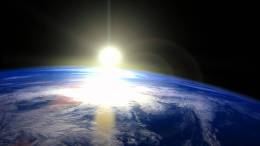
Astronomically, this open space is the first of 5 levels of earth’s atmosphere, and is distinctly different from the other 4 levels.
Earth’s atmosphere can be divided (called atmospheric stratification) into five main layers:
- Exosphere: 700 to 10,000 km (440 to 6,200 miles)[21]
- Thermosphere: 80 to 700 km (50 to 440 miles)[22]
- Mesosphere: 50 to 80 km (31 to 50 miles)
- Stratosphere: 12 to 50 km (7 to 31 miles)
- Troposphere: 0 to 12 km (0 to 7 miles)[23]
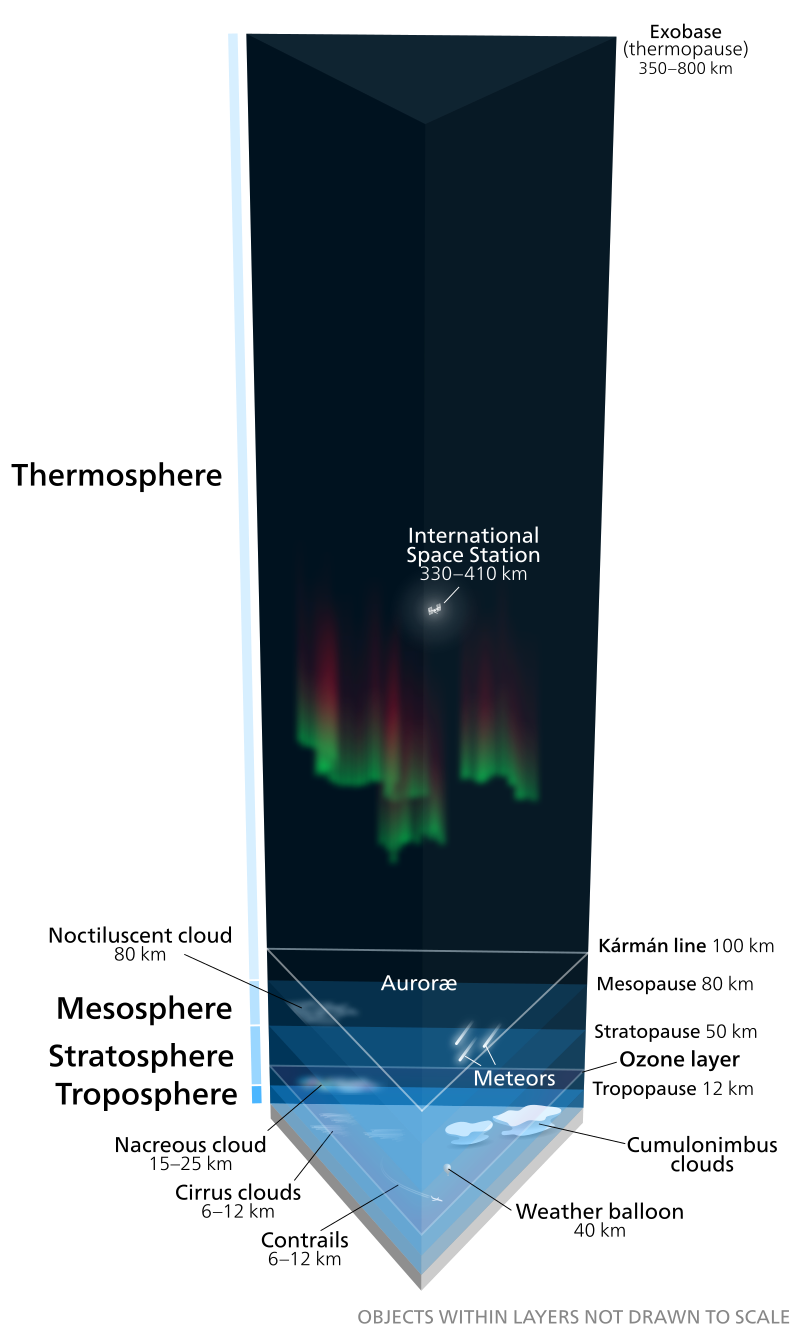
The true outer edge to space beyond the Earth’s atmosphere, or a reasonable candidate for it, is the magnetic shock front with the solar wind…earth’s topmost layer of atmosphere.
However. a definition proposed in international law discussions defines the lower boundary of space as the lowest perigee (nearest point to earth during its orbit) attainable by an orbiting space vehicle, but does not specify an altitude from earth. This is the definition adopted by the U.S. military. The U.S. government is resisting efforts to specify a precise international boundary, because the U.S. Armed Forces defines an astronaut as a person who has flown higher than 50 miles (80 km) above mean sea level, This is a shorter distance than the international record-keeping body FAI (Fédération aéronautique internationale) defines as an altitude of 100 kilometres (62 miles) above mean sea level.
Even that is a thousand times lower than true space! Why so very low so close to earth? “To answer questions such as ‘how many astronauts have flown in space?’
-
Let’s put this in historical context.
On October 4, 1957 the Soviet Union inaugurates the “Space Age” with its launch of Sputnik, the world’s first artificial satellite. Traveling at 18,000 miles an hour, its elliptical orbit had an apogee (farthest point from Earth) of 584 miles and a perigee (nearest point) of 143 miles, putting it within the top atmospheric layer of the exosphere.
Visible with binoculars before sunrise or after sunset, Sputnik transmitted radio signals back to Earth strong enough to be picked up by amateur radio operators. Those in the United States with access to such equipment tuned in and listened in awe as the beeping Soviet spacecraft passed over America several times a day.
-
The Soviet launch of the first Sputnik satellite was one accomplishment in a string of Soviet technological successes. It was quickly followed by the launch of two additional satellites, including one that carried a dog into space. The Soviet Union also tested the first intercontinental ballistic missile that year.
-
-
-
-
Three months later the United States launched its first satellite, the Explorer.
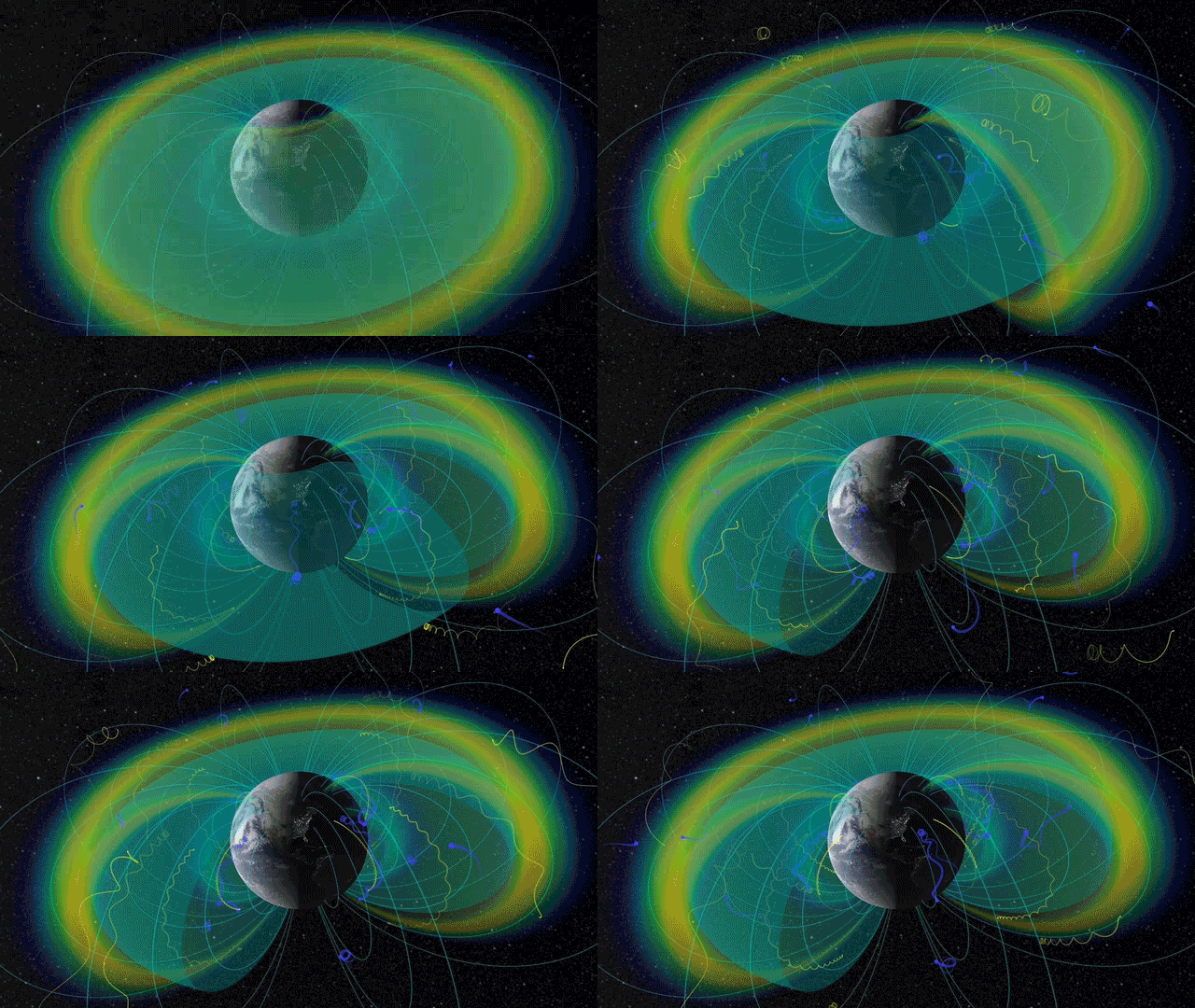
It was the first spacecraft to detect the Van Allen radiation belt.
Be serious.
There is no question that the Russians had already detected the intense radiation covering the earth with Sputnik within the Exosphere and were certainly were investigating this.
-
-
Plasma (from Ancient Greek πλάσμα (plásma) ‘moldable substance’)[1] is one of the four fundamental states of matter. It is the most abundant form of ordinary matter in the universe, being mostly associated with stars, including the Sun.
- So plowing through the Van Allen Belts be like flying into the sun?
- Not possible.
-
In the historic reports of trips to the moon there is no mention of the Van Allen Belts which “form a nearly impenetrable barrier” from 400 to to 36,000 miles above Earth’s surface. It was only years later when the Van Allen Belts became widely known through public access to the World Wide Web that explanations were offered to explain how that miracle was accomplished. It’s like DNA evidence – who knew that would show up in the future to haunt you?
-
It’s a common misconception among the public that when a rocket lifts off, it somehow pushes against the launch pad, or the air around it, to gain altitude. This is based on common sense and everyday experience…
The simple answer is that a rocket moves by pushing on the gas that flame out from its engines. Even though it seems impossible for a massive rocket to move by only venting gas, it’s the simple scientific truth, based on Newton’s third law of motion:
for every action in nature there is an equal and opposite reaction…
So, when a rocket violently pushes gas out of its nozzles, that same gas…pushes in unison on the rocket, propelling it forward.
OK. Accepting this explanation, let’s calculate the amount of fuel required to make a round trip to the moon.
 The 1st stage
- burned 521,000 gallons of fuel to produce
- 7.5 million pounds of thrust. Note, at this stage the entire thrust system had not only the gas but the massive earth available to assist in pushing off, like a race car’s tires against pavement.
- for 3 min
- to propel the spacecraft 42 miles / 67 km
- accelerating to 6,164 miles per hour.
- The 2nd stage
- burned 340,000 gallons of fuel to produce
- 1.1 million pounds of thrust in a vacuum
- for 6 minutes
- to propel the spacecraft 67 more miles to 109 miles / 175 km high – i.e. above the Karman Line into, technically, space because of the lack of air particles.
- accelerating to 15,647 mph.
- During Apollo 11, a typical lunar mission,the third stage
- burned 87,000 gallons fuel to produce
- 200,000 pounds of thrust
- for about 2.5 minutes
- to reach 118 miles / 190 km above earth
- and turn the spaceship at a right angle to the earth
- and accelerate it to 17,432 miles per hour.
 Orbital velocity is the velocity needed to achieve balance between gravity’s pull on the satellite and the inertia of the satellite’s motion — the satellite’s tendency to keep going [in a straight line]. This is approximately 17,000 mph (27,359 kph) at an altitude of 150 miles (242 kilometers). Without gravity, the satellite’s inertia would carry it off into space. Even with gravity, if the intended satellite goes too fast, it will eventually fly away. On the other hand, if the satellite goes too slowly, gravity will pull it back to Earth.
S-IVB topped the third stage to reignite the engine for a second burn
- with 87,000 gallons fuel to achieve enough thrust
- to escape earth orbit and place Apollo 11 into a translunar orbit [for] the command and service module, or CSM, Columbia…with the LM [lunar module, Eagle].
Once above earth’s atmosphere the velocity attained by the last boost was supposedly not hindered by any particles, so the spaceship was able to coast for 75 hours without additional engine assist during the 250,000 miles to the moon.
Where once again there’s gravity.
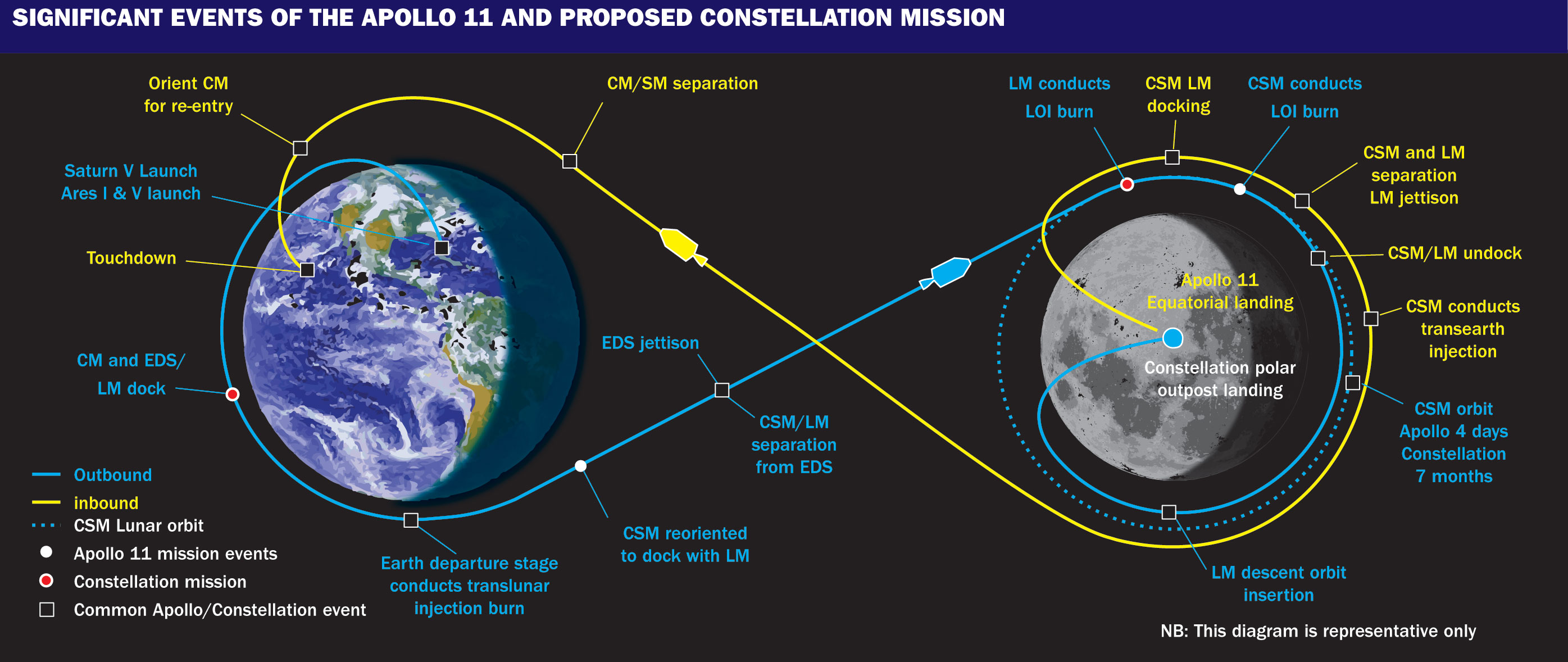
The Earth, if we think about it from a position hovering somewhere above the North Pole, rotates from west to east…The Moon does the same thing. It rotates west to east and travels around the Earth in the same direction…In both cases, the eastern edge of the body, the edge towards which all that momentum goes, is called the leading edge. The opposite side away from which all that momentum goes is called the trailing edge. (it’s the spin and the direction of travel that matters here.)
This becomes important when you do a gravity assist, also called a fly by…the Apollo spacecraft…is affected by all the bodies near it…that’s exerting a gravitational pull…If it flies past close enough and stays flying fast enough that it can’t be captured by the body to start orbiting it, that spacecraft will slingshot around. The spacecraft will get a boost of momentum and change in direction… But the side of the body matters. If the spacecraft flies past the trailing edge, it will get a bigger boost of momentum because it’s going with the direction of travel. If it flies past the leading edge, it will…lose some speed because it’s flying against the direction of the body’s travel…
Every mission [was] launched [from earth] towards the east, taking advantage of the Earth’s rotation to need a little less fuel to get into orbit. From there, the next big mission event was the translunar injection or TLI burn. This changed Apollo’s orbit from a nearly circular one to an elliptical one with the apogee, the furthest point, somewhere near where the Moon would be in three days time — mission planners had to account for travel time over some 250,000 miles…passing by the leading edge would…act like a gravitational brake almost, changing the spacecraft’s path to an ellipse that would bring it straight back to Earth without any input from the crew…
Seriously?
Earth exerts an gravitational effect…that is 80 times stronger than the moon’s. If the moon’s 1/80th force of gravity could slow down the spaceship once it reached the moon, wouldn’t Earth’s much stronger gravity also have slowed down and dragged back the spaceship once it was just coasting as it departed earth?
And the answer to that is:
the Apollo Service Module Propulsion System (SPS), a liquid-fuel rocket engine used on Apollo spacecraft…to steer the spacecraft toward the Moon, place it into lunar orbit, and propel it back toward Earth.
Using storable propellants, the SPS produced a thrust of 21,900 pounds…up to 12.5 minutes, as required.
Interesting that the amount of fuel carried by the SPS is not given.
Compare the SPS to the size of engines 1-3 and SIV-B in the Saturn rocket which, combined, used over 1,000,000 pounds of liquid fuel to produce over 9 million pounds of thrust just to escape Earth’s gravity.
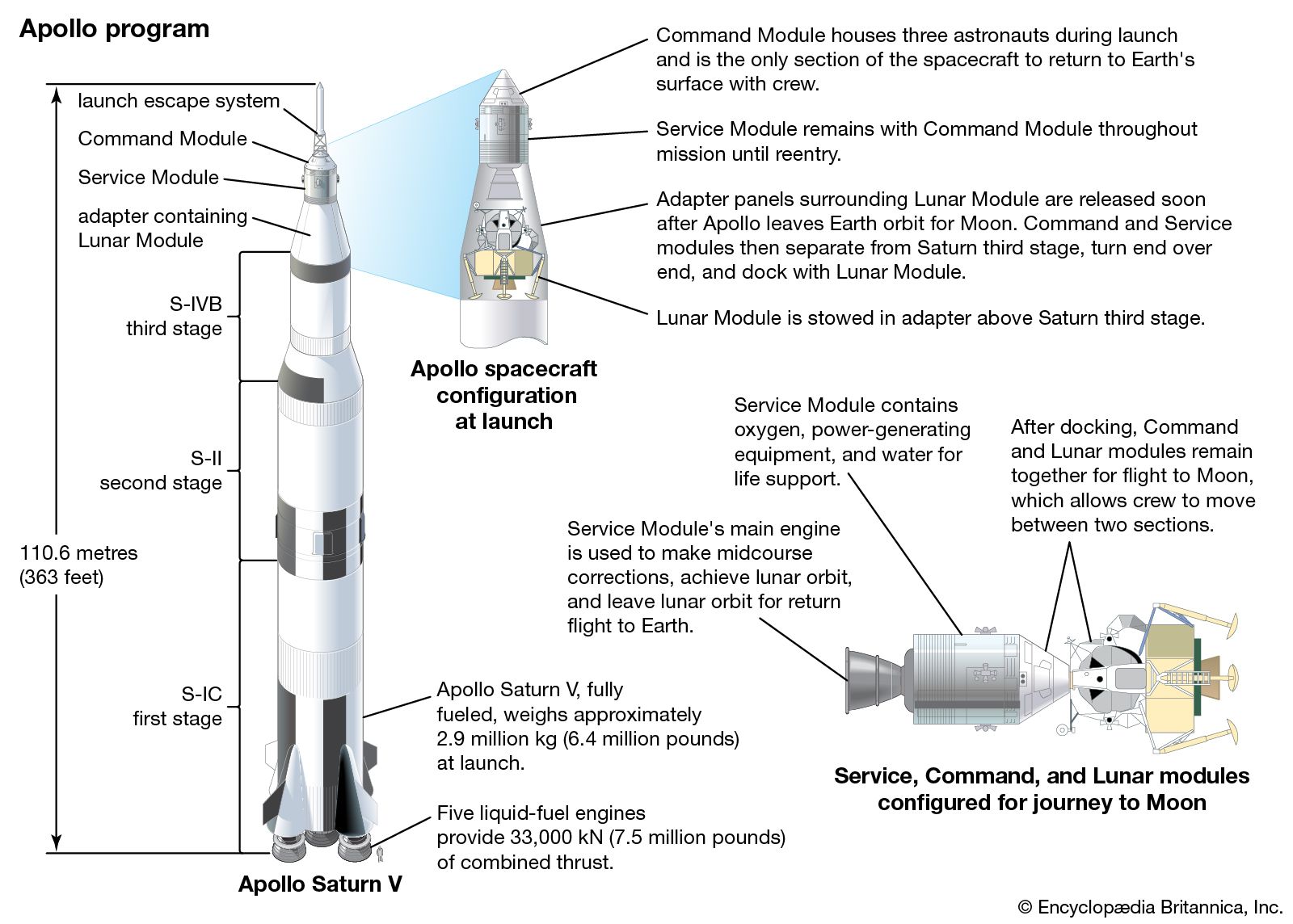
Is the SPS engine big enough to carry enough fuel to
- brake against the moon’s gravitation pull
- push off against the moon’s gravity
- and brake against earth’s gravity on return?
Wow. Talk about the little engine that could!
- the lack of technological achievements made by the U.S. in contrast to the USSR
- in the 16 years between both seizing existing rocket science as spoils of war from Germany in 1945
- and initial space achievements.
- the first to rocket a man into space,
- the first to orbit the earth,
- the first to spend a significant amount of time in space.
- developed the Saturn Rocket
- which propelled a series of spaceships in round trips totaling 500,000 miles to the moon and back
- never again repeated by any nation including the US or the highly competitive Russians or emerging power houses China or India
-
We are headed 3600 miles above earth…As we get further from earth, we’ll pass through the Van Allen Belts, an area of dangerous radiation…But Orion has protection. Shielding will be put to the test as the vehicle cuts through waves of radiation. Sensors aboard will record radiation levels for scientists to study. We must solve these challenges before we send people through these regions of space…It’s time to head home…75 miles above earth…We’re now traveling more than 20,000 miles per hour…An envelope of hot plasma surrounds the vehicle…reaches temperatures of 4,000 degrees Fahrenheit, almost twice as hot as molten lava. This may be the most dangerous part of the flight…A specially constructed heat shield takes the full brunt of the inferno. This is the largest heat shield of its kind ever made…One day people will be aboard…For the first flight, we won’t have astronauts inside.
Seriously?
NOW NASA is so concerned about the safety of the astronauts – despite the massive advances in aerospace technology in the intervening 40 years – that you won’t expose the astronauts NOW.
But in 1969 – with knowledge of the radiation dangers of the Van Allen Belts but far, far less technology – NASA did?
And successfully, without any damage to equipment or life?
That’s just unbelievable, given that it has taken 53 years and enormous technological developments for any nation to consider another trip to the moon.
What is believable is the use of propaganda to keep subjects in line with the programs – taxation without representation as to where the money is going.
One year after the discovery of the Van Allen impenetrable ultra-radiation belts the U.S. launched the X-15, a small rocket-powered aircraft which provided thrust for 80 to 120 seconds of flight. ending with a 200 mile-per-hour glide landing.
The three X-15 aircraft made 199 powered flights for the next ten years.
To do what? As aircraft, consistent with the reported short bursts of flight with rapid glide returns, they could only investigate the Van Allen Belts from within the Karman line boundary, unlike the Soviet’s deep penetration into the Van Allen Belts themselves.
for decades, spacecraft observations were limited to brief forays because the region is so hazardous…“no one actually dared to send a spacecraft,” Nelli Mosavi, project manager for the Van Allen Probes at Johns Hopkins University Applied Physics Laboratory, told Space.com. “The legacy [of the VA Probes] is the resilient spacecraft we built [looong after the late 1960’s] to withstand these environments that no one else could have gone to.
“Radiation is also a key threat to astronauts living and working on the International Space Station, [located 350 miles above earth, just below the inner belt] and protecting humans from the dangers of radiation is one of the most important challenges NASA will need to tackle as it looks to expand human exploration of space. The Van Allen Probes…revealed that…the belts can fluctuate from [two to] three thinner belts to one massive one…in just seconds.
the Van Allen Probes transformed our understanding of the particle radiation environment close to Earth during their seven-year mission [2012-2021].
In addition to the danger of charged particles, plasma is a form of matter that requires force to plow through.
So any report of “outer space” activity has been limited to the space between 62-400 miles above earth, and is actually “inner space.”
So how, in 1959, could the USSR’s Luna 2 reach the surface of the moon?
Or even ten years later on 16 July 1969, as an estimated 650 million people watched Neil Armstrong as he took “…one small step for a man, one giant leap for mankind” along with astronauts Neil Armstrong, Buzz Aldrin and Michael Collins, how did the US?
Not possible.
Before blackballing this thoughtful consideration as an idiot conspiracy theorist, compare this effort made to understand a secretive militaristic government agency’s claim against your own.
 Let’s say that engines 1-3 miraculously drove the astronauts, lunar module and high tech equipment through the Van Allen Belts going and coming, twelves times no less, in the six claimed manned moon missions without incurring any damage!
But how is it possible that no damage occurred while coasting through a round trip of 500,000 miles which we – now – know is filled with asteroids?
Not possible!
The Columbia space shuttle blown to smithereens when one piece of foam came loose.

And there’s more.
After collating various sources of data on this subject and comparing and contrasting conflicting statements from NASA itself, I don’t find America’s claim to have landed men on the moon to be a valid – externally supported – or reliable – internally consistent – claim.
Seriously? That statement is simply incredible in light of all the technological achievements made in the last 50 years.
That statement is also incredible in light of
By 1961 the USSR had beaten the US in every space race event –
But within the next 8 years in a massive technological leap forward the US
In 1972 the US sent its last crewed missions to the moon. 1972 was the most recent time humans have set foot on the Moon or traveled beyond low Earth orbit.
I encourage you to listen to NASA’s own public service announcement, launched in 2014, on Apollo’s replacement, the Orion spacecraft. Don’t overlook the visuals in the film created by NASA to publicize their planned mission. It is so realistic that it could easily be misinterpreted as the real thing.

 Kingdom Come