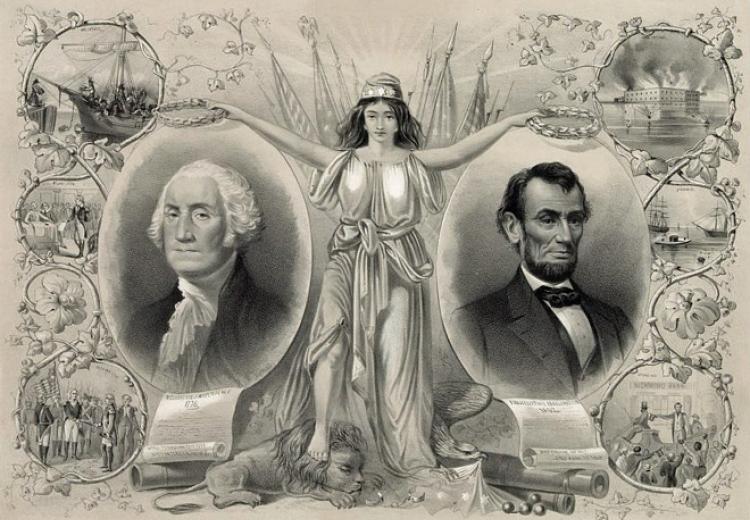
America has been at war 93% of the time since its birth in 1776.
America’s tax-base wealth empowers the US Presidents to execute the political strategy of the four horsemen of the apocalypse.
- Promising peace and prosperity through political deals of foreign aid and bribing rulers,
- the foreign disenfranchised masses revolt,
- leading to repressive measures by their foreign overlords causing famine, sickness, death
- and inevitably the outbreak of catastrophic war from which America must “defend” itself from the problem it started.
American Revolution Era during Napoleonic Wars
- White Horse: George Washington led the American Revolution, a vision which propelled America to become the super power it is today by, ironically, inspiring British colonists to free themselves from British taxation without representation.
- Red Horse: Immediately supported the Napoleonic wars in Europe by diverting France’s greatest adversary, Britain, in the War of 1812, followed by over 1,500 wars, attacks and raids on Indians, the most of any country in the world against its Indigenous people.
- Black horse: Dreadful living conditions, poor nutrition and pandemics for the majority with a small minority of wealthy benefitting from all the resources of the continent. Plains Indians were unable to hunt buffalo since these had been deliberately exterminated. Instead, they had to rely on government rations that could be withdrawn at any time for poor behaviour. Since they could not leave their reservations they were reduced to a subsistence life. Indian children were forcibly taken from their familiess and sent to boarding schools. In 1889 the federal government opened lands in the Oklahoma Territory to white settlement that were by treaties reserved for Indians. Starvation was common, and living in close quarters hastened the spread of diseases brought by white settlers.
- Pale horse – massive death rates from all causes. By the close of the Indian Wars in the late 19th century, fewer than 238,000 Indigenous people remained from the estimated 5 million to 15 million living in North America when Columbus arrived in 1492 – statistics worse than the Holocaust.
American Civil War Era during England’s rise to world power.
- White Horse: Abraham Lincoln led the country through the US Civil War with conviction, humility, oratory skills and freed the slaves. Over 90 percent of Confederate trade with Britain ended, negatively impacting the South’s war effort and even causing high unemployment in English textile mills, nonetheless some Manchester cotton workers refused out of principle to process any cotton from America, leading to direct praise from President Lincoln, whose statue in Manchester bears a plaque which quotes his appreciation for the textile workers in “helping abolish slavery”. Large-scale trade continued between Britain and the Northern US, developing foreign relations for future wars.
- Red Horse: The U.S. Army underwent an enormous expansion during the Civil War (1861–65), growing from 16,000 troops in December 1860 to 1,000,000 by 1865 plus another 500,000 Confederate troops at its height, resorting to conscription to maintain their vast armies. The Army Reorganization Act of 1866 provided for a standing army which saw almost constant combat in the Indian Wars, the Mexican American War, the Spanish American war, and the Philippine American War. When war came again in 1917, the U.S. Army was well prepared.
- Black Horse: “Destruction, hunger, lawlessness and violence in the South, one million plus homeless African American refugees, white male population decimated by the war, governments in many places ceased to exist, cities in shambles, farms destroyed, new labor arrangements of tenant farming and sharecropping became a way for wealthy whites to continue dominating society and keep blacks repressed well beyond the Civil War, poor African Americans and some whites routinely convicted of vagrancy or other crimes then sentenced to prolonged periods of forced labor leased to mines and plantations cheaper than slaves (In Alabama, convict leasing constituted 73% of the state’s revenue in 1898), lasted for almost 60 years. Redeemers passed Black Codes that sidestepped the 14th Amendment by passing Jim Crow laws at the local and state levels. Paramilitary groups like the Ku Klux Klan used intimidation, threats and attacks on people and property to preserve white supremacy.”
- Pale Horse: “The Civil War was America’s bloodiest conflict. The unprecedented violence of battles such as Shiloh, Antietam, Stones River, and Gettysburg shocked citizens and international observers alike. Nearly as many men died in captivity during the Civil War as were killed in the whole of the Vietnam War. Hundreds of thousands died of disease. Roughly 2% of the population, an estimated 620,000 men, lost their lives in the line of duty. Taken as a percentage of today’s population, the toll would have risen as high as 6 million souls.” In addition, there were 50,000 civilian deaths during the war, the overall mortality rate for the South exceeded that of any country in World War I and all but the region between the Rhine and the Volga in World War II. The American Civil War produced carnage that was often thought to be reserved for the combination of technological proficiency and inhumanity characteristic of a later time.
World War I – Theodore Roosevelt & Woodrow Wilson
- White Horse: led the country into Imperialism throughout the 1890s, increasingly relying on its military and economic power to pursue foreign policy goals Freed workers from exploitation by Industrialists and began noble policy of furthering the Progressive agenda around the world.” Roosevelt believed that the United States had emerged as a world power, and he sought ways to assert America’s newly-eminent position abroad by involvement with European conflicts and strengthening ties with Great Britain.
- Red Horse: through his successor Woodrow Wilson, the first U.S. president to visit Europe also the first to claim the U.S. role of making the world “safe for democracy.” American involvement in World War I tipped the victory to the allied side and caused Britain and France to falsely declare the Germans guilty of starting the war, rub its nose in defeat with heavy war reparations, and grab Germany’s and its losing allies’ colonies overseas. Woodrow Wilson demanded that the German king, Kaiser Wilhelm II, abdicate. All of these post-war depredations paved the way for the rise of the hyper-nationalist and jingoistic Hitler.
- Black Horse: Before World War I, the global economy was growing robustly. There were no limits on immigration and no need for passports. Governments were small and kept their budgets balanced…after World War I countries imposed restrictions…protectionism set the stage for the Great Depression. Countries dropped the gold standard. Governments learned their people would submit to taxation and conscription if it meant protection from outside forces. The U.S. top tax rate rose from 7% in 1915 to 77% in 1918, rising above 90% in 1944. Lenin called the rise of government influence during the war as “wartime socialism.” He used it as the basis for the Soviet Union. The German government printed money to pay for the war. It increased the number of Deutschmarks in circulation from 13 billion to 60 billion. Germany’s sovereign debt went from 5 billion to 100 billion marks also printing money to meet the 132 billion marks of Treaty of Versailles’ reparations. As a result, Germany experienced hyperinflation. Production collapsed, leading to a shortage of goods, especially food with the price of everyday items doubling every 3.7 days. Sandwiched between the giddy 1920’s and World War II, the 1930s saw a huge disparity in the lifestyles of the common man and those considered High Society. on “Black Friday”, October 29, 1929 the stock market crashed. Within a year 5,000 banks collapsed and six-million workers lost their jobs. By 1933 more than 15-million people – one-quarter of the workforce – were unemployed. The Great Depression was partly caused by the great inequality between the rich who accounted for a third of all wealth and the poor who had no savings at all…For the vast majority the 1930s was a time of misery. But for many American dynastic families, parties helped to escape the reality on the street and the grander the better. While storefronts stood empty, the 47-storey Waldorf-Astoria Hotel opened in 1931 at a cost of $42 million ($600 million today)…The Ritz was another favored venue for extravagant celebrations…Barbara Hutton, grand-daughter of the dime-store magnate Frank W. Woolworth, made her debut there in 1933. Costing more than $60,000 ($1million today)…on the West Coast even greater excesses were witnessed, at a time when most Americans could not afford to feed their family.
- Pale Horse: Troops movement in WWI helped the spread of the 1918 influenza pandemic. Worldwide, one out of three or 500 million people got sick. Of those, 50 million died, some within hours. In the United States, one out of four got sick. Of those, 675,000 died.
World War II: Franklin D. Roosevelt & Harry Truman
- White Horse: Conquered fear – of the Great Depression which he ended, of WWII which he won, and of world isolation which he overcame by making America the industrial and commercial world leader with the Lend-Lease Act during the war, while not providing combatants in the war until the end was in sight.
- Red Horse: The Cold War between the Soviet Union and the United States and their respective allies began with the Truman Doctrine.
- Black Horse: World War II’s siege of Leningrad with its 600+ factories proves the Russian capacity to endure. While enemy fire would eventually kill or wound some 50,000 civilians during the siege, Leningrad’s most serious problem was lack of food for the 2.5 million civilians left in the city. By the end of the siege civilian rations cut to the equivalent of three small slices of bread, and this mixed with sawdust. During the bitterly cold winter of 1940-41 100,000 persons died each month, yet the city held out against the Nazis. The U.S. did not support Russia as an ally against Germany until after this event.
- Pale Horse: Some 75 million people died in World War II, including about 20 million military personnel and 40 million civilians, many of whom died because of deliberate genocide, massacres, mass-bombings, disease, and starvation. The Soviet Union experienced the highest number of casualties at 24,000,000, the United States lost 418,500.
The Cold War & War On Terror – Presidents Eisenhower – Trump
- White Horse: In 1950, a National Security Council Report…called for a four-fold increase in defense spending to ensure Americans’ safety in the event of nuclear war. In particular, American officials encouraged the development of atomic weapons like the ones that had ended World War II so no-other country would dare fight against the U.D.
- Red Horse: Continuation of the Cold War as each President supported major regional conflicts known as proxy wars. in Korea, Viet Nam, Afghanistan and other countries. Thus America has been permanently fighting overseas wars since WWII, with the exception of a 3 years hiatus after the debacle of ending the Vietnam War, and two other 1 year pauses.
- Black Horse: famine and poverty throughout the world touched by US wars.
- At the end of 2000, violent conflict and its aftermath had left nearly 24 million people in 28 developing and transition countries and territories food insecure and in need of humanitarian assistance.
- In addition, some 35 million war-affected refugees and internally displaced persons showed high rates of malnutrition. Armed conflict leads to the destruction of crops, livestock, land, and water, and disrupts infrastructure, markets, and the human resources required for food production, distribution, and safe consumption.
- Safe removal of 60-70 million unexploded landmines from 70 poor countries could expand agricultural lands by 88-200 percent in Afghanistan.
- Pale Horse: deaths
- Over 12 million people have been killed by American troops in The Korean War, The Vietnam War and wars in Iraq, Afghanistan and Pakistan. Each of these three conflicts have something in common: they were wars fought in the name of making the world “safe for democracy.” A particular horror was the largest use of chemical weapons against civilians since World War II, the massive use of Agent Orange against Indochina where it continues to poison people today. It may take Vietnam and Laos thousands of years to recover. In the case of Iraq, American spy satellites helped Saddam Hussein use use poison gas against the troops of Iran.
- “Millions of people, both civilians and military personnel, lost their lives…where United States and Soviet Union proxy wars took place.
- Because so many nuclear weapons were stockpiled during the Cold War, the chances of an intentional or accidental nuclear strike were dramatically increased.


 Kingdom Come