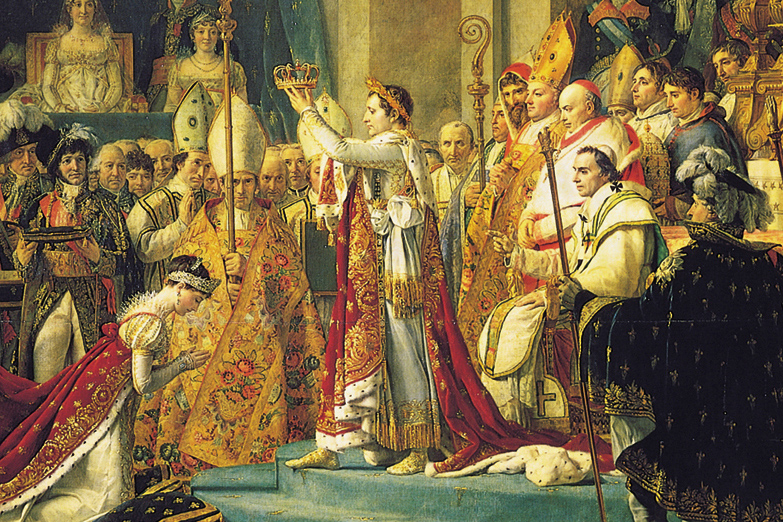
The vocabulary of a “Third Rome“, the “First” Rome being Rome in Italy and the “Second” Rome being Constantinople in the Byzantine Empire, is often used to convey such assertions of legitimate succession.
Several polities have claimed immediate continuity with the Roman Empire, using its name or a variation thereof as their own exclusive or non-exclusive self-description…The most enduring and significant claimants of continuation of the Roman Empire have been, in the East, the Ottoman Empire and Russian Empire, which both claimed succession of the Byzantine Empire after 1453; and in the West, the Holy Roman Empire from 800 to 1806…
The tracks of the horses out of classical Rome through the Middle Ages to the Third Rome are easy to spot. Step One – a powerful nation befriends the Jews, only to turn on them to destroy them.
Spain
White Horse / Peace: After the destruction of the Second Temple in 70 CE the largest group of Jewish exiles found shelter in the Iberian Peninsula. Tariq bin Ziyad took the Iberian peninsula from the Visigoth successors of the Romans in 711-720 AD, establishing the Western-most reach of Islamic territory.
The Muslim period in Spain is often described as a ‘golden age’ of learning where libraries, colleges, public baths were established and literature, poetry and architecture flourished. Both Muslims and non-Muslims made major contributions to this flowering of culture. Following the Islamic conquests of the 7th century, successive waves of Jewish refugees migrated from North Africa and the Middle East onto the Iberian Peninsula, attracted by the country’s reputation as a land of opportunity and rich potential.
Living with both Moslems and Christians, Sephardic (Hebrew for Spanish) Jews would develop as a unique branch of the Jewish people—multilingual, multitalented, and also deeply attached to a place where they lived for over a thousand years. Sephardic Jews were inspired to craft unique forms of self-expression in poetry, philosophy, science, and monumental legal codes by the co-existence of the three cultures in one territory and a veritable Golden Age of Jewish culture occurred, while Jews living in the Christian kingdoms faced persecution throughout the 14th century, leading to the 1391 pogroms,
Moses Maimonides, the foremost example of Judaic and classical traditions, harnessed Aristotelian thought to rabbinic Judaism. Scientific and philological study of the Hebrew Bible began,
Red Horse / War: Isabella and Ferdinand: The Making of the First World Power: The marriage of Isabella of Castile and Ferdinand of Aragon united two powerful kingdoms into the Kingdom of Spain, which was promptly expanded by conquering and expelling all Moslems from Granada in 1492, a feat no other Christian ruler had been able to accomplish in the last 700 years. Spain became a major voice on the European continent, and Isabella became one of the most formidable monarchs in Europe and the most powerful woman in the world. Overseas, “the first major colonial wars in North America were fought by Spanish conquistadors.”.
Black Horse / Destitution, Famine
The Alhambra Decree, which was not overturned until 1968, expelled the entire Jewish community, some 200,000 people during the Spanish Inquisition. In actions repeated 450 years later by Nazi Germany, the Jews were given only four months to leave the country, guaranteeing that the highly educated, accomplished and affluent Jews lost all their wealth to Spain.
The celebrated conquest of the New World by these monarch’s underwriting of Christopher Columbus wiped out massive numbers of the indigenous population through exposure to Old World diseases and harsh conditions of slavery. “About 10% of the landmass of the Americas had been farmed or under another human use when Columbus arrived. After being wiped out by contact with Europeans, landscapes returned to their natural jungle conditions with the added trees and vegetation absorbing so much more carbon from the atmosphere that it removed enough CO₂ to cool the entire planet, as seen in Antarctic ice cores.
Pale Horse / Death: During this period, severe winters and cold summers caused famines and rebellions from Europe to Japan. Our new data-driven best estimate is a death toll of 56 million by the beginning of the 1600s — 90 percent of the pre-Columbian Indigenous population and around 10 percent of the global population at the time.
Republican France
White Horse: France was a popular centre of Jewish learning in the Middle Ages, with many being very proud to be fully assimilated into French culture comprising an upscale subgroup. During the French Revolution in the late 18th century, France was the first European country to emancipate its Jewish population. In Austria, Chancellor Metternich wrote, “I fear that the Jews will believe (Napoleon) to be their promised Messiah”.
Red Horse: Napoleon Bonaparte was one of the greatest military strategists in history who led an increasingly admiring and loyal army to stunning victories in 23 years of warfare, defeating the Italians and the Austrians then menacing the growing British Empire in Egypt as he created an empire that stretched from the River Elbe in the north, down through Italy in the south, and from the Pyrenees to the Dalmatian coast. Greeted by the French population with adulation as a potential saviour, he led a short and bloodless coup against an unpopular regime. Establishing a Roman republican government recently resurrected by America in 1776, he became, like Caesar, first consul with dictatorial powers, then Emperor of the still existing Western Holy Roman Empire.
Black Horse: The Napoleonic Wars devastated Europe in both the short and long run. Throughout the 19th century, the monarchies of Europe, fearing what had happened in France at the end of the 18th century, became more and more suppressive with heavy taxation. Urban workers had no choice but to spend half of their income on food, which consisted mostly of bread and potatoes. In the years 1845 and 1846, a potato blight caused a subsistence crisis in Northern Europe. Harvests of rye in the Rhineland were 20% of previous levels…the cost of wheat more than doubled in France and Habsburg Italy. There were 400 French food riots during 1846 to 1847. Revolutions of 1848 remains the most widespread revolutionary wave in European history with over 50 countries were affected
Pale Horse: One estimate is that in the Napoleonic Wars alone, 5,000,000–7,000,000 died overall, including civilians. The number of deaths from such wide-spread devastation is incalculable. In Ireland alone, about one million people died from starvation or from typhus and other famine-related diseases, and about two million Irish emigrated from their families and country.
The British Empire
White Horse: William the Conqueror invited Jews from Normandy into England around 1070. Medieval Jews were considered to be the king’s property, and received certain protection, despite ruthless exploitation of their finances by the crown. However, their religious beliefs created suspicion that resulted in frequent persecution.
During the Reformation Henry VIII famously converted England to Protestantism. HIs heir, Queen Elizabeth I, made England the underdog champion against the giant Catholic Spanish Empire. during which privateers were granted open season for piracy on Spain’s treasure ships from the New World and raids acquiring Spanish holdings in the Caribbean. Ultimately establishing English colonies on the American continent, wealth from growing tobacco and sugar enabled England to reach for the biggest commercial prize of all. Once again playing on the lack of government resources in this small island country, a group of prominent merchants successfully petitioned Elizabeth I to grant them a monopoly over trade east of Africa, laying the foundations for what would eventually become the biggest corporation in the world – The East India Company, which turned from a trading monopoly into a de facto sovereign state conquering India – the Jewel in the Crown.
Red Horse: In 1290, due to growing antisemetism in part arising from the belief that the English had superceded the Jews as God’s Chosen People, King Edward I expelled all Jews from the Kingdom of England. The Seven Years War was the world war of the 18th century, spreading to every corner of the world where the great European colonial powers had a foothold.
Possessing the greatest navy in the world because of the East India Company, Britain gobbled up territories all over the world, from Canada, Australia, New Zealand and trading posts in South East Asia that would one day become some of the richest cities on the planet. to swathes of Africa.
Black Horse: Some 12.5 million Africans were taken from their homes and forced aboard slave ships that were destined for the New World. About 10.7 million people survived the horrors of the Middle Passage between 1526 and 1866, only to end up in bondage on sugar, rice, cotton, and tobacco plantations throughout the Americas and the Caribbean.
Prior to colonisation, India was one of the largest industrial producers in the world, exporting high-quality textiles to all corners of the globe. The British East India Company created a system of exorbitant taxes and internal duties that effectively de-industrialised and impoverished the country. (Conditions shared by the United States in the 21st century.)
Pale Horse: In 340 years between 1526 and 1866, over 2 million Africans died on board ship to the Americas. In just forty years from 1880 to 1920 at the height of British colonialism in just India, somewhere in the vicinity of 100 million people died in the largest political policy-induced mortality crises in human history Iarger than the combined number of deaths that occurred during all famines in the Soviet Union, Maoist China, North Korea, Pol Pot’s Cambodia, and Mengistu’s Ethiopia. Britain taxed the Indian population and then used the revenues to buy Indian products – indigo, grain, cotton, and opium – thus obtaining these goods for free and draining India of their revenue worth trillions of dollars in today’s money. (Match to current Neocolonialism impoverishing Africans and causing horrific famines in Somalia and Sudan.)
German Second Reich – Attempt To Replace The British Empire
White Horse: Otto von Bismarck, chancellor of United States of Germany, believed in a Christian monarchy that received its sanction ultimately from the deity and vigorously fought against the liberal revolution that swept through Europe in 1848. Beginning by unifying 39 independent Germanic states into the modern nation of Germany, he made the resulting German empire the most powerful in Europe through alliances with Austria-Hungary, Italy, and the Ottoman Empire against Russia and its allies France and Great Britain. To assimilate German Jews into the wider society at this time, the Jewish Reform Movement rejected the need to follow ritual, laws, and customs, liturgy was in German rather than Hebrew and omitted all references to a personal messiah who would restore Israel as a nation. In the Scramble for Africa, Germany managed to build the third-largest colonial empire at the time, after the British and the French.
Red Horse: When the heir to the Austro-Hungarian Empire was assassinated by a Serbian nationalist…Russia, Belgium, France, Great Britain and Serbia lined up against Austria-Hungary and Germany, and the first global modern war had begun.
Black Horse: In the catastrophic aftermath of losing the Great War hyperinflation from 1918 to 1923 wiped out the entire middle class, followed by the stock market crash of 1929 and the world-wide Great Depression that lasted until 1939.
Pale Horse: During its colonial expansion, between 1904-1908 the German Empire committed what is now considered the first genocide in the 20th century, against the Herero and Nama peoples of South West Africa, Between 24,000 and 100,000 Hereros and 10,000 Nama were killed by widespread death from starvation and dehydration from being driven into the desert, then by imprisonment in concentration camps, where the majority died of diseases, abuse, and exhaustion. World War I took the lives of more than 9 million soldiers; 21 million more were wounded. Civilian casualties numbered close to 10 million. One of the world’s deadliest epidemics, the Spanish flu epidemic of 1918, spread worldwide by massing troops, killed an estimated 20 to 50 million people.
Russian Communism – Eastern European Roman Empire
White Horse: In 1917 at the height of WWI, in hopes of eliminating their powerful rival Tsarist Russia from their eastern border, Germany supported Vladimir Lenin’s revolution. (Talk about out of the frying pan into the fire.) Lenin had devoted his life from a young age to replacing capitalism’s enrichment of the few by exploitation of the many workers with a classless society founded on Karl Marx and Frederich Engels’ philosophy of socialism – collective ownership and administration of the means of production and distribution of goods. In eager anticipation of salvation from war and poverty, so many workers flocked to Lenin’s leadership they were called the Bolsheviks, i.e. Majority Party in Tsar Nicholas II’s tepid democratic reforms through elected representatives to councils, called soviets.
Red Horse: Communes had been founded on these idealistic principles on a small scale, but Lenin’s grand scale of Communism required total war to rapidly and radically alter the Russian Empire. The Russian Revolution of 1917 was one of the most explosive political events of the 20th century. The violent revolution marked the end of the Roman-ov / “son of the Roman” dynasty and centuries of Russian Imperial rule and ushered in the Russian Civil War between the Whites / Royalists and Red / rival factions of Communists. The Communists proclaimed the right of self-determination, but in practice they imposed the dictatorship of the Russian Communist Party on them. Russia had ceded parts of Transcaucasia to the Ottoman Empire as part of the Treaty of Brest-Litovsk, but in 1920 the Azerbaijan government surrendered to the threat of invasion by the Red Army. Also in 1920 Communist Russia split Armenia with Turkey. In 1921 the Red Army invaded and conquered Georgia. A far territory east of Lake Baikal held by Japan was relinquished to Moscow in 1922.
Black Horse: Between 1914 and 1920 the number of working locomotives in Russia declined from more than 17,000 to fewer than 4,000, and the railways were devastated, making it impossible to distribute even those inadequate supplies that the government made available. In the cities, wooden houses were pulled down to serve as fuel, and urban workers—ostensibly the foundation of the Soviet government—began to vanish back to the countryside where life was only relatively less miserable.
Pale Horse: As many as 10 million lives were lost, the overwhelming majority of these were civilian casualties. Thousands of perceived opponents of the Bolsheviks were murdered by the Cheka,, foreunner of the KGB. Disease, particularly typhus, was rampant, and malnutrition was the natural consequence of Lenin’s widespread grain confiscations.
German Third Reich – Repeat Attempt To Replace The British Empire
White Horse: In the catastrophic aftermath of losing the Great War and Emperor Kaiser Wilhelm’s abdication, Adolf Hitler rose to power as one of the world’s most influential orators. His leadership skills were matched only by few in the world, unmatched oratory skills, brilliant strategic military expansions and economic growth plans. The severe effects that chemical weapons such as mustard gas and phosgene had on soldiers and civilians during World War I galvanized the Geneva Convention agreements, signed in 1925.
Red Horse: World War 2 is the biggest mass war known to man. Look at the pattern of actions in history, not what governments say! The Geneva Convention was not honored any more than the League of Nations restrictions on war. Until today “war tactics include siege, attacks on hospitals, sexual violence and the arbitrary execution of detainees… “shattering of the system of the Geneva Conventions”.
Black Horse: Europe became a “Savage Continent…a world without institutions. No governments. No school or universities. No access to any information. No banks. Money no longer has any worth. There are no shops, because no one has anything to sell. Law and order are virtually non-existent because there is no police force and no judiciary. Men with weapons roam the streets taking what they want. Women of all classes and ages prostitute themselves for food and protection. and vengeance killings were common, as was rape.” Millions of Europeans were displaced, without homes, families or friends. The Netflix series The Defeated does an excellent job of presenting these unimaginable circumstances.
Pale Horse: Some 75 million people died in World War II, including about 20 million military personnel and 40 million civilians, many of whom died because of deliberate genocide, massacres, mass-bombings, disease, and starvation. 80% of Soviet males born in 1923 didn’t survive World War II, the vast majority of an entire generation. Instead of increasing through birth rate, the Jewish population of Europe dropped from about 9.5 million in 1933 to about 3.5 million in 1950, from 60% percent of all Jews living in Europe to 51% of all Jews living in North and South America.


 Kingdom Come