“At the mouth of two or three witnesses shall every word be established.”
While current eschatology focuses on Daniel’s prophecies of the end times, they are in fact the required second witness to the earliest prophesy of Israel’s latter days given before Israel had even entered the Promised Land.
From Numbers 22-25: pagan priest-king Balak of Moab was so disconnected from his Hebrew relatives – and their God YHVH – dating back to Lot, that despite having a kinship basis for an alliance, in contrast with the Gibeonites who could only act on a basis of faith in their miraculous God of goodness, he didn’t send an emissary to inquire about an alliance, but instead chose to attempt to wipe them out.
“Come now therefore, I pray thee, curse me this people…: for I wot that he whom thou blessest is blessed, and he whom thou cursest is cursed.”
“Balaam the son of Beor hath said, and the man whose eyes are open hath said…which heard the words of God, which saw the vision of the Almighty, falling into a trance, but having his eyes open…
Pagan priest-king Balak of Moab thought he understood exactly what Balaam meant.
The pineal gland is revered as a metaphysical organ of perception that transcends physical sight.
Across cultures, this gland has been seen as a gateway to inner knowing. The ancient Egyptians linked it to the Eye of Horus, a symbol of divine vision and protection. Hindu traditions associate it with the Ajna chakra, the center of intuition and spiritual insight…This is not superstition—it’s a forgotten instinct. And when we nourish it, honor it, and listen to it, we begin to reclaim a way of seeing that is ancient, embodied, and profoundly human.
Ahh, the fundamental humanism underlying all paganism – WE can control the spiritual when we contract with the spirits. Which is why Balak didn’t just ask Balaam for secret intelligence but for sabotage of his enemy. This concept is the plot of the movie The Devil’s Advocate, in which the devil states that he is a humanist.
But Balaam is successful in his predictions because he not a humanist making deals with demanding and deceptive gods, he is he is the human medium for the Most High God. And he explains this to Balak.
“And Balaam said…I will advertise thee [not attempt to control] what this people shall do to thy people in the latter days.”
“Agag” is treated in scripture as the title of the ruler of the Amalekites, in place of “King”, like “Pharoah” in Egypt. Since it is not a Hebrew name, we don’t find a Hebrew translation, but we can use a cuneiform translation of this time period:
A-gag = Powerful Arrowhead.
Ancient bows and arrows represent a pivotal technological advancement in early human history. These weapons also shaped the social dynamics and cultural practices of ancient civilizations as they symbolized power, skill, and even divinity, serving as a bridge between the physical and spiritual realms.
Arrowhead is still a major military term. Its meaning depends heavily on the context in which it’s used, typically referring to formations, operations, or specific military units and decorations. The term’s evocative nature, suggesting direction, leadership, and penetrating force, makes it a popular choice for designating strategic elements.
Let’s pay attention to details here. Balak asked for protection of his people the Moabites and Balaam seems to go off topic when he replies with information about another tribe, the Amalekites.
We can’t just assume that there was a confederation between the two, although there likely was during war. We need to draw our conclusions from scripture.
The Amalekites were an early breed of hybrid giants who successfully fought the Canaanite giants then Nimrod’s giants for a foothold in YHVH’s territory during Abraham’s reign as Melchizedek.
Only two generations later, i.e. when there was still genetic expression of giant traits especially when inbreed through incestuous couplings, Abraham’s grandson
- Esau bred with Canaanite / hybrid women,
- and his son Eliphaz – breeding with a concubine –
- specifically named his son Amalek, obviously referencing the giant race.
- and his son Eliphaz – breeding with a concubine –
As detailed in the relevant post, the reference to a concubine / woman used to produce desired children and the identification of Esau’s grandson by a giant name can only indicate continued incestuous giant breeding practices. Expectation that this hybrid condition has already been signed, sealed and delivered in scripture could explain why it is not mentioned, only the genocidal warrior tactics, when, making a major issue of this, the LORD swore perpetual war against Amalek and later commanded Israel to “blot out the memory of Amalek from under heaven”
So who is the equivalent to “Agag king of the Amalekites” in the latter days – our days?
For Covenant and Dispensationalist Christians a geographical match doesn’t work, since it places the king of the Amalekites squarely in Israel, which they consider to be the domain of “this people [Israel]” and “his king.”
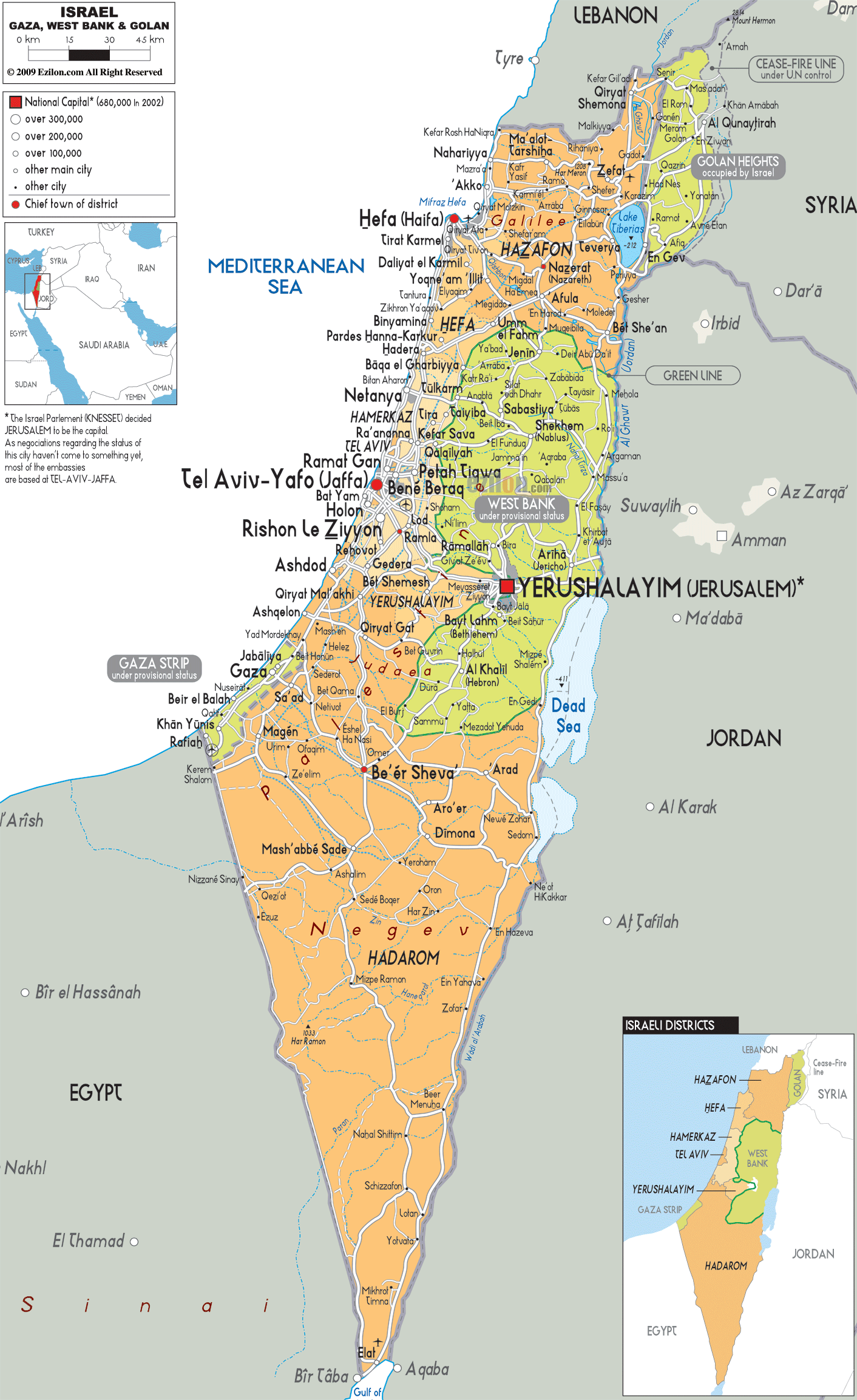
For those of us who apply the same consistency, reliability, continuity and intentionality to Holy Scripture as we do to any literary masterpiece, we recognize the rivalry for the same piece of land that was occurring during the Exodus between the Hebrews’ Melchizedek and Agag of the Amalekites.
- his kingdom shall be exalted...
- He [Melchizedek, already during the Exodus as they had heard and feared] couched [in ambush]
- he lay down as a lion, and
- as a great lion: who shall stir him up?
- I shall see him, [future tense]
- but not now:
- I shall behold him,
- but not nigh / soon:
- there shall come a Star [God’s Representative / Priest out of Jacob, and a Sceptre / King]
- shall rise out of Israel,
- and smite the corners of Moab and destroy all the children of Sheth.” (Numbers 24)
So Balak gets his answer and we’re left with a new one.
Who is this “Sheth”? We can deduce in context that he is another priest-king like Balak and Agag whose children / followers are doomed to destruction by Melchizedek in the latter days.
It is this writer’s conviction that nothing in scripture is random, therefore we can discover the identity of this particular “father Sheth” by comparing the original ancestor Seth’s three genealogical records.
- Adam. Seth, Enos, Cainan, Mahalaleel, Jared, Enoch, Methuselah, Lamech, Noah (Genesis 5)
- Adam, Sheth, Enosh, Kenan, Mahalaleel, Jered, Henoch, Methuselah, Lamech, Noah (I Chronicles 1)
- Adam, Seth, Enos, Cainan, Maleleel, Jared, Enoch, Mathusala, Lamech, Noe (Luke 3)
Note that the Greek version in Luke 3 leaves out an “h” in two names – Maleleel and Mathusala – which can be accounted for by language differences, so we can set that version of “Seth” asid e from consideration and focus on I Chronicles which was written the same Hebrew language as Genesis, yet there are added h’s in names in the Chronicles version – not only in “Sheth”, the very person under investigation, as well as his son Enos-Enosh.
Chronicles was most likely written during the time of Ezra or Nehemiah, while the Jews were dispersed throughout Persia, Indications throughout the book reveal the unknown author(s)’s reliance on a variety of source materials—“annals,” “books,” and “records”—which are cited as dependable historical documentation whether official or unofficial documents.
So let’s compare notes with the book of Ezra.
“Thus saith Cyrus king of Persia…Who is there among you of all his people? his God be with him, and let him go up to Jerusalem…and build the house of the LORD God of Israel, (he is the God,)” (Ezra 1:2-3)
“these are the children [disciples] of the province [of Judea] that went up out of the captivity [which in contrast stayed in the secular comfort and prosperity of the empire of Persia]…Jeshua (Ezra 2:1-2)
And here is another change in spelling – from the Hebrew Joshua. This can be accounted for by the use of both Hebrew and Aramaic records in writing Ezra.
“Now when the adversaries of Judah and Benjamin heard that the children of the captivity builded the temple unto the LORD God of Israel; Then they…said unto them, Let us build with you: for we seek your God, as ye do;
Only half true! They had a blended version, like Constantine’s Christianity, incorporating the false gods with enough of the Son of God to convince the ignorant of its saving power.
“They feared the LORD, and served their own gods, after the manner of the nations whom they carried away from thence. (II Kings 17:33)
“But Zerubbabel, and Jeshua, and the rest of the chief of the fathers of Israel, said unto them, Ye have nothing to do with us to build an house unto our God;
Then the people of the land…hired counsellors against them, to frustrate their purpose, all the days of Cyrus king of Persia, even until the reign of…Artaxerxes…
and the writing of the letter was written in the Syrian / Aramean tongue, and interpreted in the Syrian / Aramean tongue against Jerusalem to Artaxerxes the king…”
Aramaic is a Semitic language with roots dating back over 3,000 years. It was the lingua franca of the ancient Near East, spoken by empires such as the Assyrians, Babylonians, and Persians. Despite the rise of Arabic and other languages in the region, Aramaic has endured to this day.
So the use of Aramaic texts in compiling Chronicles could explain the changed spelling of “Jeshua” instead of “Joshua”, and perhaps the change from “Seth” to “Sheth” – made available even to the latter days by the continuation of the Aramaic language over time.
But that doesn’t make sense prophetically. We should follow this thread further.
“Then sent the king an answer…Give ye now commandment to cause these men to cease, and that this city be not builded, until another commandment shall be given from me…
So it ceased unto the second year of the reign of Darius king of Persia. Then the prophets, Haggai the prophet, and Zechariah the son of Iddo, prophesied unto the Jews that were in Judah and Jerusalem in the name of the God of Israel, even unto them….saying, I am with you, saith the LORD. And…
- Zerubbabel…governor of Judah, and…
- Joshua…[Hebrew spelling] the high priest, and
…all the remnant of the people…came and did work in the house of the LORD of hosts, their God,..in the second year of Darius the king.” (Ezra 4. Haggai 1:13-15)
And once again – opposition by a rival religious faction.
“At the same time came to them Tatnai, governor on this side the river, and Sheth-arboznai and their companions, and said thus unto them, Who hath commanded you to build this house, and to make up this wall?…
The copy of the letter that
- Tatnai, governor – King’s representative on this side the [Euphrates] river,
- and Sheth-arboznai – a priest in the sacral kingdom certainly, as this was a religious matter
- and his companions the Apharsachites / “Young Ones”, “lesser” authorities, i.e. students…sent unto Darius the king:” (Ezra 5:5-6)
Whether pronounced “Seth” or “Sheth”, the word is the same – “Substitute”.
This defines the secret identity of “Sheth” in the prophecy spoken 800 years earlier. He is the high priest of the “substitute” religion to YHVH’s.
Strong’s Concordance doesn’t define the entire name “Sheth-ar-boznai”, very likely because it is Aramaic instead of Hebrew, so it is up to us to parse it out through the similarities between the two languages.
After separating out the obvious “Sheth’ and “ar” being a connector in the sense “of”, the rest of the name “boznai” is found to be a compilation of a multitude of meanings as follows:
- “Whose eyes are open” – mimicking exactly God’s prophet Balaam (Numbers 24:3)
- “an enemy male defined as old enough to direct his piss against a wall” (I Kings 21:21)
- “secret parts” (I Samel 5:9)
- mostly “little chambers” used for mystery religious rites (Ezekiel 8:7-12)
This reveals the identity of the children of / disciples of the absolute authority Sheth as the followers of a mystery blended religion that incorporates the worship of Creator YHVH without actually obeying his laws.
Applied to our current culture, this defines denominations of Christianity accepting salvation from hell but not from sin in this life, forms of Judaism denying YHVH, and Dispensationalists smugly superior to ordinary born-again Christians because they have the mysteries of the end times revealed in the footnotes of their Scofield Reference Bible.
As the signs of the times loom into view, what can we draw from Balaam’s prophecy of the “latter days” to current secular lsraeli-American Christian Nationalism alliance instigating war in the Middle East for human power and profit mindless of God’s will?
“I shall see him, but not now: I shall behold him, but not nigh: there shall come a Star out of Jacob, and a Sceptre shall rise out of Israel, and shall…destroy all the children / followers of Sheth / substitute Melchizedek..
Alas, who shall live when God doeth this!” (Numbers 24:22-23)


 Kingdom Come