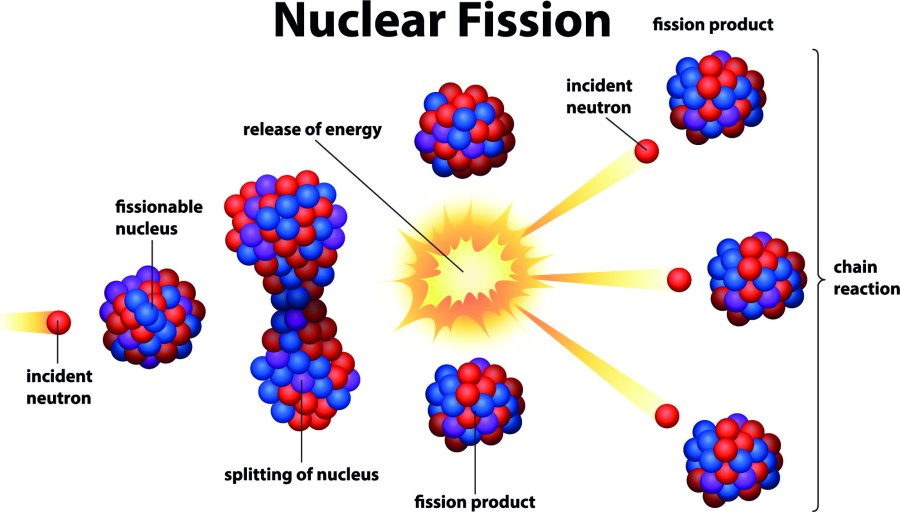
In nuclear fission the nucleus of an atom breaks up into two lighter nuclei, releasing the huge amount of energy that had bound the subatomic particles together, and emitting several neutrons. Like billiard balls, these strike nearby atoms creating a chain reaction in which every atom in the involved mass undergoes fission, releasing an enormous of energy. This how the atomic bomb works.
There is also a kind of science to a couple staying together, or breaking into two separate, lesser bodies with a loss of life energy.
Chemistry is the inexplicable, ineffable magic that happens when two people are profoundly attracted to each other, magnetized by each other’s voice, smell, body and gestures and infused by a feeling that one has hit the equivalent of the mate lottery and stumbled upon the right fit.
Chemistry opens you to receive another being; you grow to enlarge yourself beyond what you would otherwise be, know and perceive…We don’t feel that with just anyone.
“attraction hormones” such as serotonin, dopamine, and norepinephrine…are the hormones responsible for giving you those feelings of euphoria when you’re really into someone.
On the down side, when all your feel-good hormones are spiked, there’s a tendency to become irrational.
“When your neurotransmitters are destabilized by new romantic love, your mood becomes unsteady,” she says. “You don’t always make the most wise decisions.”
That’s an understatement.
Crystal meth provides a short, intense high that leads to euphoria, a rush of energy, and a boost in confidence. Many argue that crystal meth is the most addictive drug in the world since crystal meth is three times as powerful as cocaine. Meth also leads to dependency faster than any other substance. Crystal meth is notorious as the most difficult drug to quit. Crystal meth releases more dopamine in the brain compared to any other drug…This is how crystal meth addiction develops.
Cocaine is another addictive stimulant drug. In its crystal form, it is known as crack cocaine…When you smoke crack cocaine, the drug immediately crosses from the lungs into the bloodstream…Snorted cocaine, in contrast, takes a slower route throughout the body. This provides a less intense and longer-lasting high.
Crack cocaine users become easily addicted to the drug due to its fast onset and immediate and intense euphoric high [resulting from]…a higher production of dopamine in the brain. This substance, therefore, can produce stronger feelings of pleasure and positive mood.
The human body has a built-in safety valve to prevent the destructive effects of excessive stimulation, called homeostasis.

Any auto-regulating process that a biological system uses to maintain stability while continuously adjusting to surrounding conditions…These adjustments made by the body are necessary for survival. When the process of homeostasis is successful, life will continue. When it is unsuccessful, imbalance can ensue and can lead to death.
The neurochemical balance is achieved through two complementary systems – the sympathetic / stimulant and neurosympathic / calming.

My physiology professor summed up the sexual orgasm’s involvement of both components of the nervous system as P & S memorialized as Point and Shoot. Point / Parasympathetic stimulation of the sex response with upraising of the sex organs both male and female, and Shoot / Sympathetic discharge of fluids in both male and female and release of tension back to a state of calm.
A sexual relationship based solely on dopamine / stimulant production can no more remain functional than an addict’s relationship with crack.
Fortunately, the human body provides the treatment. Balanced chemistry is a couple’s longevity drug cocktail – it motivates and enables a couple to go the distance when the arduous work of mature love begins.
Oxytocin, a hormone that’s associated with relationship-building, trust, empathy, bonding, well-being, lowered anxiety and stress.
Oxytocin is a natural hormone that stimulates contractions of the female uterus and breast for birth and lactation, and of the male penis in ejaculation.
Increasing evidence supports a key role of Oxytocin (OT) as a modulator of social relationships in mammals. OT has been reported to promote social approach, pair bonding and copulation…one of the main mediators of the development of attachment in childhood, pair bonding, as well as to relating social signals with cognition, behaviours and reward…proper development of the OT…may be critically impaired by a lack of the essential care in young children…Not surprisingly, comforting physical contact, familiar smells and other socially pleasant sensory experiences are capable of raising the levels of OT.
The OT system and some of its parameters show some sex-related differences. It is higher in females.
Oxytocin, a hormone involved in mother/infant bonding, also plays an important role in the initial stages of our romantic attachments. At a biological level, the process of becoming attached to a new partner may be similar to the process of bonding with a new child.
Couples with higher levels of oxytocin exhibited more affection…such as touching and eye-gazing. Such intimate behaviors may increase oxytocin levels and, in turn, increase a couple’s emotional involvement in the relationship…
Elevated levels of oxytocin also have been seen in new parents, although the levels were not as high as those seen in couples in this study, suggesting the initial period of romantic love may induce the most intense oxytocin activity…
The people in new relationships had oxytocin levels that averaged nearly double those of singles. For couples who stayed together, oxytocin levels remained stable, i.e. higher than those of singles. Six months after beginning a new relationship, the couples with the higher levels of oxytocin tended to still be together, while the others had split.
There’s a lot of empathy in relationships where couples are deeply bonded together. “When they hurt, you hurt,” therapist Dr. Tracey M. Phillips, tells Bustle. “Sometimes, this means feeling the actual physical pain that your partner feels.” If that sounds crazy, it’s not too far off. A 2004 study published in the journal Science found that we are hardwired to process pain when a loved one is hurt. Researchers conducted a study of 16 heterosexual couples and measured one partner’s brain activity while the other received a short jolt of pain. When one person was feeling pain, brain activity in their partner was triggered enough to elicit an empathetic response.
We can conclude that the reason researchers only studied heterosexual couples is because women are needed to contribute the critical mass amount of oxytocin to the chemical reaction of bonding.
Without bonding there is no opportunity to build gradients of trust proven over privately shared time together, providing essential safety assurance that, despite differences, you are, at a minimum, listened to without judgment, better yet, find support and encouragement in your maturation process, and best and rarest of all, find a partner in mutual growth and development.
- physical – expressed most intensely through sex
- emotional – revealing one’s fears, pains, and doubts
- mental or intellectual – dialoging different ideas, opinions, and life perspectives, intellectually challenging each other and being open to considering, the other person’s ideas, showing mutual respect, even when you have differing views with the intention of learning from each other more than debating opinions.
- spiritual – emerging from one’s deepest safe haven of existential conviction to contemplate new possibilities on the meaning of life and one’s interconnection with all of space-time.
The Problem Of Sexual Sameness
A Clinical Understanding Of Gay Infidelity
Gay relationships are typically burdened with each man’s same-sex defensive detachment, and their need to compensate for that same-sex detachment. Therefore the relationship will often take the form of an unrealistic idealization of the other person as an “image.” In pursuing the other man as a representation the masculine introject that he himself lacks, many gay men either develop a self-denigrating dependency on the partner, or they become disillusioned because they discover “he has the same deficit I have.”
As he did in relationship with his father, the homosexual man fails to fully and accurately perceive the other man. His same-sex ambivalence and defensive detachment mitigate against trust and intimacy. When he becomes disillusioned, he will often continually set his hopes on the possibility of yet another, more satisfying partner.
In seeking out and sexualizing relationships with other males, the homosexual is attempting to integrate a lost part of himself. Because this attraction emerges out of a deficit, he is not completely free to love. He often perceives other men in terms of what they can do to fulfill his deficit. Thus, a giving of the self may seem like more of a diminishment than a self-enhancement.
A man who is depressed may gain a temporary sense of mastery through anonymous sex because of its excitement, intensity, even danger – followed by sexual release and an immediate reduction of tension. Later he is likely to feel disgusted, remorseful, and out of control. He feels regretful, regains control and feels all right again. But when there is nothing to “feed” that healthy state, it will be a matter of time until he gets depressed, feels powerless and out of touch with himself, and seeks anonymous sex again as a short-term solution to getting back in touch and feeling in control.
Often a homosexual client will report seeking anonymous sex following an incident in which he felt ignored or slighted by another male. Feeling shamed and victimized, he acts out sexually as a way of reasserting himself and getting something back he feels was taken from him. Once again, he feels guilty and has to repent or make amends. Many gay men become addicted not just to the sexual release, but to the entire compulsive, life-dominating cycle– if not through overt behavior, then through preoccupation and fantasy.
In these repetitive, compulsive, and impersonal sexual behaviors, we see a focused engagement with the object–with a desire for an intense relationship, but at the same time, a resistance toward genuine intimacy. Hoffman (1968) describes the “sex fetishization” found in gay life (p. 168), and Gottlieb (1977) points out the strong element of sexual fantasy that has become institutionalized in gay culture. Masters and Johnson (1979) also found that those fantasies tend to be more violent than those of heterosexuals.


 Kingdom Come