“because thou sufferest that woman Jezebel, which calleth herself a prophetess, to teach and to seduce my servants to commit fornication, and to eat things sacrificed unto idols. And I gave her space to repent of her fornication; and she repented not. Behold, I will cast her into a bed, and them that commit adultery with her into great tribulation, except they repent of their deeds. And I will kill her children with death; and all the churches shall know that I am he which searcheth the reins and hearts: and I will give unto every one of you according to your works.” (Revelation 2:20-23)
Prior to 1633, as observed in the 1611 King James Bible, the name “Jezebel” did not include the letter or pronunciation of “J”
Like the name “Jesus“, in the Latin superscription INRI – Jesus of Nazareth, Rex/King of the Jews – her name was spelled with an “I”.
Isabella.
This most famous of Spanish queens is the virtual reincarnation of the Sidonian Jezebel, who could very well have been her ancestor as the Phoenicians settled the far shores of the Mediterranean. The blood evidence they both left behind certainly matches.
Born as she was in 1451 when the Church reigned supreme, Isabella’s parents would have deliberately named her after a Bible character. And that tells us everything about her family.
“And unto the angel of the church in Thyatira write…thou sufferest that woman Jezebel, which calleth herself a prophetess, to teach and to seduce my servants to commit fornication…the depths of Satan…hold fast till I come. And he that overcometh, and keepeth MY works unto the end, to him will I [not HER] give power over the nations.” (Revelation 2:18-26)
After the fall of the Western Roman Empire in the fifth century, a power vacuum developed in Iberia. It was quickly filled by the fierce warrior-like Visigoths…the most influential cultural impact they had was their adoption of Christianity.
The importance of this decision cannot be understated. The new religion imbued its Iberian adherents with a fiery sense of purpose, an attribute that would lead them to greatness in later centuries, as Christianity would go on to play an important role in the formation of the future Kingdom of Spain and its empire.
In the year 711, warriors of the new religion of Islam surged into the Iberian Peninsula…One by one the cities of Iberia fell under the sway of the Muslim forces. The Christian kings of Iberia were pushed back to the Pyrenees…the Muslim capital of Cordoba…became the third most important mosque in the world after those in Mecca and Jerusalem…
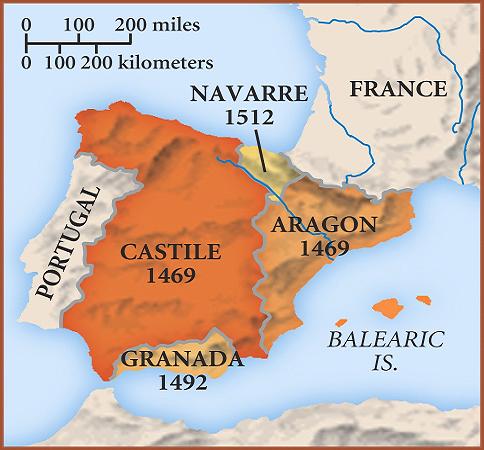 Thus began a long period in Iberian history known as the Reconquista, incessant wars bleeding each side without benefit to either, which would last for over 700 years.
And that is where Isabella would play a vital role. A powerful ruler in her own right as the queen of the largest kingdom in Iberia, through a marriage alliance with the king of (smaller) Aragon she created a Christian superpower not only capable of retaking Granada but surging into the world beyond. The birth of the nation of Spain would shape the destiny of the world.
Ferdinand and Isabella: The Making of the First World Power
Isabella is famous for being “Europe’s first great queen“. The similarities between the two Jezebels are striking.
- Forged a powerful military alliance through marriage with a neighboring kingdom.
- Jeroboam the son of Nebat…took to wife Jezebel the daughter of Ethbaal king of the Zidonians, and went and served Baal, and worshipped him.” (I Kings 16:31)
- Establishment of religious-empowered royal authority can be seen as one of the crucial steps toward the creation of a strong nation-states.
- “the prophets of Baal four hundred and fifty, and the prophets of the groves four hundred…eat at Jezebel’s table.” (I Kings 18:13,19)
- Isabella established a strong European nation-state through the creation of “the Holy Brotherhood”, used to keep the nobles in check.
- Eliminated any religious opposition
- “Jezebel slew the prophets of the LORD…Then said Elijah unto the people, I, even I only, remain a prophet of the Lord…Jezebel sent a messenger unto Elijah, saying, So let the gods do to me, and more also, if I make not thy life as the life of one of them by to morrow about this time. And when he saw that, he arose, and went for his life” (I Kings 18:13,22, 19:3-4)
- While inquisitions swept all of Christian Europe, the Spanish Inquisition was the most infamous of all religious persecutions.
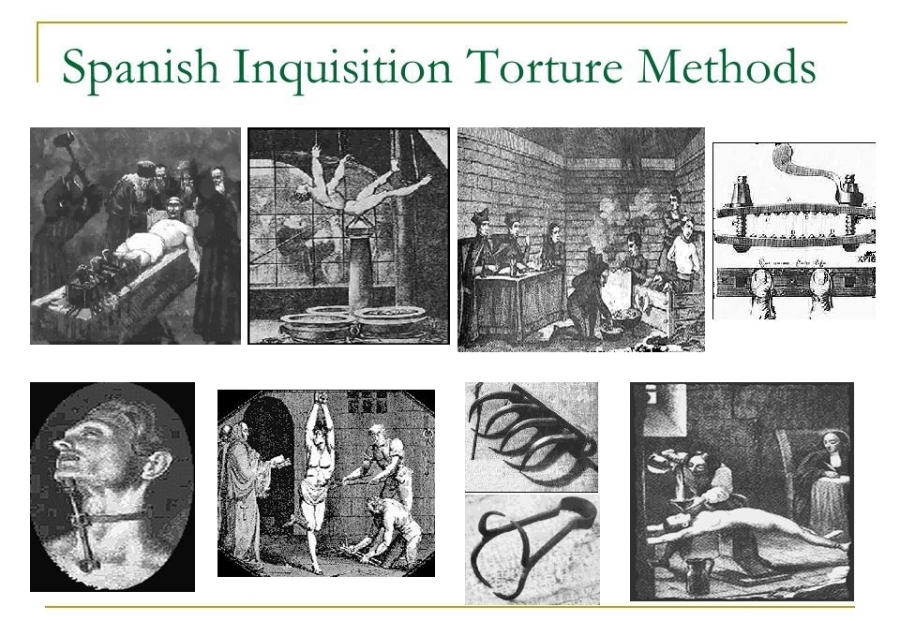
“Put your feet to the fire” and “a slow death” were not figures of speech during the infamous Inquisition under Torquemada which ferreted out by torture and executed by cruel means any “heretic”.
During the sixteenth century, Protestant reformers bore the brunt of the Inquisition. Curiously, though, a large percentage of Protestants were of Jewish origin…
many true and faithful Christians, because of the testimony of enemies, rivals, slaves and other low people—and still less appropriate—without tests of any kind, have been locked up in secular prisons, tortured and condemned like relapsed heretics, deprived of their goods and properties, and given over to the secular arm to be executed, at great danger to their souls, giving a pernicious example and causing scandal to many.
Torture was always a means to obtain the confession of the accused, not a punishment itself. It was applied without distinction of sex or age, including children and the aged.
The methods of torture most used by the Inquisition were garrucha, toca and the potro. The application of the garrucha, also known as the strappado, consisted of suspending the criminal from the ceiling by a pulley with weights tied to the ankles, with a series of lifts and drops, during which arms and legs suffered violent pulls and were sometimes dislocated.[26]. The toca, also called tortura del agua, consisted of introducing a cloth into the mouth of the victim, and forcing them to ingest water spilled from a jar so that they had impression of drowning.[27]The potro, the rack, was the instrument of torture used most frequently.[28] The Spanish Chair was a device used to hold the victim while the soles of their feet were roasted.
Other severe punishments existed, among them long sentences to jail or the galleys, and the confiscation of all their property.
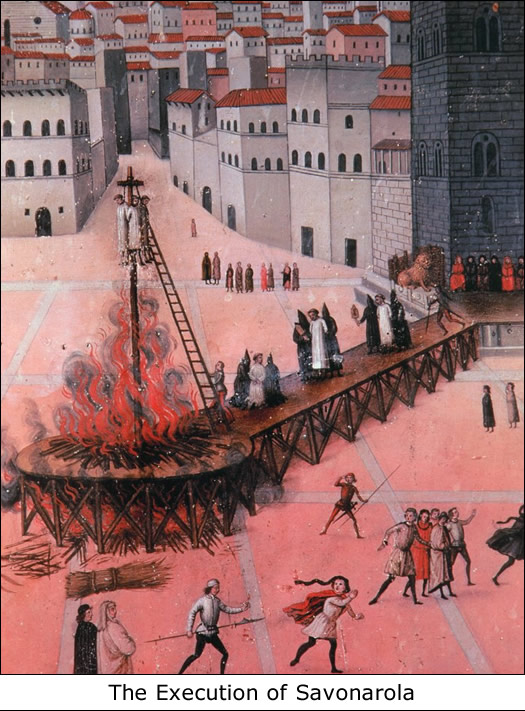
The most serious punishment was…burning at the stake.
The condemned had to participate in the ceremony of an auto de fe / act of faith that solemnized his return to the Church (in most cases), or punishment as an impenitent heretic. The auto de fe eventually became a baroque spectacle, with staging meticulously calculated to cause the greatest effect among the spectators.
The autos were conducted in a large public space (in the largest plaza of the city, frequently), generally on holidays. The rituals related to the auto began the previous night (the “procession of the Green Cross”) and lasted the whole day sometimes. The auto de fe frequently was taken to the canvas by painters: one of the better known examples is the painting by Francesco Rizzi held by the Prado Museum in Madrid and which represents the auto celebrated in the Plaza Mayor of Madrid on June 30, 1680.

Those familiar with the fictional Cercei Lannister on Game of Thrones should recognize the same power-grabbing actions in Isabella’s reign. Watching this program triggers a gut horror reaction that is more informing than simply reading words for which we have no visual or emotional context from our own limited experience.
Cercei was ranked No. 1 of “30 Best Game of Thrones Villains” by Rolling Stone and described as the “most dangerous human being in Westeros“. This is quite a tribute if you consider that Ramsey Bolton is only ranked No. 4, despite his characterization as “‘pure evil ‘…basically Ted Bundy…the sort of irredeemable monster you usually read about in books on serial killers.
The Convention against Torture and Other Cruel, Inhuman or Degrading Treatment of Punishment (The Torture Convention)…adopted in 1984…became the first confirmed and binding agreement toward eradicating torture…but some of the most damaging acts of torture have been performed by our country’s own CIA.
Isabella is famous, with her husband Ferdinand, for funding Christopher Columbus’ exploratory voyage to the new world in 1492. This single maritime action, like the Phoenician’s settlement of Carthage, driven by a combination of politics and religion so characteristic of the Sidonian’s practices, shot Spain to stratospheric heights of wealth and power.
Columbus’ expedition was funded by seizing, like the Nazis, property privately owned by individual Jews and Jewish families. The more conservative estimates of Nazi plunder begin at $US 8 billion, the vast majority never returned nor compensation made.
In the same month (March) in which their Majesties [Ferdinand and Isabella] issued the edict that all Jews should be driven out of the kingdom and its territories, in the same month they gave me the order to undertake with sufficient men my expedition of discovery to the Indies.
So begins Christopher Columbus’s diary. The expulsion that Columbus refers to was so cataclysmic an event that ever since, the date 1492 has been almost as important in Jewish history as in American history. On July 30 of that year, the entire Jewish community, some 200,000 people, were expelled from Spain.
Tens of thousands of refugees died while trying to reach safety. In some instances, Spanish ship captains charged Jewish passengers exorbitant sums, then dumped them overboard in the middle of the ocean. In the last days before the expulsion, rumors spread throughout Spain that the fleeing refugees had swallowed gold and diamonds, and many Jews were knifed to death by brigands hoping to find treasures in their stomachs.
The Jews’ expulsion had been the pet project of the Spanish Inquisition, headed by Father Tomas de Torquemada. Torquemada believed that as long as the Jews remained in Spain, they would influence the tens of thousands of recent Jewish converts to Christianity to continue practicing Judaism. The short time span was a great boon to the rest of Spain, as the Jews were forced to liquidate their homes and businesses at absurdly low prices. Throughout those frantic months, Dominican priests actively encouraged Jews to convert to Christianity.
Specifically because their earlier sojourn in that country had been so happy, the Jews regarded the expulsion as a terrible betrayal, and have remembered it ever since with particular bitterness. Of the dozens of expulsions directed against Jews throughout their history, the one from Spain remains the most infamous. The Alhambra Decree was not officially overturned until December 16, 1968, at the Second Vatican Council.
The reign of Queen Isabella of Spain was one of the most consequential in world history…She is the founder of not only the Kingdom of Spain, but also, the Spanish Overseas Empire.
Spain would go on to acquire territory in both Central and South America, Italy, and the Netherlands. Her actions shaped the history of two continents, and her legacy still endures today. Wherever, in these distant lands, the Spanish language is spoken, wherever the Catholic faith is practiced, we have Isabella to thank.
Following the standard practice of strengthening the empire through marriage alliances, their daughter, Joanna, married Philip the Handsome of the Habsburgs, which united Spain with the powerful Habsburg dynasty. This placed their grandson, Charles V, on the thrones of both Spain and the Holy Roman Empire, securing Spain’s prominence in European affairs. They also forged a critical alliance with England through the marriage of their daughter Catherine to King Henry VIII.
“Spain enjoyed a cultural golden age in the sixteenth and seventeenth centuries when silver and gold from American mines increasingly financed a long series of European and North African wars.”
In order to pay for this siphoning of wealth, “The population of the Native American population in Mexico declined by an estimated 90% (reduced to 1–2.5 million people) by the early 17th century.
In Peru, the indigenous Amerindian pre-contact population of around 6.5 million declined to 1 million by the early 17th century. The overwhelming cause of the decline in both Mexico and Peru was infectious diseases, such as smallpox and measles, although the brutality of the Encomienda [forced labor like that in the Nazi concentration camps] also played a significant part in the population decline.
Beginning in 1514 Spanish conquerors adopted “the Requirement,” an ultimatum in which Indians were forced to accept “the Church as the Ruler and Superior of the whole world” or face persecution. If Indians did not immediately comply, the Requirement warned them:
We shall take you and your wives and your children, and shall make slaves of them, and as such shall sell and dispose of them as their Highnesses may command; and we shall take away your goods, and shall do all the harm and damage that we can.”
Columbus was forthcoming that he should be remembered “as a captain who for such a long time up to this day has borne arms without laying them aside for an hour.”
Columbus’s impact on the area that would become the United States was incredible. After his reports, every European power sent explorers, and an explosion of European colonization.
Columbus helped set the precedent for the genocidal campaigns that followed his voyages. When colonists of what would become the United States arrived, they followed Columbus’s lead. The United States was built on land cleared of indigenous people by war and disease that were first initiated by Columbus.
Columbus also helped to establish the slave trade that would later dominate the southern United States. Later colonists and explorers followed his example. Between 1525 and 1866, in the entire history of the slave trade to the New World, 12.5 million Africans were shipped to the New World.


 Kingdom Come