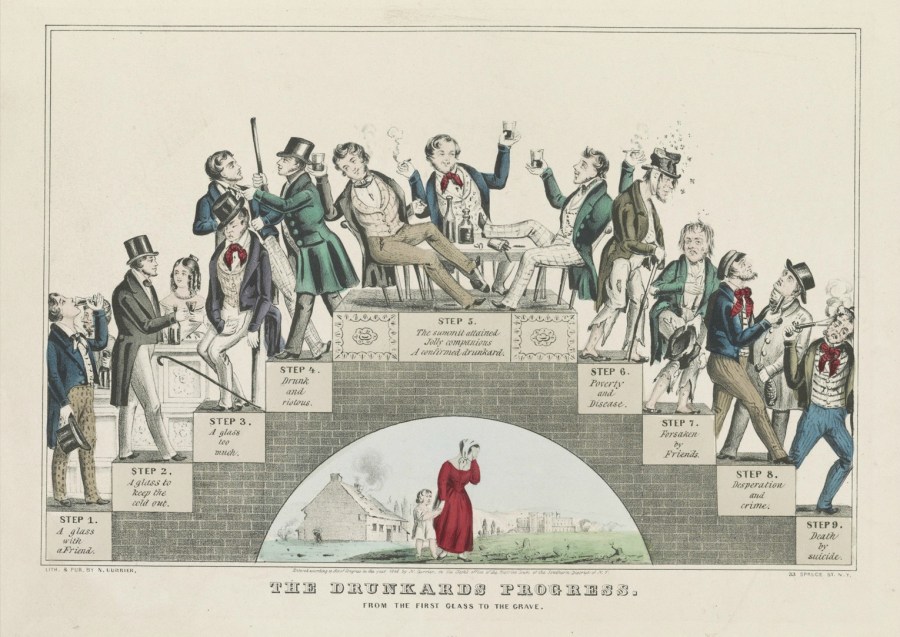
“God hath given them the spirit of slumber, eyes that they should not see, and ears tht they should not hear;) unto this day.” (Romans 11:8)
Dissing the Great Awakening revivals is certainly trodding on Christian Fundamentalists’ holy ground. But how many American preachers recognize that they inflame war exactly like fundamentalist jihadist Imams?
Each lasted about 100 years and consist of three phases, each about a generation long.
- Technological advances outpace the existing ethical capacity to cope.
- Religious revival brings changes in church beliefs and practice.
- Political reform is effected by a coalition of church and state through shared commitment to improve society.
- With essential mass support through churches’ endorsement, the state expands though war.
Exactly like jihadist Imams.
Each of the Awakenings serves to bring together the purportedly inviolable separation of Church and State written into the American Constitution through a Hegelian dialect: “the way in which two very different forces or factors work together, and the way in which their differences are resolved.”
- Something happens – a thesis / problem,
- which provokes a response – an antithesis / reaction,
- both ideas are then melded together – a synthesis / solution.
This is also called “problem, reaction, solution.”
The First Great Awakening Sets Up The Revolutionary War 1730-1830
Problem: The Enlightenment emerged out of Renaissance humanism, the Scientific Revolution and the work of Francis Bacon and Isaac Newton, culminating in the 1789 outbreak of the French Revolution. Emphasizing the replacement of religious orthodoxy, the Enlightenment broadcast new ideas of the sovereignty of reason and primacy of the scientific method through the evidence of the senses instead of religious revelation, the priority of the pursuit of happiness over religious duty, and new ideals of liberty and separation of church and state. The Enlightenment was converting many people to atheism, Deism, Unitarianism and Universalism.
Reaction: Revival services placing an emphasis on sinners choosing God replaced the Calvinist doctrine of God’s sovereignty. Personally experiencing God’s love and forgiveness through sensing outpourings of the Holy Spirit forged a common evangelical identity across denominational boundaries which became a political force.
The First Great Awakening began in the 1730s when the British evangelist George Whitefield made a “triumphant campaign north from Philadelphia to New York, and back to the South”. In 1740, he visited New England, and “at every place he visited, the consequences were large and tumultuous”. Pastoral styles began to change from reading theologically dense arguments to the “rhetoric of the revival” understood as “a really wide array of patterns and communicative strategies to initiate religious conversions and spiritual regeneration among the hearers”
During the Revolutionary era, the pulpit played a key role in encouraging dissent. The political activism of these black-robed ministers earned them the name “the black regiment. ”At the bottom of the original Declaration of Independence, the Continental Congress ordered copies of the Declaration first be sent not to town clerks or newspapers but to parish ministers, who were “required to read the same to their respective congregations, as soon as divine service is ended, in the afternoon, on the first Lord’s day after they have received it.”
Solution: The American Revolution supported by churches as a consequence of the widespread adoption of egalitarianism vs predestination, the priority of the pursuit of happiness over religious duty, and the new ideals of liberty, progress, constitutional government, and separation of church and state.
The new American nation was modeled on the Roman Republic / Fourth Empire and designed, not by Christians, but by Enlightenment Deists and Freemasons such as George Washington, Paul Revere, John Paul Jones, and the Marquis de Lafayette.
The Freemasons were a fraternal society that advocated Enlightenment principles of inquiry and tolerance… Masonic lodges (local units) soon spread throughout Europe and the British colonies. One prominent Freemason, Benjamin Franklin, stands as the embodiment of the Enlightenment in British America.
In recent years, we have been told by a variety of conservatives that America’s founding fathers established the country under Christian doctrine—that we are a “Christian nation” and should operate accordingly.
This notion…is both foolish and wrong…
James Madison objected to chaplains opening the proceedings of Congress with prayer…Many of the founding fathers—Washington, Jefferson, Franklin, Madison and Monroe…[were] Deists [who] believe in a supreme being who created the universe to operate solely by natural laws—and after creation, is absent from the world…
A treaty of peace and friendship between the United States and Tripoli that was approved by George Washington explicitly stated: “The government of the United States is not in any sense founded on the Christian religion…”
[Enlightenment Philosopher Francis] Bacon promoted colonization of the New World…to found a new and better world. Bacon’s vision was cherished by Thomas Jefferson, who considered Bacon one of the three greatest thinkers of modern times. In a sense, Bacon can be seen as the Godfather to the Founding Fathers.
Unknown to most people, Sir Francis Bacon has been one of the most influential people in western society since Jesus Christ. Few people are aware of the full story of Francis Bacon or why it has been hidden for so long by those who have written our history…
he was the father of modern science because he introduced research through recorded trial and error.
He was the editor in chief for the King James Bible…
he was perhaps the greatest politician who ever lived having represented 3 seats in the House of Commons plus a Member of the House of Lords all concurrently…
He created a new religion combining Jesus, Horus and Lucifer under the banners of Rosicrucianism and Freemasonry.
Can we not see how Christianity’s reaction to the ideals of the Enlightenment played right into the Deist and Freemason founders of America?
Second Great Awakening Sets Up The Civil War Mid-1700’s to Mid-1800’s
The Second Great Awakening (sometimes known simply as “the Great Awakening”). moved beyond the educated elite of New England to the so-called Burned-over district in western New York. Named for its overabundance of hellfire-and-damnation preaching, the region produced dozens of new denominations, communal societies, and reform.
- Free black churches were formed largely due to racial discrimination within the white churches in the form of segregated seating and the forbiddance of African Americans from voting in church matters or holding leadership positions in many white churches.
- The abolition movement emerged in the North from the wider Second Great Awakening 1800–1840.
- The women’s rights movement grew from female abolitionists who realized that they too could fight for their own political rights.
- The temperance movement encouraged people to abstain from consuming alcoholic drinks in order to preserve family order.
- Reforms touched nearly every aspect of daily life including dietary and dress reforms.
 Problem: Darwinism in both individual and social “survival of the fittest” in opposition to Postmillennialist belief that Christ will return to earth after either a literal 1,000 years or a figurative “long period” of peace and happiness which Christians had a duty to bring about.
Reaction: Centered in a region of western New York by Charles Finney, a leading revivalist active in the area. The religious events in Western New York had a unique and lasting impact upon the religious and social life of the entire nation.
Solution: The Civil War supported by churches. “Mine eyes have seen the glory of the coming of the Lord.” Evangelists often directly addressed issues such as slavery, greed, and poverty, laying the groundwork for political abolition of slavery, prohibition of alcohol, women’s rights and a multitude of other social issues. The common understanding of reform as being a part of God’s 1,000 year reign of righteousness before Jesus’ return to earth plan further increased the role religion played in American politics.
During the Civil War almost the entire population of those who were of military age in both the South and North went to war.
The scales of the armies were enormous…in a single battle there might be 100,000 men on each side, and casualty rates ran as high as 20 to 25 percent. Cities were razed. Thousands of prisoners of war starved to death. And many were simply shot and left to die on the roadside…
The phrase public diplomacy may not have become an official term in the popular press until World War I. But it was during the Civil War that deliberate, state-sponsored programs began attempting to influence the public mind abroad about American foreign policy.
The Cause of All Nations: an International History of the American Civil War…takes us through the trajectory of the intellectual and diplomatic international debate that continually evolved as each stage of the Civil War progressed in a global context during the 19th century.
the public debate that was happening in Europe by prominent intellectuals of the day…saw the Civil War as far more than just internal strife between the Confederacy and the Union. They viewed it instead as an epic showdown between democracy and aristocracy. [Exactly like the founding of the Roman Republic.] It was a matter of free versus slave labour, where the winners would decide how the capitalist world would progress in tandem with modernity.
Before 1860 the United States had offered aspiring republicans around the globe a template for how a free, self-governing nation might live in peace and prosperity. And America…thus automatically became, in many European minds, a model country to aspire to when thinking about progressive ideas such as liberty, equality, and self-rule. And with the Civil War, the U.S. seemed to offer to the rest of the world a literal battle between those values and rights.
The Third Great Awakening Sets Up World War 1890-1920
Problem: Rapid economic growth began to occur after 1870 in what has been called the Second Industrial Revolution due to the presence of an entrepreneurial class often linked to the Protestant work ethic.
Reaction: The marked difference in quality of life enjoyed by Western nations attributed to one’s own works crept into a new theology that poverty is not a personal failure (“the wages of sin”) but a societal failure that can be addressed by the state; a shift from preaching against personal to social sin; and a shift to more secular interpretation of the Bible and creed. The reaction to the growing awareness of an inevitable apocalyptic end to the world due to industry’s ravaging of nature was met with Dispensationalism, wherein the Church escapes God’s judgment on humanity’s mistreatment of his earth through the Rapture.
The Third Great Awakening in the 1850s–1900s was characterized by new denominations, active missionary work, Chautauquas, and the Social Gospel approach to social issues. The YMCA. The Christian and Sanitary Commissions and numerous Freedmen’s Societies were also formed in the midst of the War. Social Gospel preachers and reformers fought battles against child labor, for compulsory elementary education, the protection of women from exploitation in factories and the settlement house movement. The Woman’s Christian Temperance Union crusaded against liquor, pornography and prostitution, and sparked the demand for women’s suffrage. The Salvation Army founded in England arrived in America.
Mary Baker Eddy’s Christian Science gained a national following. The Society for Ethical Culture attracted a Reform Jewish clientele. The New Thought movement expanded with Unity and Church of Divine Science.
The Social Gospel influenced Evangelical support for WWI in the Third Great Awakening bastions of England and America.
A just war is a war which is declared for right and noble reasons…a war that Christians feel to be necessary or ‘just’ in the circumstances.” J. K. Popham, editor of the Gospel Standard, pastor of the famous Galeed church in Brighton…Popham believed the First World War was a just war, that the defence of the realm was a clear bounden duty of the government and the people…
John Murray [in America] was just the same. He and two brothers fought in the war. Both his brothers were killed…John Murray was almost killed…He was resolute in his conviction that it was a just war.
The Fourth Great Awakening Sets Up Permanent War
The Fourth Great Awakening is a debated concept that has not received the acceptance of the first three. Advocates such as economist Robert Fogel say it happened in the late 1960s and early 1970s. The Jesus Movement is one evidence of this awakening, and it created a shift in church music styles.
Mainline Protestant denominations weakened sharply in both membership and influence while the most conservative religious denominations (such as the Southern Baptists and Missouri Synod Lutherans) grew rapidly in numbers, spread across the United States, had grave internal theological battles and schisms, and became politically powerful.
Billy Graham is the keynote speaker for the Fourth Great Awakening.
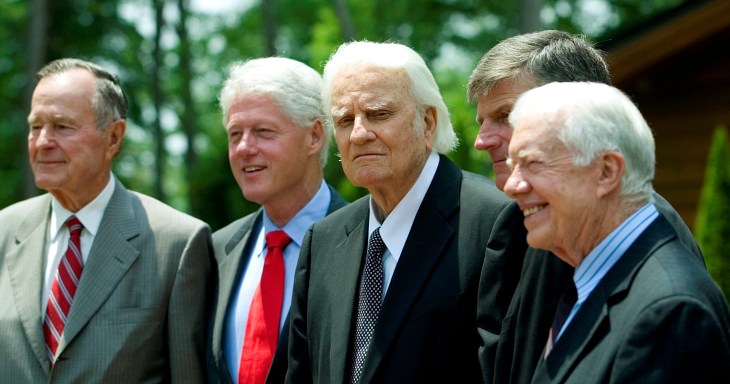
Billy Graham, the evangelical preacher, held an unrivaled role for a religious figure in US public life [with] an audience of hundreds of millions around the world—including in the White House.
Since the 1950s, Graham was a frequent guest of numerous US presidents on both sides of the political spectrum. Photos of Graham’s encounters with presidents current and former…highlight the importance that US presidents have placed on religion in public life.
- Kneels in prayer for President Truman on the White House Lawn after meeting with the President in 1950,
- talks with US president Dwight Eisenhower during a visit at the White House in Washington, D.C. on May 10, 1957,
- talks with president John F. Kennedy at the White House on Dec. 12, 1961,
- shares a lighter moment with president Lyndon B. Johnson share a lighter moment as they leave Washington DC National City Christian Church August 23, 1964,
- with President Richard Nixon waves to cheering crowds in Charlotte, North Carolina on Oct. 15, 1971.
- talks with Vice President Gerald Ford before the start of their round of golf in the Pro-Am at the Kemper Open in Charlotte, North Carolina.on May 29, 1974,
- Applauds President Jimmy Carter and first lady Rosalynn Carter as they arrive for the National Prayer Breakfast at a Washington hotel, Jan. 18, 1979,
- chats with President Ronald Reagan and first lady Nancy Reagan at the White House on July 18, 1981,
- accompanies President George Bush after attending a nondenominational church service at the Fort Myers, Virginia on Jan. 17, 1991,
- reverenced with bowed heads by President Bill Clinton and first lady Hillary Clinton, along with others, during the annual National Prayer Breakfast in Washington on Feb. 2, 1995,
- receives President Barack Obama at his mountainside home in North Carolina on April 25, 2010 when he is 91 years old,
Following his death at age 99, Former President Jimmy Carter honored him with a eulogy that could have been Ghandi’s if not for the Christian characterization.
Tirelessly spreading a message of fellowship and hope, he shaped the spiritual lives of tens of millions of people worldwide. Broad-minded, forgiving, and humble in his treatment of others, he exemplified the life of Jesus Christ by constantly reaching out for opportunities to serve.
Really? He exemplified the life of Jesus Christ by being broad-minded and throwing his support and that of his immense numbers of followers behind the reigning politicians like Richard Nixon whose criminal activities caused his downfall, warmongers (there’s a clue) in Viet Nam and the Middle East, Bill Clinton caught in flagrante?
Doesn’t sound like the Jesus Christ of the Bible. Sounds like Caiphus whose status as the most respected religious leader in the nation depended on collaborating with the government even if it meant supporting murder.


 Kingdom Come