“In the first year of Belshazzar king of Babylon Daniel had a dream…four great beasts came up from the sea…
fourth beast, dreadful and terrible, and strong exceedingly…diverse from all the beasts that were before it… I beheld till the thrones were cast down, and the Ancient of days did sit…even till the beast was slain, and his body destroyed, and given to the burning flame…”
If we take Daniel’s prophecy at face value, the continued existence of the fourth empire, the Roman, can be tracked throughout history despite name, location, and culture changes.
In A.D. 330, Roman Emperor Constantine’s “New Rome,” was a Christian city of immense wealth and magnificent architecture. Constantinople stood as the seat of the Roman Empire for the next 1,100 years, until being overrun by Mehmed II of the Ottoman Empire in 1453.
The Holy Roman Empire, AKA The 1st German Reich, was created in 962 AD when, as the Byzantine Roman Empire was crumbling under the Islamic assault, Pope John XII crowned Otto 1 of Prussia to perpetuate the legacy of the ancient Roman Empire. The Germany branch of the Roman Empire spanned much of Central Europe, parts of France and Italy, and various other territories across the continent.
In 1095, the Fourth / Roman Empire
- Paganized Christian Byzantine Roman Emperor – who had moved East to effectively hold the fort against the permanent Eastern military incursions against the West,
- and the Pope – who has stayed generally at Rome – drummed up military support by blessing the fighters as participants in a joint religious pilgrimage.
The Christian theology of war developed from the link of Roman citizenship to Christianity,
Just let that sink in.
It made the relation between man and the gods a political duty of all good citizens.
The Church continued to sanction geo-political Crusades in the West, such as against the Moors in the Iberian Peninsula–the Reconquista–which ended in 1492 with the consolidation of the nation of Spain under Isabella and Ferdinand, following with Spain’s military takeover of the lands of the New World with the enslavement or extermination of native populations.
In 1806, Emperor Francis II submitted to Emperor Napoleon of France who declared “I am a true Roman Emperor; I am of the best race of the Caesars.” 1812.
The 2nd German Reich followed Napoleon’s defeat at Waterloo by the combined forces of the British and Prussian armies, beginning in 1871 with the unification of Germany under the Prussian Chanceloor, Otto von Bismarck. The Second Reich was marked by a strong military national identity, culminating in WWI, during which Germany allied with the Ottoman Empire to provide Germany with safe passage into the neighbouring British colonies.
From 1820 until its collapse during WWII, the British Empire dominated the Middle East. Britain’s initial interest in the Gulf region was driven by its stake in the British East India Company (EIC) – one of the largest and most powerful commercial entities to have ever existed. To protect its trade routes, the EIC developed from simply economic domination to political rule in collaboration with local leaders, enforced by its own standing army and navy. Throughout the nineteenth century the British signed a number of bilateral treaties with rulers of individual Arab sheikhdoms.
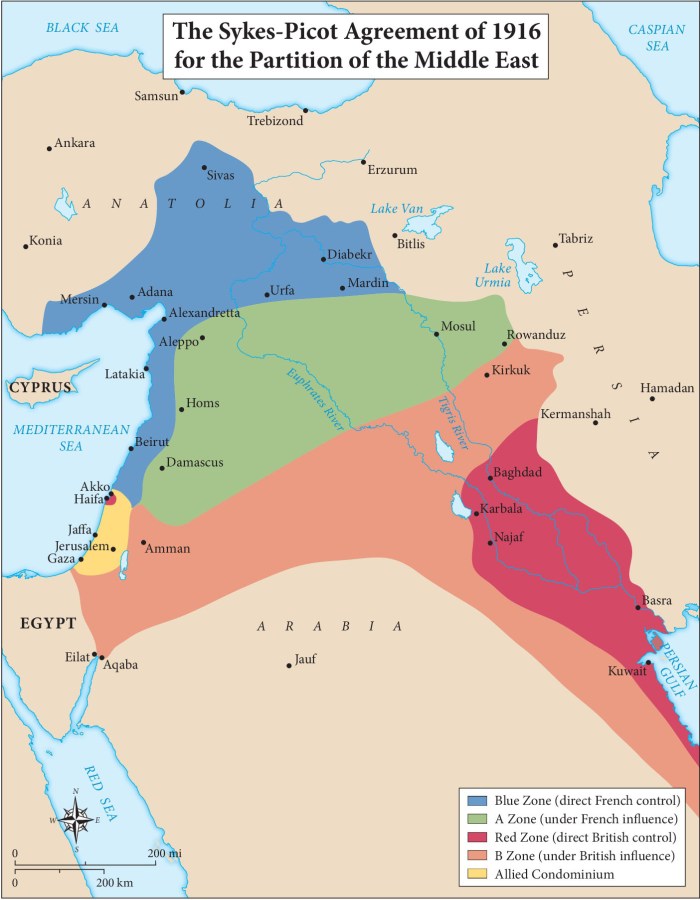
After the fall of the Ottoman Empire in World War I, [always the rival] French diplomat François Georges-Picot and British diplomat Mark Sykes secretly agreed on its division into French and British zones of influence in the Sykes-Picot Agreement of 1916. These divisions were based on rationing natural resources between the two European powers with a complete disregard for the mix of diverse – and separated populations – guaranteeing unresolved conflicts to this day.
Not when religion voluntarily creates a coalition with the state for friends with benefits.
When we look beyond the catchy slogans, we find that American Christian’s crusades against Islam are a cover for political control.
And it’s losing the war.
Iraq
After the dissolution of the Ottoman Empire in World War I, Great Britain acquired Iraq as a mandate. The US first allied with Great Britain in exchange for acquiring a 23.75% interest in Iraq’s emerging oil industry, then assumed Great Britain’s overlord role. Between 1980 – 1988 the U.S. provided Iraqi President Saddam Hussein with aircraft and satellite reconnaissance of battlefields to fight as the US proxy in the Iran-Iraq War which claimed half a million lives, two-thirds of them Iranian.
The United States provided the Iraqi security forces hundreds of millions of dollars of military aid and training annually as well as uses its military bases.[2]
In January 2020, Iraq voted to ask the U.S. and its coalition members to withdraw all of their troops from the country. U.S. President Donald Trump initially refused to withdraw from Iraq, but began withdrawing forces in March 2020. U.S. President Joe Biden announced that the remaining U.S. troops in the country would shift to an advisory role.[7]
In 2021, Iraq’s Chief Justice, Faiq Zaidan, issued an arrest warrant for the United States President Donald Trump, accusing him of premeditated murder for ordering the 2020 American drone strike that killed Iranian General Qassem Soleimani and Iraqi militia leader Abu Mahdi al-Muhandis. The warrant, based on the Iraqi law, carries the death penalty.
Afghanistan / Persia
Afghanistan was part of many Persian Empires such as Achaemenid and Sasanian dynasties, and the regions which encompass the modern state of Afghanistan were considered an integral part of Iran (Persia). Both modern countries share the same religion, culture, language and ethnicity.
After the 9/11/2001 event President Bush blamed al-Qaeda and its sanctuary in Afghanistan. From 2005 – 2021 The US gave a total of $18.6 billion of equipment to the Afghan National Defense and Security Forces to fight on America’s behalf, but the Taliban sweeps across Afghanistan in just 10 days as American forces scramble chaotically to get out of its longest war. More than 120,000 people are evacuated while thousands of Afghans who assisted the United States and its allies are left behind along with equipment worth $7.12 billion, now at the disposition of an enemy the US was trying to destroy over the past twenty years.
The Palestinian Problem triggered the latest Western Empire’s series of crusades.
During the Six-Day War in June 1967 Israel seized Egyptian-assigned Sinai Peninsula and the Gaza Strip from Egypt; the West Bank and East Jerusalem from Jordan; and the Golan Heights from Syria. The brief war significantly altered the map of the Mideast and gave rise to lingering geopolitical friction.
Wow. That’s a massive understatement.
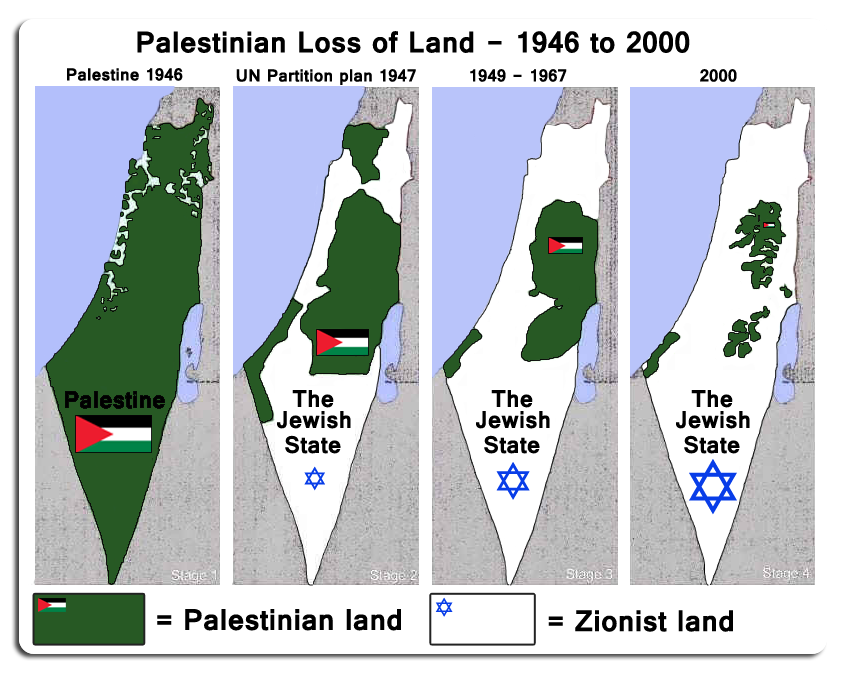
Hundreds of thousands. of Palestinians were displaced and in the decade following the 1967 war an average of 21,000 Palestinians per year were forced out of Israeli-controlled areas.
Syria
Syria became a refuge for one hundred thousand Palestinians who were expelled from Palestine by the state of Israel in 1948,
As a result of Black September in Jordan and the Lebanon War,the number of Palestinians seeking refuge in Syria swelled to over 350,000, but contrary to other nations, only about 1/3 live in refugee camps. Despite remaining permanent refugees without the option of citizenship, the Syrian government paved the way for their integration into the Syrian socioeconomic structure while preserving their separate Palestinian identity.
In contrast to American-backed Jordan, Syria continued to support stateless Palestinian opposition to Israel’s seizure of Palestinian land and expulsion of Palestinians, and in 1979 Syria was placed on the U.S. list of state sponsors of terrorism.
On 8 December 2024, the Assad regime collapsed during a major offensive mainly by the Turkish-backed Syrian National Army.
Egypt, AKA The Suez Canal
In 1914, as soon as Britain declared war on the Ottoman Empire it proclaimed a protectorate for Egypt, whose Suez Canal, a sea-level waterway connecting the Mediterranean and the Red seas provides the shortest maritime route between Europe and the lands east.
In 1952 Gamal Abdel Nasser toppled the British-backed monarchy and nationalized the Suez Canal.
In 1956-1957 during the Suez Crisis American-backed Israel attempted to take possession of the canal, opposed by French and British troops who blockaded the canal for some months.
From 1968-1970 The War of Attrition raged across the Suez Canal.
In 1973 when Anwar Sadat launched the Yom Kippur War he physically barricaded both ends of the canal opening of the canal until a cease-fire was secured by the United States.
In 2025, supporting Palestinians under siege by Israel in Gaza, Houthi attacks on ships in the Red Sea at the eastern end of the Suez Canal led to a 79.6 percent drop in drybulk carriers going through the Suez Canal in June 2024 versus June 2023. Catch the perpetuation of the EIC’s interest in this region? As of March 2025 Suez Canal revenues dropped as much as 60%, meaning billions in losses for Egypt and forcing many shipping companies to divert to alternative routes, such as the longer shipping route via the Cape of Good Hope, increasing costs to customers.
In 1992 in North Africa and South Asia the Islamic Jihad’s political conflicts with secular Western-oriented government authorities led to bloody civil wars, resulting in the exile of many Islamist activists to Europe and the Americas and led many others to join such military fronts as the Afghan Jihad.
In 1999 ISIL or ISIS (depending on the translation) – the Islamic State of Iraq and the Levant – was created as the latest iteration of Pan-Arabism against Western interference into Islamic operations. It introduced itself by pledging allegiance to Al-Qaeda and participating in the Iraqi insurgency following the 2003 invasion of Iraq by Western forces. In 2014, the group proclaimed itself a worldwide caliphate by which it claimed religious, political, and military authority over all Muslims worldwide, changing its name to Islamic State which claims to be a global caliphate by co-opting existing Islamist insurgencies.
Lebanon
The historically significant Maronite Catholic Christians had formally united with the Roman Catholic Church during the Crusades. The state of Greater Lebanon was created as a safe haven for the Christian minority in the Middle East and the Maronites given a leading position in Parliament.
After the 1948 and 1967 wars an influx of thousands of Palestinian refugees led by the PLO created their own state-within-a-state, weaponizing a dozen Palestinian refugee camps around Beirut and in South Lebanon, and triggering the 1975-1990 Lebanese Civil War resulting in an estimated 150,000 fatalities and the exodus of almost one million Lebanese.
In 1982 Israel invaded Lebanon to evict the PLO, destroying 80% of villages in Southern Lebanon in the process and causing around 400,000 refugees to flee their homes, leading to the formation of Hezbollah, an Iran-backed Shia Islamist militia. as an armed organization.
Lebanon demonstrates that economics, as much as war, is a weapon of mass destruction.
The reason was that Lebanon built up a debt equivalent to 150% of national output – total value of goods and services produced within a country. When banks no longer had enough dollars to pay depositors queuing outside, they simply shut their doors and peoples’ life savings were gone.
Hmm, sounds familiar.
By December 2024 the United States Government had built up a debt of 124% of the country’s gross domestic product, and we can substitute the following analysis for either country.
An economy in deep crisis:
_______________ has been in a prolonged economic meltdown since 2019, marked by hyperinflation and soaring poverty levels. The currency has lost over 90% of its value, drastically reducing purchasing power and leading to widespread economic hardship. A lack of foreign exchange reserves has crippled imports, causing fuel, medicine, and food shortages.
The banking sector has effectively collapsed, with depositors locked out of their savings. Government corruption and financial mismanagement have exacerbated the crisis, with no clear recovery plan in place.
Businesses struggle to operate amid currency instability, power outages, and rising operational costs. Many skilled professionals have emigrated in search of better opportunities.
While negotiations with the International Monetary Fund (IMF) have stalled, a bailout program remains the best hope for recovery, but political paralysis continues to block meaningful progress. The road to recovery will be long and uncertain.
January 14, 2025 The Hill
The Middle East is undergoing a profound transformation as new rivalries reshape its geopolitical order. The collapse of the [American-supported] Assad regime in Syria and the rise of Turkey as a resurgent power have created a fresh dynamic for leadership within the Sunni Muslim world.
So in 2018 it was with distress that the US State Department announced that “While Turkey remains formally a NATO ally, it is not a partner of the United States.”
“[President Recep Tayyip] Erdogan’s consolidation of power…incursion into northern Syria, its intention to purchase an advanced air defense system from Russia…have further widened the chasm between the United States and Turkey.
As concerning the rest of the beasts – Empires 1-3 – their lives were prolonged for a season and time.” (Daniel 7:1-12)
Taking Daniel’s prophecy at face value, the first empires – Babylon/Iraq, Persian/Iran, Greece/Turkey outlasts the fourth empire.
Given the standard practice of empires’ rise and fall, we should anticipate that the first three Middle Eastern Empires form a coalition against the outsider, the Fourth Western Gentile Empire.
And that’s exactly what we find under the Islamic Empires stretching from the eastern-most Persian westward into Babylonian then the Greek territories around the Mediterranean.


Are we catching the pattern here?
- The Palestinian diaspora has destabilized virtually every nation.
- You can oppress people for only so long before the possibility of death is no longer a threat, it’s a promise of release from a fate worse than death.
- War against the Great Satan America is guaranteed.
- The fervently monotheistic devout Muslims won the last Western Crusade against a corrupt Christianity.
January 14, 2025 The Hill
The Middle East is undergoing a profound transformation as new rivalries reshape its geopolitical order. The collapse of the Assad regime in Syria and the rise of Turkey as a resurgent power have created a fresh dynamic for leadership within the Muslim world.


 Kingdom Come