-
-
-
-
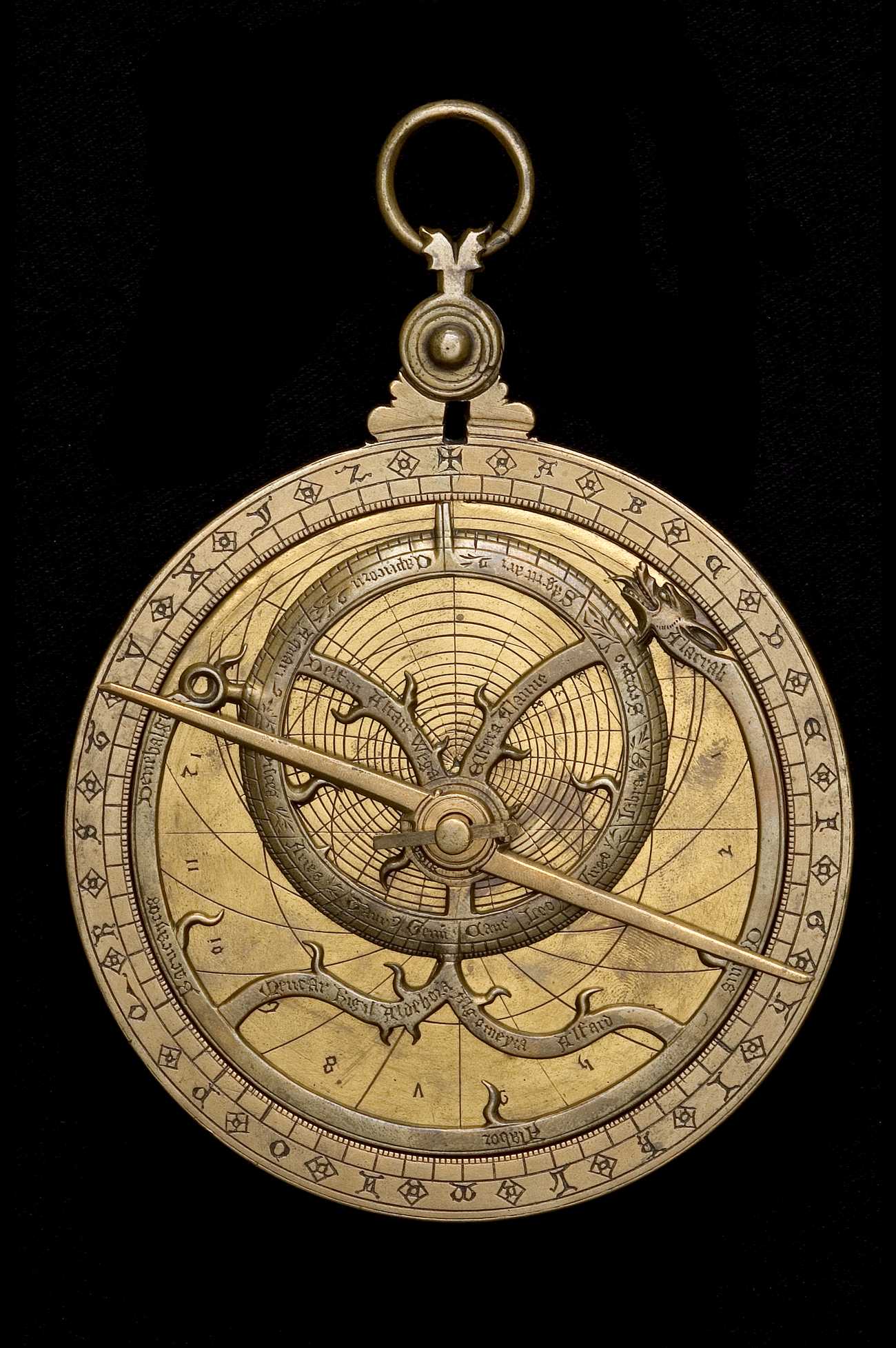
The astrolabe that was used from ancient times all the way up to the early modern period was, like the flattened surface of an oblate spheroid earth depicted by every ancient culture, was a flat circular surface, like a sundial – with a series of dials, pointers and engravings to accurately not only tell the time of day, but also determine the positions of certain guide stars, to determine coordinates for travel on earth, predict when the sun would rise or set, and more.
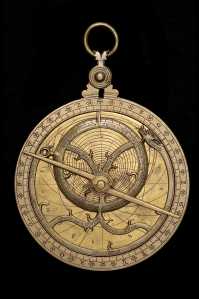 Using these physical observations accurately defining the reference frame from earth, the oldest known scientific theoretic model was developed by Ptolemy of Alexandria about 150 CE and recorded by him in his Almagest and Planetary Hypotheses as a geo / earth – centric cosmology – assigning a stationary position to Earth.
It wasn’t until 1543 that Nicolaus Copernicus (1473-1543) published On the Revolutions of the Heavenly Spheres in Nuremberg, Holy Roman Empire, as a philosophical – NOT scientific – alternative model of the universe to Ptolemy’s geocentric system. -
-
-
-
-
This model required changing the earth’s shape from an oblate spheroid to a sphere which rotated on its axis to account for day and night cycles, and periodically changes the tilt of its axis to account for the precession of the equinoxes of the celestial bodies.
No explanation was provided for the force(s) that keeps the earth rotating, revolving in orbit, or periodically shifting its leaning axis.
To understand how this unscientific idea gripped the scientific community up to the present time we need to understand the religious connection.
-
-
-
-
-
-
“Western Europe” in the context of this review refers to the European cultures bound together by the Catholic Church and its Latin language. Following the fall of the Western Roman Empire it was cut off from the sources and intelligibility of most classical scientific treatises, which were written in Greek and preserved in libraries in the East.
-
-
-
-
The perpetual warfare that had isolated the West from the East had economically degraded the loser West, resulting in de-urbanization and focus on simple survival. By the 6th century education was provided in monastic and cathedral schools, whose leading scholars were clergymen. Their focus was studying the Bible, with the study of nature pursued for practical reasons such as the need to care for the sick, leading to the study of medicine and pharmaceutical, the need for monks to determine the proper time to pray led them to study the motion of the stars, the need to compute the date of Easter led them to study and teach rudimentary mathematics and the motions of the Sun and Moon.
-
In the 1600’s Kepler’s “laws” [a scientific misnomer] of planetary motion were developed to support Copernicus’ heliocentric system, although Kepler’s observations and calculations were necessarily based on the ancient astronomers’ geocentric records, so do not establish a heliocentric model of the universe.
Beginning around the year 1050, European scholars built upon their existing knowledge by seeking out ancient learning in Greek, some of which had earlier been translated into Arabic, accompanied by commentaries and independent works by Islamic thinkers and Jewish key texts. These collections with their scholars birthed the medieval universities which founded the modern European universities, and by 1200 the method of scholasticism.
Scholastics believed in empiricism and supporting Roman Catholic doctrines not by faith alone, but through secular study, reason, and logic. The most famous was Thomas Aquinas (later declared a “Doctor of the Church“). Built upon Aristotle’s portrait of induction, Roger Bacon described a repeating cycle of observation, hypothesis, experimentation, and the need for independent verification. He recorded the manner in which he conducted his experiments in precise detail so that others could reproduce and independently test his results—a cornerstone of the scientific method,
Logic studies by William of Occam on the principle of parsimony, employed explicitly by both Aquinas and Aristotle before him, known today as Occam’s razor, is used by modern science to select between two or more under-determined theories.
By the late Middle Ages the search for natural causes vs diving intervention had come to typify the work of Christian natural philosophers. Nicole Oresme (ca. 1320–82), who went on to become a Roman Catholic bishop, admonished that “there is no reason to take recourse…to our glorious God as if He would produce these effects directly, more so than those effects whose causes we believe are well known to us.”
The 1400’s saw the beginning of the cultural movement of the Renaissance, and near the end of the Renaissance, the astronomer Nicolaus Copernicus proposed that the earth revolves around the sun.
In 1687 Sir Isaac Newton developed the “law” of gravitation which states that there is a “force of nature” by which any particle of matter in the universe attracts any other.
Although Newton did not himself hold to the heliocentric model, the heliocentric advocates claim that “Newton’s law of gravitation provides a scientific basis for the heliocentric model. The force of gravity from the sun constantly pulls it towards the sun, causing it to deviate from a straight line and move in an elliptical orbit instead.”
-
So why, for centuries and especially with NASA’s obvious ability to manufacture “evidence”, has humanity been informed otherwise?
-
All discussion of relative motion must define the reference frames involved, and it is a fundamental truth that humanity’s perspective of the universe cannot be based at the sun. Therefore the sun, moon and stars are scientifically in motion around a stationary earth.
-
-
-
-
We can only understand this obstinancy by going back to the Copernican Revolution.
What was he revolting against?
Nicolaus Copernicus (1473 – 1543) was born into a wealthy family in Poland, at that time a powerful state, and grew up during the Renaissance. When Copernicus was age 10, his father died and his maternal uncle took him under his wing with the plan that he would succeed him as Bishop of Warmia in order to support his faction in the vicious Church-dominated political system of the time. However, Copernicus left the University of Kraków after the requisite four years but without a degree to be supported at the court of his uncle, now Prince-Bishop of Warmia. Copernicus was them sent to a better university to earn a different degree, in canon law, for another four years, which again he did not earn. He then spent two separate sessions, for a total of three more years, before finally being granted his degree. One can’t help suspecting that his uncle decided that a “donation” to the university was the only way out at this point, as succeeding events show that Copernicus was not equipped to pursue a legal profession. He instead sent to the University of Padua for two years so that “he may in future be a useful medical advisor to our Reverend Superior [his uncle, the Bishop and the gentlemen of the chapter”). This rationale can only be interpreted as one last attempt to extract some useful service for a man who had until then had demonstrated none, supported by the lukewarm review that from the beginning of 1504, Copernicus accompanied his uncle the Bishop and “participated … in all the more important events in the complex diplomatic game that ambitious politician and statesman played.” If he was any good as an assistant, he would have handled some of the less important diplomacies.
After 13 years total education at the top universities of the time, Copernicus never obtained a means of independently earning a living aside from his uncle’s connections. He never married, which in the wealthy society into which he was born indicates he had nothing to bring to the table of any appropriate in-laws. At the death of his uncle he was forced to move out of court life to solitary life in a town on the Baltic Sea coast, where the religious authorities reluctantly allotted Copernicus an “external curia”—a humble dwelling outside the defensive walls of the cathedral mount as he occasionally took responsibility for administering the chapter’s economic enterprises.
Here, and from an unidentified “small tower” (turricula), in these circumstances, is where Copernicus conducted over half of his more than 60 registered astronomical observations using primitive instruments homemade instruments modeled on ancient ones – the quadrant, triquetrum, and armillary sphere.
How such a nondescript, uneducable, unemployable man engaging in a personal hobby is acclaimed for a scientific revolution can only be explained as fabricated evidence.
Intrinsically bound up in Copernicus’ astronomical revolution was the religious revolution triggered at this same time by Martin Luther’s publication of the Ninety-five Theses in 1517 challenging the papacy and the authority of the Catholic Church hierarchy and laying the groundwork for modern Western civilization.
Luther’s weapon was the doctrine of Sola Scriptura / Only Scripture – the written text – is the final authority – not the pope or any ecclesiastical body.
And in the middle of this religious war Copernicus finally made his mark when he handed the Pope a weapon – Science – to prove that the Genesis account of Scripture must be interpreted by the authorities – and so also the rest of the Bible.
-
No we don’t.
If you say a person is sitting in a train moving at 10 m/s east, then you imply the person on the train is stationary and moving relative to the surface of Earth at this velocity, and Earth is the reference frame.
If we say Earth is spinning in its orbit around the Sun, the solar system is the reference frame.
-
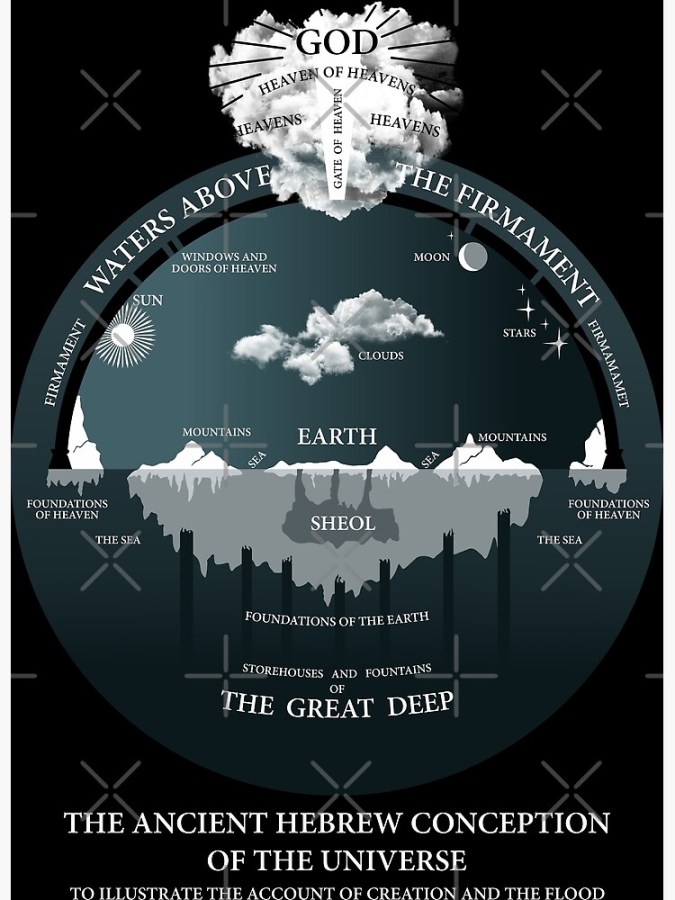
51) Why The Shape of Earth Mattered To Copernicus


 Kingdom Come