“the great whore that sitteth upon many waters: With whom the kings of the earth have committed fornication, and the inhabitants of the earth have been made drunk with the wine of her fornication…a woman sit upon a scarlet coloured beast, full of names of blasphemy…And the woman was arrayed in purple and scarlet colour, and decked with gold and precious stones and pearls, having a golden cup in her hand full of abominations and filthiness of her fornication: And upon her forehead was a name written, Mystery, Babylon The Great, The Mother Of Harlots And Abominations Of The Earth.
I will tell thee the mystery of the woman, and of the beast that carrieth her, which hath the seven heads and ten horns.
- The beast / not human that thou sawest was / can be identified historically, and is not / apparently died and shall ascend out of the bottomless pit / apparently resurrect, and go into perdition / but not live forever in a resurrection body as promised to the Creator’s resurrected followers:
- The seven heads are seven mountains, on which the woman sitteth. And there are seven kings…And the beast that was, and is not, [and ascends out of the bottomless pit]…is of the seven, and goeth into perdition.
- As detailed in the relevant post, in paganism a mountain connects the spiritual world with the earthly. Historically these seven mountains are identified with the city of Rome, but in context they are identified as seven beast/kings, i.e. spirit-earthly/human hybrids.
- And the ten horns which thou sawest are ten kings, which have received no kingdom as yet; but receive power as kings one hour with the beast. These have one mind, and shall give their power and strength unto the beast / political entity…[But] these shall hate the whore, and shall make her desolate and naked, and shall eat her flesh, and burn her with fire.
- This dovetails with the ten horns / Islamic rulers detailed in the pertinent post.
- The waters which thou sawest, where the whore sitteth, are peoples, and multitudes, and nations, and tongues.
And the woman which thou sawest is that great city, which reigneth over the kings of the earth.”
The woman is the religious/spiritual power, stretching back to the Mother Goddess carrying hyperdimensional genes who empowered kings by producing hybrid warrior WMDs. See relevant posts for details.
Just as the world empire’s political capitol shifted over time from Babylon, to Ninevah, back to Babylon, to Asia Minor under the Seleucids, to Rome with its own iterations of the New Rome and the Third Rome, so the center of world-wide paganism changed locations and cultures and names as the original population was scattered throughout the earth, while remaining essentially “Babylon” – Gateway of the Gods.
Any reference to the daughter of Babylon, or even simply shortened to just Babylon, must be understood as the world religious capitol city according to its prophetic context. Like “the Queen of Heaven”, “Babylon” has changed cultures multiple times and references to this entity must be put into their historical context to understand this final future fulfillment.
For example, Israel’s acculturation into the Babylonian lifestyle is noted by calling Jerusalem the “daughter of Babylon”. This is a common way of expressing the abstract concept of a rebirth of another city’s heritage in ideals, values and goals.
- “Deliver thyself, O Zion / rebuilt Jerusalem, that dwellest [is co-mingled] with the daughter [iteration] of Babylon
- Sing and rejoice, O daughter [future iteration] of Zion: for, lo, I come, and I will dwell in the midst of thee, saith the LORD”. (Zechariah 2)
At the time of the writing of Revelation, Babylon as the world center of religion was unquestionably Rome. This is evident in the Latin word for priest – pontifex – which literally means “bridge-builder” (pons+ facere). Exactly like Nimrod’s mountain bridging humans on earth to the gods in the heavens, the pontifices controlled the spiritual bridge between gods and men. His real power lay in the administration of jus divinum or divine law, including the regulation of all expiatory ceremonials such as the last rites and the superintendence of all marriages.
The Pontifex Maximus (which literally means “Greatest Pontiff”) was the high priest of the Ancient Roman College of Pontiffs. This was the most important position in the ancient Roman religion.
- A distinctly separate religious office under the early Roman Republic,
- it gradually became politicized until, beginning with Emperor Augustus, it was subsumed into the Imperial office. Its last politicized use with reference to the emperors is found in 383 AD
- when its religious function reverted back to the Roman Church upon its creation as the official sole church of the Roman Empire.
Exactly as under paganism. making the High Priest’s divine authority higher than the king’s.
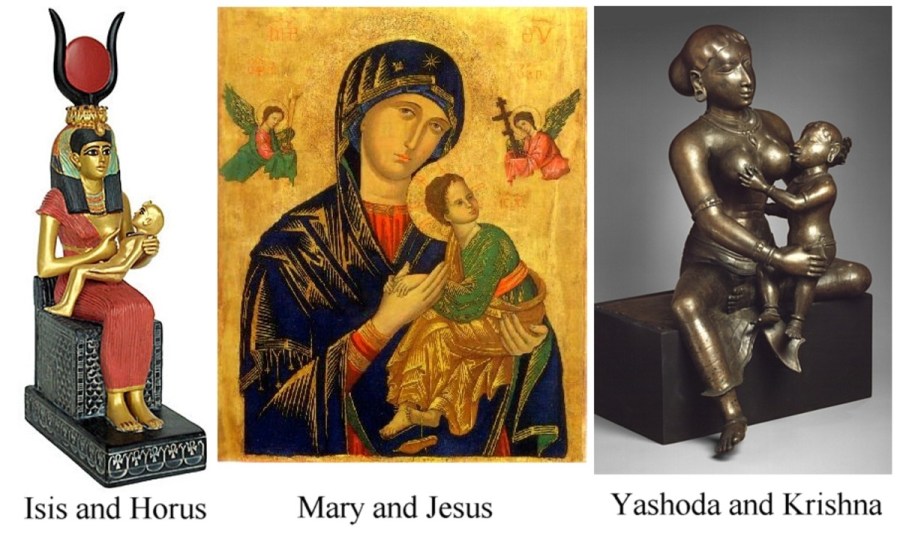
Rome’s combining of beliefs from different traditions, called syncretism [and abomination in the Bible] was not new but a recurring theme in ancient cultures in what Stephen Benko calls “functional equivalency.” The cult with the greatest influence on early Christianity was that of the Great Mother (Magna Mater). In The Virgin Goddess: Studies in the Pagan and Christian Roots of Mariology, he unerringly traces Mary’s roots to the pagan, pre-Christian heavenly queens of Greece, Rome and the wider Mediterranean—those mutable goddesses whose ranks include Artemis, Astarte, Celeste, Ceres, Cybele, Demeter, Diana, Ishtar, Isis and Selene.
“Christianity,” he notes, “did not add a new element to religion when it introduced into its theology such concepts as ‘virgin’ and ‘mother’; rather, it sharpened and refined images that already existed in numerous forms in pagan mythology.”
These concepts were engrained in the Gentile converts to Christianity, whose educational backgrounds were not in the Jewish Torah and prophets, but in Greek philosophy and, who became the early church fathers, like Augustine.
“lest any man should beguile you with enticing words…As ye have therefore received Christ Jesus the Lord, so walk ye in him…as ye have been taught…Beware lest any man spoil you through philosophy and vain deceit, after the tradition of men, after the rudiments of the world, and not after Christ / the Seed of the Woman.” (Colossians 2:4-8)
The Christian apologists had to differentiate their belief in the virgin birth from similar ideas found in Hellenistic mythology in which Zeus, Apollo and other gods raped or overcame with lust human women’s terror of the gods. Justin Martyr argued correctly that Mary’s conception of Jesus was different. Mary as “Queen of Heaven”, i.e. Semiramis, is an ancient address to Mary used in prayer that dates back to at least the fourth century. The imagery of Mary as queen of heaven was very popular in the Middle Ages.
Then In the early fourth century, Augustine introduced his theology of Original Sin, wherein he deemed sex to be integral to the fall of Adam and Eve. Rather than accept a simple reading of the New Testament in its context, the early fathers developed the notion that Mary was a virgin not only prior to Christ’s birth but remained virgo intacta post partum; i.e., a perpetual virgin after childbirth. This was one of the earliest Marian beliefs to become official Catholic teaching (451); Pope Martin I went on to declare it dogma in 649.
Warner notes that…“It is almost impossible to overestimate the effect that the characteristic Christian association of sex and sin and death has had on the attitudes of our civilization” in turning our civilization against the Bible’s much more realistic presentation of sin, salvation from eternal death, and engaging in fulfilling sexual relations.
The church fathers used the same philosophical methods to define the nature of Christ as trinitarian, fully God, in the fifth century, elevating Mary to the role of Theotokos, the Mother of God…“the one who gave birth to the one who is God.” From the perspective of pagans, this makes Mary equivalent to Gaia, in existence before Cronus, Father of the Gods. The honoring of Mary as the Mother of God can be traced back to the Council of Ephesus in 431.
If Mary was without sin, then she should not have seen death (death being the penalty for sin according to the Scriptures). The Catholic Encyclopedia…explains that “sanctifying grace was given to her before sin could have taken effect in her soul.” In 1854 Pope Pius IX declared the mother of Christ to have been “immaculately conceived. “Many people, even some practicing Catholics, do not realize that the Immaculate Conception refers to Mary’s conception, not to Christ’s (which is known simply as the Virgin Birth).
Effectively making her immortal, i.e. a goddess.
And his father God Almighty, so doesn’t this mean that Jesus the Christ is not human, therefore cannot redeem humanity?
On what basis could the church reverse the doctrine of the savior of humanity being the Seed of the Woman / Son of David passed down through generations of human parents?
The answer comes in the form of another edict from Pius IX in 1870, with the utmost implications for the acceptance of all teachings based more on philosophy and tradition than on Scripture, declaring the infallibility of the pope when speaking ex cathedra (from his chair) on such matters as faith and morals. The pope, in a single declaration, removed any possibility of further debate within the church by declaring it a matter of faith instead of reason—faith, that is, in the church’s infallibility.
In 1950 Pope Pius XII proclaimed Mary’s “assumption”—her reception, body and soul, into heaven.
Four years later, in 1954, the same pope officially confirmed the title Mary had been accorded over many centuries: “Queen of Heaven.”
This connects the largest Christian denomination directly to paganism, and makes it easy for its adherents to transition to belief in ancients gods / aliens coming to save us from the consequences of our sins,
Wicca, paganism, folk magic and other New Age traditions, is one of the fastest-growing spiritual paths in America.
Wicca began to be practiced in America in the 1960s by feminists, environmentalists and those seeking a nonstructured spirituality. With the ability to find communities online and the decline in affiliation with traditional religions, witchcraft began its entry into the mainstream.
Online platforms like TikTok and Instagram offer tutorials on every aspect of magical practice. The witchcraft hashtag has over 7 million posts on Instagram and more than 11 billion views on TikTok or, as it’s known in the community, WitchTok. Podcasts about witchcraft enchant the airwaves. Along with crosses and Stars of David, major retailers like Walmart and Amazon sell the witchcraft symbol of the pentacle, pendulum divining tools and dried herbs for spells and rituals. The use of Tarot cards proliferates in lux magazines.


 Kingdom Come